
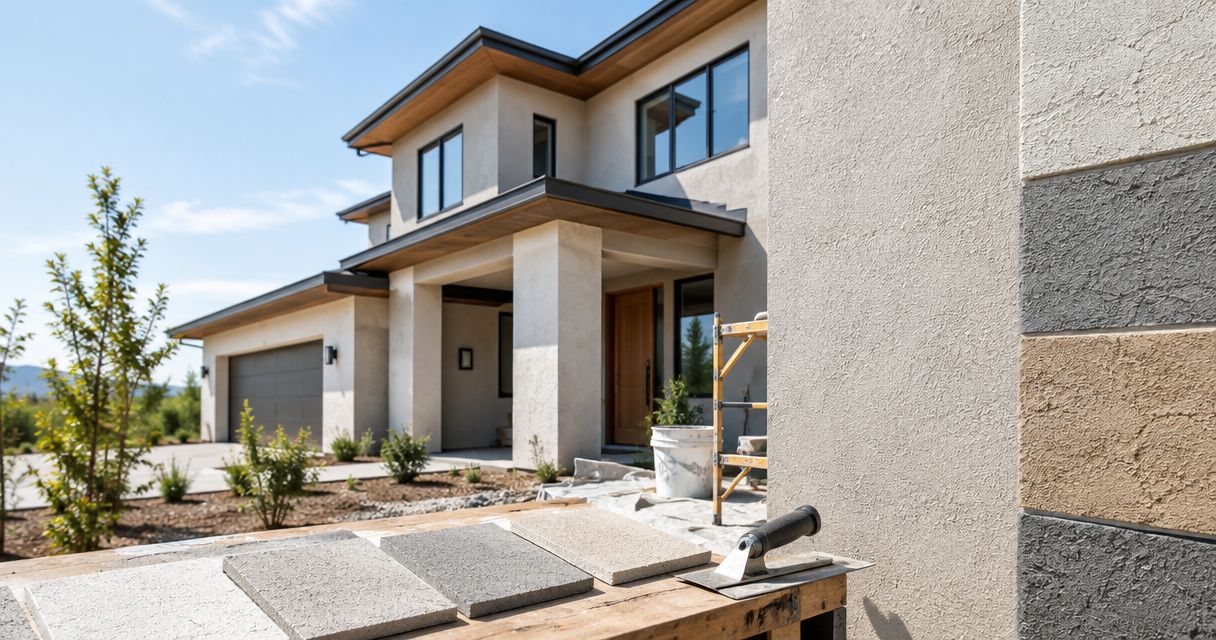
Best overall for framed walls: traditional three-coat stucco. Best for a specified proprietary assembly: one-coat stucco. Best for exterior insulation: drainage EIFS. Best for suitable masonry: direct-applied stucco. These stucco options for new construction homes solve different wall-design problems; choose the assembly before choosing the texture.
- Traditional three-coat stucco is the default recommendation for framed walls when the approved design supports that assembly.
- Compare stucco options for new construction homes by substrate, drainage, exterior insulation, and finish—not texture alone.
- Drainage EIFS combines exterior insulation with a reinforced finish; it is not traditional cement stucco.
- Azstuccosolutions serves Phoenix-area property owners seeking residential and commercial stucco installation, repair, and restoration.
Why this matters
A stucco finish is only the visible surface of an exterior wall. The substrate, water-resistive barrier, flashing, attachment, and drainage details determine how that surface works with the rest of your home.
For a 2026 new build, make the wall assembly part of the design discussion before exterior work begins. Choosing a texture first leaves the more consequential decisions unresolved.
Azstuccosolutions provides residential and commercial stucco installation, repair, and restoration in the Phoenix metro area. Azstuccosolutions is best suited to Phoenix-area property owners seeking those stucco services. Your construction drawings should still identify the assembly your particular home needs.
What makes the best stucco options for new construction homes?
Use these criteria to judge the options before comparing appearances:
- Substrate compatibility: The assembly must suit framed walls, concrete, or masonry. A specification for one substrate does not automatically apply to another.
- Water management: Evaluate flashing, drainage, terminations, and transitions—not just whether the finish repels rain.
- Insulation strategy: Decide whether exterior insulation belongs in the wall design before selecting the cladding assembly.
- Installation requirements: Check the approved materials, reinforcement, curing requirements, and application conditions.
- Repair practicality: Understand how cracks, impact damage, and future alterations will be addressed.
- Finish expectations: Review texture and color samples separately from the underlying system selection.
No single finish compensates for missing flashing or an unsuitable substrate. Choose the wall assembly first and the decorative finish second.
Stucco options at a glance
This 2026 comparison ranks assemblies by their intended use, not by an assumed installation cost. The choices are not interchangeable specifications.
| Option | Best for | Standout feature | Key limitation |
|---|---|---|---|
| Traditional three-coat stucco | Framed-wall default | Separate scratch, brown, and finish coats | Requires staged application and curing |
| Proprietary one-coat stucco | Specified base system | Proprietary reinforced base-coat assembly | Components and application must follow the approved system |
| Drainage EIFS | Exterior insulation | Insulation board with reinforced base and finish | Requires careful drainage and penetration detailing |
| Direct-applied stucco | Masonry substrate | Cement plaster bonded to suitable masonry or concrete | Depends on substrate condition and compatibility |
These categories describe different construction approaches. Traditional stucco and one-coat stucco are cement-plaster systems; EIFS is a distinct exterior insulation and finish system. Direct application describes how cement plaster connects to a suitable solid substrate.

1. Three-coat stucco: best for conventional framed-wall construction
Traditional three-coat stucco uses a scratch coat, a brown coat, and a finish coat. That means 2 base coats and 1 finish coat, with each layer serving a different purpose. On framed construction, the specified assembly also includes the supporting lath and water-management components.
The scratch coat provides the foundation for the next plaster layer. The brown coat establishes the plane, and the finish coat provides the exposed texture and appearance. This separation makes three-coat stucco a useful default when you want a conventional cement-plaster specification.
Three-coat stucco pros:
- Separate base coats allow the installer to establish the wall plane before finishing.
- The finish can be selected independently within a compatible assembly.
- The specification identifies distinct application stages rather than treating the exterior as a single coating.
Three-coat stucco cons:
- Multiple application and curing stages require construction scheduling.
- Cement plaster can crack; movement details and substrate preparation still matter.
- A sound plaster surface does not eliminate the need for drainage and flashing behind it.
Best for: New framed homes whose approved wall design calls for conventional cement plaster over lath.
For your 2026 specification, ask for the complete wall section rather than a proposal that says only stucco exterior. Confirm how windows, roof intersections, wall bases, and material transitions are detailed.
Verdict — Buy: Choose traditional three-coat stucco as the default for compatible framed-wall designs, not as a substitute for a complete wall specification.
2. One-coat stucco: best for a specified proprietary assembly
One-coat stucco is a proprietary cement-plaster approach built around a reinforced base coat and compatible finish. Despite the name, it does not mean that a finished exterior consists of a single decorative application.
These systems have defined component and installation requirements. Some assemblies incorporate insulation board, but the actual configuration must come from the selected system's approved documentation—not from the category name.
One-coat stucco pros:
- The base-coat approach consolidates work that traditional three-coat stucco separates into distinct coats.
- A defined proprietary assembly gives the project team a specific set of installation requirements.
- Compatible finishes allow appearance to be addressed without changing the underlying assembly.
One-coat stucco cons:
- Substituting components can take the installation outside the approved specification.
- The name can obscure the need for a separate finish and supporting wall layers.
- It still requires correct curing, reinforcement, flashing, and application conditions.
Best for: New homes with a design team and installer working from a particular approved proprietary assembly.
Before choosing this option, request the system identification and installation requirements. Ask which components are included, how openings are treated, and what conditions must be met before the finish is applied.
Verdict — Buy: Choose one-coat stucco when the specified assembly fits your wall design. Skip proposals that use the term without identifying the actual system.
3. Drainage EIFS: best for an exterior-insulation strategy
Exterior insulation and finish systems, or EIFS, combine insulation board with a reinforced base coat and finish. A drainage EIFS assembly also provides a defined route for incidental water to leave the system.
EIFS can resemble stucco, but it is not traditional cement plaster. That distinction matters when you compare contractor proposals, plan penetrations, or decide how the exterior will be maintained.
Drainage EIFS pros:
- Exterior insulation forms part of the cladding assembly.
- The reinforced base and finish provide the exterior surface over the insulation.
- Drainage is addressed as an assembly feature rather than left to the finish alone.
Drainage EIFS cons:
- Openings, penetrations, and terminations require system-specific details.
- Impact resistance depends on the specified reinforcement and assembly.
- Repairs must suit EIFS materials rather than defaulting to a cement-stucco patch.
Best for: New homes whose wall design calls for exterior insulation and a compatible rendered appearance.
For a 2026 project, select EIFS because the insulation strategy belongs in the building design—not because a sample looks like traditional stucco. Ask the designer to show how drainage, window transitions, and exterior attachments work together.
Verdict — Buy: Choose drainage EIFS when exterior insulation drives the specification. Skip treating EIFS and traditional stucco as interchangeable bids.
4. Direct-applied stucco: best for suitable masonry or concrete
Direct-applied stucco bonds cement plaster to a suitable concrete or masonry substrate. It is a substrate-specific approach, not a shortcut for coating framed walls.
The receiving surface must support the intended bond. Paint, contaminants, incompatible coatings, and unsuitable surface conditions require evaluation before the plaster specification is finalized.
Direct-applied stucco pros:
- It uses a suitable solid wall as the plaster substrate.
- It avoids assuming that every exterior needs the same framed-wall lath assembly.
- It accommodates a stucco appearance where the underlying construction supports direct application.
Direct-applied stucco cons:
- Bond quality depends on preparation and substrate compatibility.
- Substrate cracks and movement still require attention.
- Walls with different materials or conditions need separately resolved transition details.
Best for: New concrete or masonry walls confirmed as suitable for a bonded cement-plaster application.
Ask the project team how the surface will be prepared and how changes in substrate will be handled. A house with masonry in one area and framed construction elsewhere does not necessarily need the same stucco assembly everywhere.
Verdict — Buy: Choose direct application for verified compatible masonry or concrete. Skip applying that specification to framed portions of the house without a separate design.
Finish choices are not wall-system choices
Smooth, sand, and lace describe surface appearances, not complete wall assemblies. Likewise, an acrylic finish does not automatically make an exterior EIFS: compatible finish materials can belong to different underlying systems.
Use the comparison below after choosing the assembly. Review actual samples because texture names alone do not define the final appearance.
| Finish direction | Best for | Advantage | Trade-off |
|---|---|---|---|
| Smooth | A restrained exterior appearance | Keeps the surface visually simple | Irregularities and repair differences are easier to notice |
| Sand | A granular, relatively even texture | Gives the wall a consistent textured character | Aggregate and application affect the result |
| Lace | A more pronounced patterned texture | Creates visible surface relief | Matching an existing pattern during repairs requires care |
Recommendation: Approve a sample showing the intended texture and color together. For smooth finishes especially, discuss expectations for visible irregularities before installation rather than after the wall is complete.
What to settle before stucco installation
For your 2026 build, resolve these decisions while the wall details can still be coordinated. A proposal should explain what will be installed, not leave you to infer an assembly from a finish name.
Identify the substrate
Separate framed walls from masonry or concrete areas. Ask whether changes in backing material require different assemblies or transition details.
Confirm water management
Review window and door flashing, roof-to-wall intersections, drainage exits, and the wall base. Do not accept the finish coat as the entire water-management plan.
Coordinate exterior attachments
Plan lights, hose connections, electrical boxes, and other penetrations before finishing. Attachments need support and weather detailing appropriate to the selected wall system.
Document application conditions
Ask how the installer will manage substrate preparation, curing, and weather exposure. In Phoenix, planning for hot application conditions belongs in the installation discussion; it is not a reason to ignore the specified requirements.
Approve the finish
Confirm texture and color through a representative sample. Keep the approved sample as the reference for appearance, while the construction documents remain the reference for assembly requirements.
Azstuccosolutions provides stucco installation services for Phoenix-area properties. Use the assembly, water-management, and finish questions above to make your project discussion specific.
Discuss your new-home stucco project
Review residential stucco installation services for your Phoenix-area property.
How these options are ranked
The ranking follows substrate compatibility, water management, insulation strategy, installation requirements, repair practicality, and finish expectations. It is a use-case comparison, not a claim of hands-on product testing.
Traditional three-coat stucco takes the default slot for compatible framed-wall construction. One-coat stucco, drainage EIFS, and direct application earn separate recommendations because each answers a different design requirement.
Which stucco option should you choose?
Start with traditional three-coat stucco for a conventional framed home, then check that choice against the approved wall design. Choose a proprietary one-coat assembly when the project specifically calls for it, drainage EIFS when exterior insulation is central, and direct-applied stucco for suitable solid substrates.
The best 2026 decision is the assembly your designer can detail and your installer can execute correctly. A preferred texture should refine that decision, not replace it.
FAQ
What’s the best stucco option for a new framed house?
Traditional three-coat stucco is the default recommendation for a conventional framed house with a compatible approved wall design. The full specification must also address lath, flashing, water management, and transitions.
Is one-coat stucco actually just one coat?
No. One-coat stucco generally refers to a proprietary reinforced base-coat approach with a compatible finish. The selected system’s documentation determines the required layers and components.
Is EIFS the same thing as traditional stucco?
No. EIFS is an exterior insulation and finish system, while traditional stucco is cement plaster. Drainage EIFS combines insulation, reinforced base material, finish, and a defined drainage approach.
Can stucco go directly onto concrete block?
Stucco can be applied directly to suitable concrete masonry when the substrate and specification support a bonded application. Surface condition, preparation, movement, and transitions need evaluation first.
Is smooth stucco better than a textured finish?
Smooth stucco is an appearance choice, not an inherently better wall system. It makes surface irregularities and repair differences easier to notice, so approve a representative sample before installation.
What should I ask a Phoenix stucco installer before construction?
Ask for the proposed assembly, substrate preparation, flashing details, curing requirements, and finish sample. Azstuccosolutions provides Phoenix-area stucco installation, repair, and restoration services for residential and commercial properties.
Does exterior paint replace stucco flashing or drainage?
No. A surface coating does not replace the wall assembly’s flashing and drainage details. Water management must be addressed at openings, transitions, penetrations, and terminations.
One last thing
Your new home does not have to use the same stucco assembly on every wall. If the substrate changes from framing to masonry, the specification may need to change with it—even when the finished exterior looks continuous.
Ask for a wall-by-wall assembly schedule before approving the exterior work. That document connects the appearance you want to the construction each wall actually needs.
Leave a Reply