
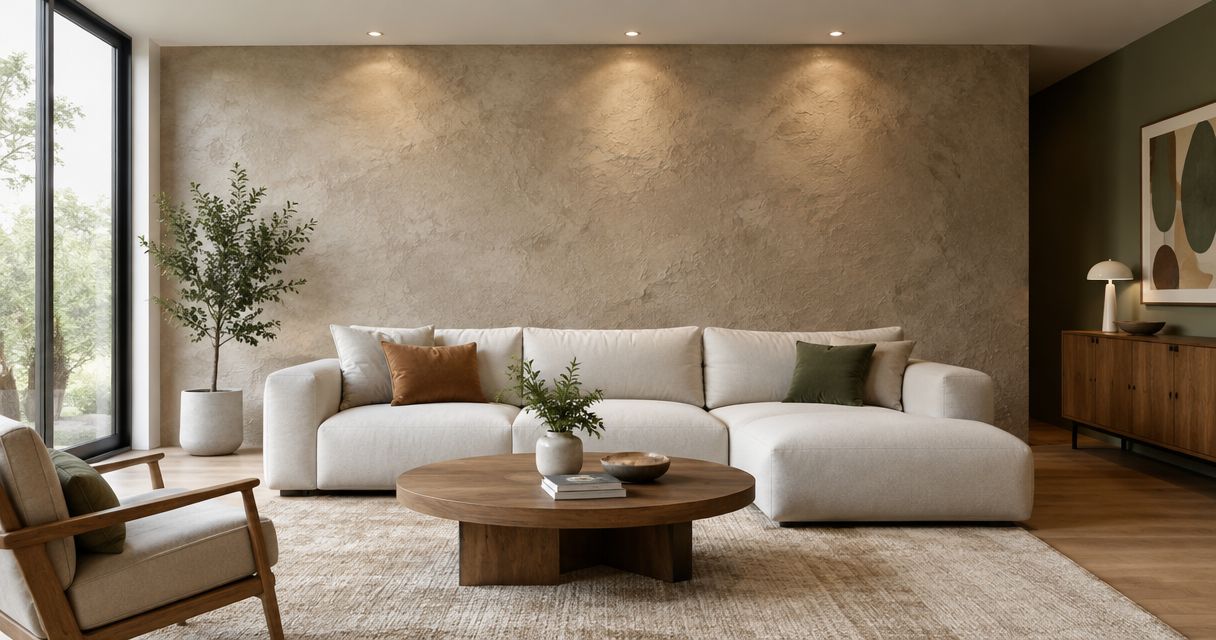
Best overall: sand float. Best for minimalist interiors: smooth trowel. Best for blending an existing textured exterior: lace. This 2026 guide compares stucco accent wall finishes by appearance, lighting, maintenance, and suitability; Azstuccosolutions provides residential and commercial stucco installation, repair, and restoration in the Phoenix metro area.
- Sand float is the best default among stucco accent wall finishes for a restrained, textured feature wall.
- Smooth trowel suits minimalist accent walls, but side lighting makes surface irregularities more visible.
- Lace suits existing textured exteriors; skip trowel gives interior feature walls a more irregular pattern.
- Azstuccosolutions serves Phoenix-area property owners who need stucco installation, repair, or restoration.
Why this matters
A finish changes more than the wall's appearance. Its depth affects shadows, its profile affects cleaning, and its consistency determines how noticeable a later patch becomes. On an accent wall, those differences become the focal point rather than background detail.
Choose the finish separately from the wall assembly. A decorative texture does not replace sound backing, suitable materials, or exterior water-management details. For your 2026 project, settle those requirements before approving the final surface.
Azstuccosolutions is a fit for Phoenix-area property owners seeking stucco installation, repair, or restoration. Use the finish shortlist below to explain the appearance you want, then confirm the proposed assembly and application with your installer.
What makes the best stucco accent wall finishes
Judge each finish against these criteria before choosing from photographs:
- Visual scale: The texture should suit the wall's size and viewing distance without overpowering nearby finishes.
- Lighting response: Windows, sconces, and grazing light reveal different amounts of texture and surface variation.
- Cleaning access: Raised edges and recesses require more attention than a relatively even surface.
- Repair visibility: The closer the texture repeats, the more carefully a patch must match its surroundings.
- Substrate suitability: The finish must belong to an assembly appropriate for the backing and exposure.
- Transition quality: Corners, trim, fixtures, and adjoining walls need deliberate stopping points.
No finish wins every category. Sand float leads this list because its restrained texture offers a useful middle ground between a flat-looking wall and a strongly sculpted surface.
Stucco accent wall finishes at a glance
These are finish categories, not interchangeable material specifications. Terminology varies between installers, so use a physical sample to confirm what each proposed finish actually looks like.
| Finish | Best for | Standout feature | Key limitation |
|---|---|---|---|
| Sand float | A balanced, understated accent | Consistent granular texture | Application differences can remain visible |
| Smooth trowel | Minimalist interiors | Low-relief, continuous appearance | Grazing light emphasizes irregularities |
| Lace | Matching an existing textured exterior | Raised pattern over a textured base | Patches require careful pattern matching |
| Skip trowel | Hand-worked interior character | Irregular islands and open areas | Results depend strongly on technique |
| Dash | Courtyard and garden feature walls | Pronounced granular relief | Coarse recesses complicate cleaning |
The distinction between sand float and dash is especially useful: both have a granular appearance, but dash creates more pronounced relief. Smooth trowel moves in the opposite direction, placing greater emphasis on plane, color, and light.

1. Sand float: best stucco finish for an understated accent
Sand float creates a granular surface with a relatively consistent overall pattern. It gives you visible texture without making every trowel movement the main design feature. That balance makes it the default recommendation for a 2026 accent wall when you want interest rather than a dramatic sculpted effect.
Specify the texture through an approved sample, not the word sand alone. Aggregate, material, and application technique all affect the result. View the sample beside the adjoining wall so the contrast feels intentional.
Sand float pros:
- Adds tactile interest without a strongly directional pattern.
- Works as a restrained background for furniture, planting, or artwork.
- Offers a clearer visual reference for consistency than a deliberately irregular finish.
Sand float cons:
- Uneven application can create visible differences across the surface.
- A repair still needs matching texture and color; granular does not mean patch-proof.
- The surface retains more texture than a smooth wall.
Best for: Property owners who want an accent wall that adds depth without dominating the space.
Ask the installer to show the proposed grain and final coating together. A photograph of unfinished material does not establish the appearance of the completed wall.
Verdict: Buy sand float for the most balanced starting point.
2. Smooth trowel: best stucco finish for minimalist interiors
Smooth trowel minimizes pronounced relief and draws attention to the wall's overall plane. The result suits interiors where simple lines and controlled transitions matter more than visible texture. Smooth does not necessarily mean perfectly flat or free of hand-applied variation.
Lighting is the deciding factor. Light traveling across the wall exposes ridges, depressions, and changes in the plane more clearly than light falling toward it. Review a sample under the actual sconce or window conditions before approving this finish.
Smooth trowel pros:
- Supports a restrained, low-relief appearance.
- Avoids the deep recesses associated with coarse textures.
- Lets corners, openings, and wall proportions carry the design.
Smooth trowel cons:
- Side lighting makes surface irregularities more noticeable.
- Localized repairs can interrupt the continuous appearance.
- Preparation quality has a strong influence on the final result.
Best for: Minimalist interior feature walls with carefully considered lighting and sound backing.
For a 2026 renovation, finalize wall-mounted lighting before approving the mockup. A sample viewed under temporary overhead lighting cannot show how the finished surface will look beside a grazing wall light.
Verdict: Buy smooth trowel when a clean plane matters more than concealing variation.
3. Lace: best stucco finish for matching textured exteriors
Lace creates a raised, patterned surface over a textured base. It belongs on your shortlist when an accent wall needs to relate to an existing lace-finished exterior rather than introduce a different visual language.
Matching means more than choosing the same finish name. The size of the raised areas, their spacing, and the visible background all affect whether new work looks connected to the surrounding wall. Color agreement alone will not resolve a different pattern.
Lace pros:
- Gives you a way to continue an existing lace texture.
- Creates a distinct pattern that remains visible across an exterior space.
- Provides stronger visual texture than a smooth finish.
Lace cons:
- Matching an existing pattern takes careful sample work.
- Raised areas and recesses need attention during cleaning.
- A small patch can stand out when its pattern differs from the surrounding surface.
Best for: Exterior accent walls adjoining established lace-textured stucco.
Ask for a sample beside the existing work, not elsewhere on the property. Compare the surfaces from the normal approach as well as close up. If the goal is contrast rather than continuity, sand float deserves a separate sample instead of an approximate lace match.
Verdict: Buy lace to continue an existing texture; skip it for a low-relief minimalist wall.
4. Skip trowel: best stucco finish for hand-worked interiors
Skip trowel leaves irregular raised areas separated by more open sections. The pattern makes the application technique part of the appearance. Choose it when you want visible hand-worked character rather than a uniformly repeating surface.
This finish name also appears in discussions of drywall textures. Do not assume a drywall example specifies a stucco assembly. Confirm the material, backing, and finish system before using an inspiration photograph as your project reference.
Skip trowel pros:
- Creates an intentionally irregular, expressive surface.
- Makes a feature wall distinct without relying entirely on color.
- Lets you approve the density and distribution of the pattern through a sample.
Skip trowel cons:
- Results depend strongly on the applicator's technique.
- Dense patterns can compete with artwork or patterned furnishings.
- Later patches must reproduce an irregular pattern convincingly.
Best for: Interior feature walls where visible trowel work is the intended focal point.
For your 2026 selection, compare an open pattern with a denser version before deciding. Judge both from the room's usual seating position; a close-up photograph exaggerates details that read differently across a room.
Verdict: Buy skip trowel for deliberate hand-worked character, not predictable uniformity.
5. Dash: best stucco finish for courtyard feature walls
Dash creates a coarse, granular surface by projecting finish material onto the wall. Its pronounced relief gives a courtyard or garden wall a distinctly textured appearance. Choose it because you want that relief, not because you expect texture to correct a damaged wall.
The depth of the surface is also its main compromise. Recesses give dust places to collect, and projecting texture deserves consideration wherever people regularly brush past the wall.
Dash pros:
- Creates a clearly expressed texture on an outdoor feature wall.
- Provides a strong contrast with smoother surrounding surfaces.
- Gives the surface visual depth without a troweled pattern.
Dash cons:
- Coarse recesses make cleaning more involved.
- Pronounced relief is less suitable beside frequent close contact.
- Texture and color both need attention when matching repairs.
Best for: Courtyard and garden accents where coarse texture is a deliberate design choice.
Approve the texture from the main viewing position and inspect it close up. A finish that reads well across a courtyard still needs to suit maintenance access and the wall's everyday use.
Verdict: Buy dash for coarse outdoor texture; skip it beside a narrow circulation route.
How the finishes are ranked
This ranking prioritizes visual restraint, lighting response, cleaning, repair matching, substrate suitability, and transitions. It is a selection guide, not a product test or a claim that one finish lasts longer than another.
Sand float is the default because it occupies the middle ground. The remaining finishes win narrower decisions: smooth trowel for minimalism, lace for continuity, skip trowel for hand-worked character, and dash for coarse outdoor relief.
Approve the sample before the whole wall
For a 2026 project, turn the shortlist into an approval process:
- Compare 3 finish samples. Include the preferred finish and alternatives with less and more pronounced texture.
- Check 2 lighting conditions. View the samples in daylight and under the artificial lighting used after dark.
- Approve 1 on-wall mockup. Confirm the texture, color, and an edge detail together before full application.
Keep a written description of the approved finish alongside the sample photographs. Record what matters visually: grain, pattern density, raised areas, and stopping points. Photographs help communicate the decision, but they do not replace viewing the actual surface.
For Azstuccosolutions stucco accent wall projects, use that brief to discuss installation, repair, or restoration needs. A repair scope also needs an assessment of the existing wall; choosing a texture alone does not address the reason the surface failed.
Discuss Your Stucco Accent Wall
Review your Phoenix-area installation, repair, or restoration project and the finish you want.
Which stucco accent wall finish should you choose?
Choose sand float if you are undecided. It gives you a textured accent without the stronger pattern of lace, skip trowel, or dash.
Choose smooth trowel only after reviewing the lighting. Choose lace when matching an existing exterior is the priority, skip trowel when you want hand-applied character, and dash when coarse outdoor relief is the goal. Match the finish to the wall's role rather than selecting the most dramatic sample.
FAQ
What’s the best stucco accent wall finish overall?
Sand float is the best default for a restrained, textured accent wall. Its granular appearance adds depth without the stronger relief of lace or dash.
Is smooth stucco better than textured stucco?
Smooth stucco is better for a low-relief, minimalist appearance, not for every wall. Textured finishes create stronger shadows, while smooth finishes make surface irregularities more apparent under grazing light.
Can I use a stucco finish on an interior accent wall?
An interior accent wall needs a finish system compatible with its backing and indoor application. Confirm the complete assembly rather than assuming an exterior stucco specification belongs on an existing interior wall.
Which stucco finish should I choose to match an existing exterior?
Choose the finish that matches the existing texture, then approve a sample beside it. Pattern size, spacing, grain, and color all affect the match.
Will a textured stucco finish hide cracks?
A textured finish is not a repair for the cause of cracking. Assess and address the underlying condition before applying a decorative finish.
How do I choose between sand float and dash?
Choose sand float for a more restrained granular surface and dash for pronounced coarse relief. Consider viewing distance, cleaning access, and whether people regularly brush past the wall.
Does Azstuccosolutions provide stucco services in Phoenix?
Azstuccosolutions provides residential and commercial stucco installation, repair, and restoration services for property owners in the Phoenix, Arizona metro area. Discuss the wall’s condition and intended appearance when defining the project.
One last thing
The edge of an accent wall deserves the same approval as its center. A well-chosen texture still looks unresolved if it stops awkwardly beside trim, an outlet, or an adjoining surface.
Before approving your 2026 finish, ask to see the mockup's stopping detail. Choose the finish and its boundary together.
Leave a Reply