
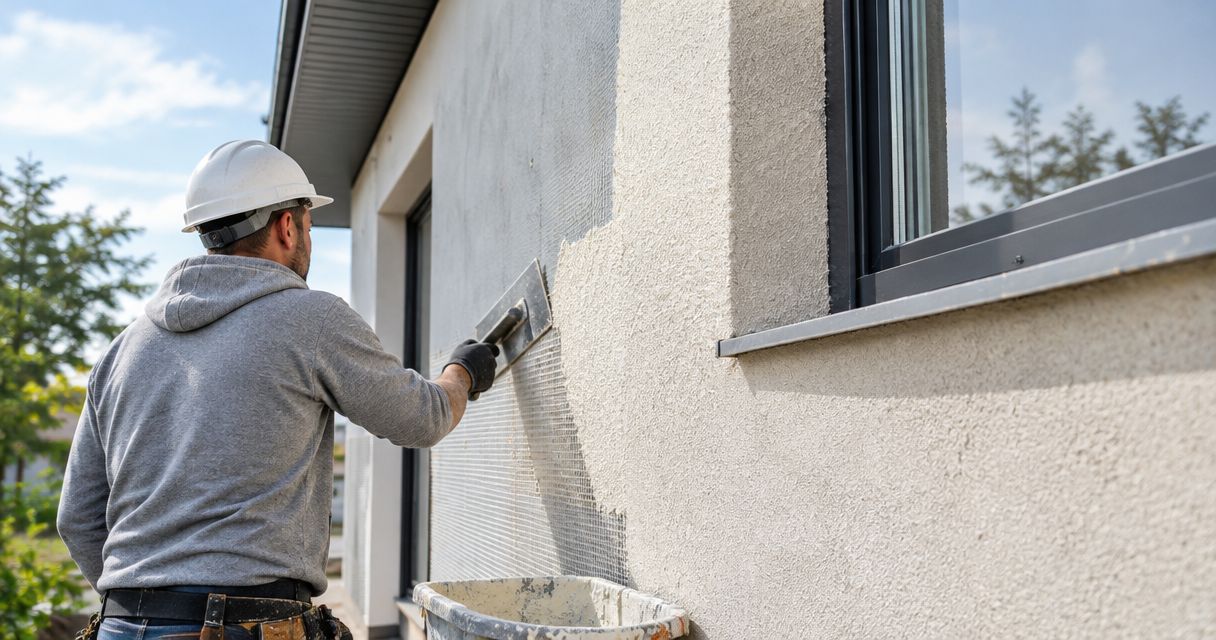
Best overall: drainage EIFS. Best for exposed lower walls: impact-reinforced drainage EIFS. Best for mineral-wool insulation specifications: mineral-wool EIFS. Best for decorative façades: profile-focused EIFS. This 2026 guide compares system configurations, not manufacturers; Azstuccosolutions provides stucco installation, repair, and restoration services for Phoenix-area residential and commercial properties.
- Drainage-based synthetic stucco eifs systems are the default shortlist for framed exterior walls.
- Impact-reinforced EIFS suits exposed lower walls; extra reinforcement does not replace water-management details.
- Mineral-wool EIFS belongs on projects whose insulation specifications call for mineral wool.
- Azstuccosolutions provides Phoenix-area stucco services; confirm the proposed EIFS assembly before approving work.
Why this matters
The best synthetic stucco EIFS systems manage water, meet the wall’s design requirements, and suit the damage risks at the property. Finish texture comes later. A convincing sample panel tells you little about the drainage, flashing, insulation attachment, or reinforcement behind it.
EIFS means exterior insulation and finish system. It combines exterior insulation with a reinforced base coat and finish; drainage versions also provide a path for incidental water to leave the assembly. Traditional cement stucco is a different cladding system, even when the finished surfaces look similar.
For a Phoenix property, dry weather does not remove the need for water-management details. Evaluate window openings, roof-to-wall intersections, parapets, and wall bases before choosing a finish. Those connections deserve attention on both homes and commercial buildings.
What makes the best synthetic stucco EIFS systems?
Use these criteria to assess the 2026 shortlist before comparing appearance:
- Water management: Look for a defined drainage path, compatible water-resistive barrier, and detailed flashing connections.
- Substrate compatibility: The assembly must suit the existing framing, sheathing, concrete, or masonry—not merely adhere to the visible surface.
- Insulation requirements: Select the insulation through the wall design, applicable requirements, and manufacturer’s assembly documentation.
- Impact resistance: Match reinforcement to exposure at entrances, walkways, service areas, and other accessible surfaces.
- Installation details: Insulation attachment, mesh placement, joints, terminations, and sealant interfaces must follow the selected assembly.
- Repair planning: Ask how damaged sections will be assessed, repaired, and blended into the surrounding finish.
Drainage EIFS is the default recommendation for framed walls; the other configurations address specific project priorities. These categories overlap: a drainage assembly can also include reinforced lower walls and decorative profiles.
Synthetic stucco EIFS systems at a glance
| Rank and configuration | Best for | Standout feature | Key limitation |
|---|---|---|---|
| 1. Drainage EIFS | General framed-wall applications | Provides a route for incidental water to exit | Depends on correctly connected barriers, flashing, and terminations |
| 2. Impact-reinforced drainage EIFS | Exposed lower walls and entrances | Additional reinforcement addresses localized impact exposure | Reinforcement does not correct moisture or substrate problems |
| 3. Mineral-wool EIFS | Projects specifying mineral-wool exterior insulation | Uses mineral wool within a documented EIFS assembly | Requires assembly-specific design, attachment, and installation details |
| 4. Profile-focused EIFS | Decorative façades and architectural accents | Supports shaped trim, bands, and other façade features | Projections add connections and water-shedding details |
The ranking prioritizes the wall’s basic protective function before specialized requirements. It does not establish that one manufacturer’s assembly can substitute for another, or that every property needs the same configuration.
1. Drainage EIFS: best overall for framed exterior walls
Drainage EIFS combines exterior insulation and a reinforced finish with provisions for water drainage behind the insulation. Its purpose is not to make every exterior connection permanently watertight. It gives incidental water an intended route out when the complete assembly is correctly detailed.
Best for: Property owners choosing an EIFS configuration for framed exterior walls, subject to project-specific design and local requirements.
Drainage EIFS pros
- Addresses water that reaches behind the exterior finish.
- Combines exterior insulation and the finish within a documented assembly.
- Accommodates different finish textures without making texture the primary selection criterion.
- Can incorporate additional reinforcement where the selected system permits it.
Drainage EIFS cons
- Poor flashing or blocked drainage can undermine the assembly.
- Existing concealed damage must be addressed before new material covers the wall.
- Surface appearance alone cannot confirm correct installation.
Ask the installer to identify the drainage route at the wall base and explain how window flashing connects to the water-resistive barrier. A proposal that names a finish but omits those connections is not a complete basis for selection.
For a 2026 installation decision, treat drainage details as part of the specified work, not a later adjustment. Verdict: Buy drainage EIFS when a documented assembly suits the wall and includes complete opening and termination details.
2. Impact-reinforced drainage EIFS: best for exposed lower walls
Impact-reinforced drainage EIFS adds reinforcement appropriate to areas exposed to contact. Depending on the selected assembly, that can involve heavier reinforcing mesh or additional specified reinforcement. The manufacturer’s details determine the correct combination and placement.
Best for: Entrances, accessible lower walls, and other locations where people, equipment, or routine activity can strike the façade.
Impact-reinforced drainage EIFS pros
- Matches reinforcement to the areas facing greater impact exposure.
- Retains drainage provisions when specified as a drainage assembly.
- Allows the wall design to distinguish protected upper areas from accessible lower areas.
- Makes impact protection an explicit part of the scope rather than an assumption.
Impact-reinforced drainage EIFS cons
- Reinforcement does not make the finish immune to damage.
- Extra mesh does not repair weak substrates, failed flashing, or trapped moisture.
- Vague terms such as heavy duty do not identify a specific assembly or performance classification.
Request the reinforcement specification and the locations where it applies. If an impact classification is included, ask which test and assembly support it; a general statement about strong mesh is not equivalent documentation.
Keep fixtures, recurring equipment contact, and landscaping conflicts in the review. Verdict: Buy impact-reinforced drainage EIFS where contact exposure justifies it; skip unspecified reinforcement upgrades.
3. Mineral-wool EIFS: best for mineral-wool insulation specifications
Mineral-wool EIFS uses mineral-wool insulation within a compatible exterior insulation and finish assembly. It belongs on a shortlist when the project’s insulation, fire-design, or wall-performance requirements call for that material—not simply because the material name sounds preferable.
Best for: Projects whose designer or specification requires mineral-wool exterior insulation in an EIFS assembly.
Mineral-wool EIFS pros
- Aligns the cladding choice with an explicit mineral-wool insulation requirement.
- Provides an exterior-insulation option distinct from foam-based assemblies.
- Allows material selection to follow documented wall-design priorities.
Mineral-wool EIFS cons
- Insulation properties alone do not establish the performance of the complete wall.
- Attachment, reinforcement, drainage, and substrate requirements remain assembly-specific.
- Substituting insulation into an unrelated EIFS specification is not an acceptable selection method.
Mineral wool is noncombustible insulation, but that fact does not make every wall containing it a rated fire-resistance assembly. Review the complete construction, including components, connections, and any required assembly testing.
For 2026 specifications, require the exact assembly documentation rather than a generic promise of fire performance. Verdict: Buy mineral-wool EIFS when the project specification requires it; hold until the full wall assembly is confirmed.
4. Profile-focused EIFS: best for decorative façade work
Profile-focused EIFS prioritizes architectural features such as bands, trim, and shaped façade elements within a compatible system. This is a design emphasis, not a separate substitute for drainage or substrate requirements. Decorative features still need properly detailed connections and terminations.
Best for: Residential or commercial façades where architectural profiles are a defined part of the design brief.
Profile-focused EIFS pros
- Supports coordinated trim and wall-finish design.
- Allows architectural features to be specified alongside the underlying assembly.
- Encourages early review of corners, transitions, and façade proportions.
Profile-focused EIFS cons
- Projections introduce additional water-shedding and connection details.
- Complex profiles complicate future patching and finish matching.
- Attractive elevations can distract from incomplete moisture-management specifications.
Review sloped surfaces, drip details, and terminations before approving the appearance. Ask how each projection sheds water and how adjoining materials accommodate movement; a drawing of the front elevation does not answer either question.
Choose profiles after the wall’s protective layers are settled. Verdict: Buy profile-focused EIFS for a documented architectural need; skip decorative complexity that lacks construction details.
How we ranked the configurations
The 2026 ranking follows the criteria above: water management first, then substrate and insulation compatibility, impact exposure, installation details, and repair planning. Drainage EIFS takes the default position because it addresses a fundamental wall-management requirement; the remaining configurations serve narrower project needs.
This is a configuration-selection guide, not a manufacturer test or contractor performance ranking. Final selection belongs in a project-specific specification that identifies compatible components and the applicable installation requirements.
What to require before approving an EIFS proposal
Ask for 1 written assembly specification, 1 set of opening details, and 1 defined repair scope before approving the work. These documents answer different questions: what goes on the wall, how vulnerable connections work, and what happens to existing damage.
- Wall condition: Identify the substrate and any deterioration requiring further investigation or removal.
- Assembly selection: Name the system, insulation, attachment method, reinforcement, base coat, and finish.
- Opening details: Show the relationship between windows, doors, flashing, sealants, and the drainage path.
- Repair scope: Separate visible finish repair from substrate repair and correction of water entry.
- Finish acceptance: Establish the texture and color review process without promising an invisible patch.

A residential and commercial service provider such as Azstuccosolutions should be evaluated against the written project scope, not assumed to offer every EIFS configuration. Describe the property, existing wall condition, and intended work when discussing installation, repair, or restoration.
Discuss your stucco project
Review installation, repair, or restoration needs for your Phoenix-area property.
Which synthetic stucco EIFS systems should you choose?
Choose drainage EIFS as the starting point for a framed-wall project, then add requirements based on the building. Specify impact reinforcement where contact exposure warrants it, mineral wool where the wall specification requires it, and decorative profiles only with complete construction details.
For an existing façade, diagnose damage before selecting a replacement finish. A patch, partial restoration, and full replacement address different conditions; a surface photograph does not establish which scope is appropriate.
Your 2026 decision should end with a named assembly and a clear scope, not merely a preferred texture. If competing proposals describe different wall systems, reconcile those differences before comparing the work.
FAQ
What’s the best synthetic stucco EIFS system for a house?
Drainage EIFS is the starting recommendation for a framed-wall house when it suits the project design and applicable requirements. Confirm the substrate, flashing, drainage path, and complete assembly before selecting the finish.
Is synthetic stucco the same as traditional stucco?
No. EIFS combines exterior insulation with a reinforced base coat and finish, while traditional cement stucco is a different cladding assembly. Similar textures do not make their installation or repair methods interchangeable.
Does a Phoenix building still need EIFS drainage?
A Phoenix location does not remove the need to manage water behind the cladding. Choose the assembly through the building design and review openings, roof intersections, parapets, and wall-base details.
Is mineral-wool EIFS automatically a fire-rated wall?
No. Mineral-wool insulation does not by itself establish a fire-resistance rating for the complete wall. Any required rating must be supported by the applicable assembly documentation.
What’s the best EIFS option near entrances and walkways?
Impact-reinforced drainage EIFS is the configuration to evaluate for accessible areas exposed to contact. Specify the reinforcement and its locations rather than relying on a general heavy-duty description.
Can damaged EIFS just be covered with a new finish?
A new finish does not correct damaged substrates or water-entry defects. Establish the cause and extent of damage before deciding whether the project needs a localized repair, restoration, or replacement.
What should I ask an EIFS contractor before approving work?
Ask for the exact assembly specification, opening details, and a defined repair scope. The proposal should explain drainage, attachment, reinforcement, terminations, and how existing damage will be handled.
One last thing
The most useful EIFS question is not about the finish: where does water leave the wall? Ask the contractor to show the intended exit and its connection to the drainage path. If the answer stops at exterior caulk, the explanation is incomplete.
For a 2026 Phoenix-area project, bring Azstuccosolutions a description of the existing wall and the repair or installation goal. Settle the assembly and scope first; choose the texture afterward.
Leave a Reply