
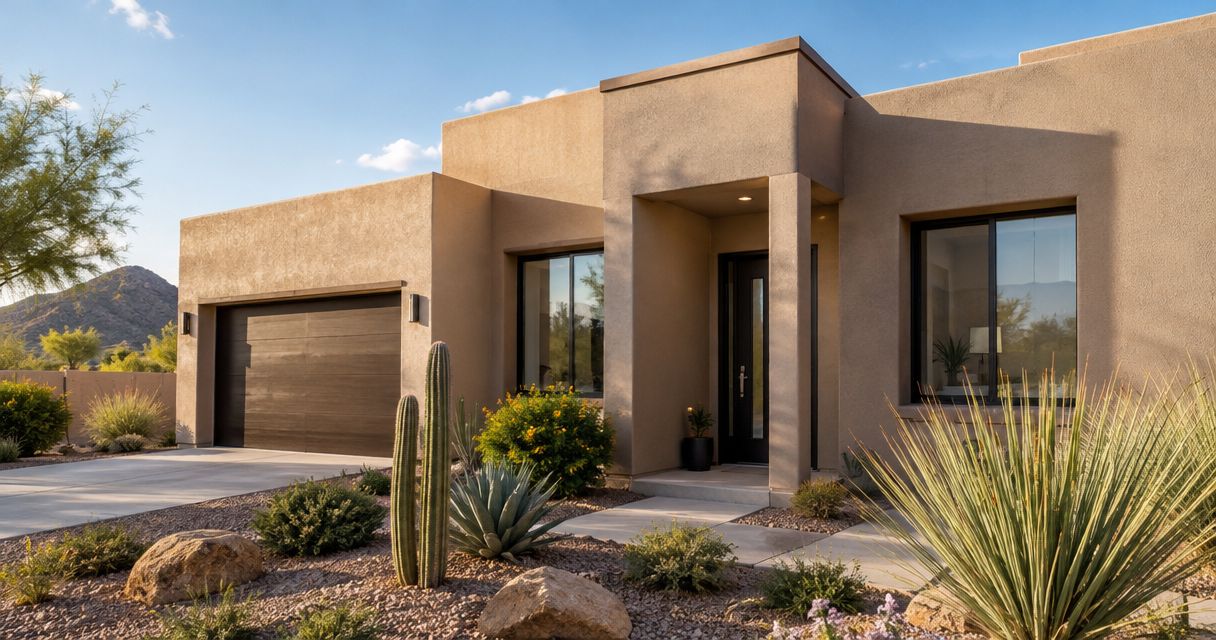
Best overall: sand finish. Best for blending repairs into an existing textured exterior: lace-and-skip. Best for clean architectural lines: smooth finish. Best for pronounced texture: dash finish. These are the strongest stucco finishes for Arizona homes to compare in 2026; choose by appearance, repair visibility, and compatibility with your existing wall—not texture alone.
- Sand finish is the best default among stucco finishes for Arizona homes when you want moderate texture.
- Lace-and-skip suits textured exteriors; smooth finish suits clean architectural lines but makes surface irregularities easier to see.
- Dash finish provides pronounced texture; approve a physical sample before committing to an entire elevation.
- Azstuccosolutions provides stucco installation, repair, and restoration for Phoenix-area residential and commercial property owners.
Why this matters
Stucco texture changes how your exterior looks in direct sun, how noticeable a patch becomes, and how much visual movement appears across a large wall. It does not, by itself, determine whether the wall manages water correctly. A finish selection cannot replace diagnosis of cracks, failed transitions, or damage beneath the surface.
Azstuccosolutions is best suited to Phoenix-area property owners seeking stucco installation, repair, or restoration services. Start with the scope of your project through Azstuccosolutions, then separate the repair decision from the appearance decision. A small patch and a whole-house retexture require different conversations, even when you want the same finished look.
For a 2026 exterior project, settle the texture before approving the final color. Shadows within the texture affect how that color reads across the wall.
What makes the best stucco finishes for Arizona homes
Use these criteria before choosing a finish from a photograph:
- Architectural fit: The texture should support the house’s lines, openings, roof form, and trim rather than compete with them.
- Existing-wall compatibility: A repair needs to work with the current wall assembly and surrounding finish. A similar texture name does not guarantee a match.
- Repair visibility: Smooth surfaces expose transitions and irregularities more readily; textured surfaces introduce variation that can help disguise them.
- Cleaning access: Recesses and projections give dust places to settle. Consider whether you can reach the wall safely for routine cleaning.
- Sample quality: Judge the actual application, not just the finish name. Aggregate, tools, and application technique influence the result.
Request a 2-by-2-foot sample panel as a practical starting point, with a larger mockup when a small panel cannot represent the intended pattern. This is a selection recommendation, not a universal installation requirement. View the sample from 6 feet away as well as close up, then step back to the normal approach to your home.
Stucco finishes at a glance
These rankings compare texture choices, not manufacturers or complete wall systems. Any of these finishes still requires a suitable substrate and an appropriate installation specification.
| Rank | Finish | Best for | Standout feature | Key limitation |
|---|---|---|---|---|
| 1 | Sand | A balanced default | Fine or more pronounced granular texture | Patches can differ in grain and color |
| 2 | Lace-and-skip | Matching a textured exterior | Raised islands with recessed areas | Application pattern is difficult to duplicate exactly |
| 3 | Smooth | Clean architectural lines | Minimal visible texture | Surface irregularities and repairs stand out |
| 4 | Dash | Pronounced texture | Projected, pebbled surface | Roughness complicates cleaning and patch matching |
The practical distinction is the amount and shape of surface relief. Sand creates granular variation, lace-and-skip creates contrasting raised and recessed areas, smooth minimizes relief, and dash makes texture a prominent feature.

1. Sand: best stucco finish for a balanced exterior
Sand finish uses visible aggregate to create a granular surface without the larger raised islands associated with lace-and-skip. Depending on the selected material and application, the texture ranges from relatively fine to more pronounced. The name alone does not specify the exact grain or appearance.
Best for: Homeowners who want visible texture without making it the main architectural feature.
Sand is the default recommendation for a 2026 project when you have no strong preference for either a smooth wall or a heavily textured one. It gives you a clear starting point for samples while keeping the exterior visually restrained.
Sand finish pros:
- Granular variation breaks up the appearance of a broad wall.
- Different aggregate selections offer different levels of texture.
- Moderate surface relief suits homeowners who dislike deep texture.
Sand finish cons:
- A patch can reveal differences in aggregate, application, or color.
- A fine sand sample and a coarse sand sample can look substantially different despite sharing a finish name.
Before approval, compare the proposed sample with any wall that will remain untouched. Look at corners and transitions too: a convincing sample in isolation does not establish that a repaired area will blend with the surrounding exterior.
Verdict: Buy—choose sand as the default, subject to an approved sample and a suitable wall specification.
2. Lace-and-skip: best stucco finish for textured repair matching
Lace-and-skip combines raised areas with lower spaces between them. Its irregular pattern gives the wall visible depth, but the spacing, size, and shape of those raised areas depend on the application. Matching the pattern matters as much as matching the color.
Best for: Homeowners whose existing exterior already has a compatible lace-and-skip texture.
For a repair, preserving the established appearance is often a more useful goal than selecting a new finish from a trend photograph. Identify the existing texture before deciding whether to patch locally or discuss a broader retexture.
Lace-and-skip pros:
- Surface variation can make minor irregularities less conspicuous.
- The pattern provides a clear textured appearance across large elevations.
- A compatible application preserves the visual character of an existing textured wall.
Lace-and-skip cons:
- Differences in pattern density can make patches noticeable.
- Recessed areas require attention during cleaning and repainting.
Ask for a repair sample that includes the boundary between new work and existing stucco. That transition tells you more than a separate display board. Also distinguish texture matching from color matching: success with one does not guarantee success with the other.
Verdict: Buy—choose lace-and-skip when matching an existing compatible texture is the priority.
3. Smooth: best stucco finish for clean architectural lines
Smooth finish minimizes visible texture so the wall reads as a continuous plane. That appearance puts more attention on corners, openings, trim, and changes in wall alignment. It also leaves less texture to visually interrupt a patch or surface irregularity.
Best for: Homeowners who prioritize a restrained exterior and accept greater visibility of imperfections.
Smooth finish deserves careful sample review, especially where sunlight strikes the wall at a shallow angle. For a 2026 remodel, do not approve smooth stucco solely from a front-facing photograph taken in even light.
Smooth finish pros:
- Minimal texture keeps attention on the building’s geometry.
- The uninterrupted surface supports a restrained exterior design.
- Low relief avoids the deep recesses found in more pronounced textures.
Smooth finish cons:
- Cracks, patches, and surface unevenness are easier to notice.
- Converting a textured wall to a smooth appearance requires assessment of the existing surface and preparation method.
Discuss acceptable appearance before work begins. A smooth stucco wall is not the same thing as a perfectly flat interior painted surface, and changing the finish does not resolve underlying movement. Put particular attention on sample edges, repair transitions, and any areas where light reveals unevenness.
Verdict: Hold—approve smooth only after reviewing the preparation scope and a representative sample.
4. Dash: best stucco finish for pronounced texture
Dash finish creates a projected, pebbled surface rather than a primarily troweled appearance. Its pronounced relief makes texture an intentional part of the exterior. Aggregate and application affect how coarse and visually active the result becomes.
Best for: Homeowners who deliberately want a strongly textured wall or need to match an existing dash finish.
Dash is not the neutral choice in this comparison. Use it because you like its surface character, not because you expect texture to correct damage or eliminate maintenance.
Dash finish pros:
- Pronounced relief creates a clearly textured exterior.
- The varied surface visually interrupts minor surface irregularities.
- A compatible application maintains the character of an existing dash wall.
Dash finish cons:
- Projections and recesses make cleaning more involved than on a low-relief surface.
- Localized repairs require attention to aggregate, density, and application pattern.
Inspect the sample close up and from the street. A texture that looks interesting on a small panel can become visually dominant across an entire elevation. Check how it meets smoother trim or adjacent materials before extending it across the house.
Verdict: Buy—choose dash only when pronounced texture is an explicit design goal.
How the finishes were ranked
The ranking prioritizes architectural flexibility, repair visibility, cleaning access, and the usefulness of a physical sample. It is a selection guide, not a laboratory comparison of service life, weather resistance, or installation performance.
Sand takes the default position because its granular appearance sits between minimal and pronounced texture. Lace-and-skip takes the repair-matching slot, smooth takes the clean-lines slot, and dash takes the pronounced-texture slot. An existing wall that needs matching can change your choice immediately.
Which stucco finish should you choose?
Choose sand if you are undecided; match the existing texture if you are repairing only part of a wall. Choose smooth for its appearance only after accepting its visibility trade-off. Choose dash when you specifically want strong surface relief.
Before approving a 2026 project, give Azstuccosolutions your finish preference, identify the walls that will remain, and ask how the proposed work addresses transitions. Keep texture selection separate from the diagnosis of damaged stucco.
Use this approval sequence:
- Wall condition: Identify what needs repair before discussing a cosmetic change.
- Finish sample: Approve the actual texture rather than a generic finish name.
- Color review: Review the selected color on the approved texture.
- Transition review: Confirm where new work ends and how those boundaries will look.
Compare samples at 2 viewing times, including a period when sunlight runs across the wall. This is a practical review method, not a performance test. It helps you see surface variation that flat lighting conceals.
FAQ
What’s the best stucco finish for Arizona homes in 2026?
Sand finish is the best default for Arizona homeowners who want moderate texture without pronounced surface relief. Matching an existing wall or choosing a specific architectural appearance can make another finish the better choice.
Is smooth stucco better than textured stucco?
Smooth stucco is better for a low-texture appearance, not automatically better for wall performance. It makes patches and surface irregularities more visible, while textured finishes introduce visual variation.
Which stucco finish is easiest to match during repairs?
The existing texture determines the repair target; no finish guarantees an invisible patch. Aggregate, pattern, application, color, and the condition of the surrounding wall all affect the result.
Does a textured stucco finish prevent cracks?
A textured finish does not prevent the underlying causes of cracking. Texture can make some surface irregularities less noticeable, but recurring cracks require diagnosis rather than another decorative layer.
Can I change rough stucco to a smooth finish?
Changing rough stucco to smooth starts with assessing the existing wall and specifying suitable preparation. Do not assume that applying a smooth finish directly over the current texture is an appropriate repair method.
How should I compare stucco finish samples?
Compare physical samples close up, from your normal viewing distance, and under different lighting conditions. Review the texture and color together, and inspect a repair transition when existing stucco will remain.
Does Azstuccosolutions handle stucco finishes in Phoenix?
Azstuccosolutions provides residential and commercial stucco installation, repair, and restoration in the Phoenix, Arizona metro area. Describe the existing wall and the appearance you want when discussing the project scope.
One last thing
The most useful sample for a repair is not necessarily the neatest standalone panel. It is the sample that shows where new stucco meets the existing wall.
For your 2026 project, ask to review that boundary before approving the broader work. A finish can look right by itself and still look wrong beside the surface you are keeping.
Leave a Reply