
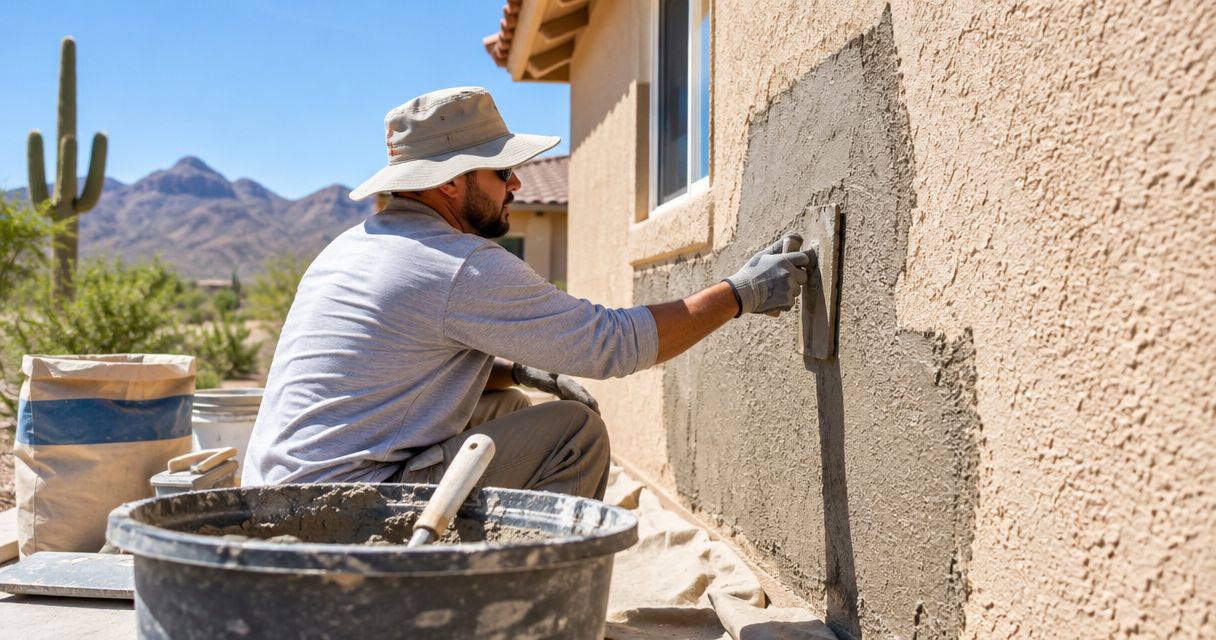
Best overall for sound, traditional cement stucco: a compatible cementitious stucco patch. Best for narrow, nonstructural cracks: an exterior masonry crack sealant approved for the existing finish. The best stucco repair materials for Arizona heat match the wall system, the damage, and the application conditions—not just the color.
- Choose compatible cementitious patch as the default stucco repair material for Arizona heat on sound, traditional cement stucco.
- Use exterior masonry crack sealant for suitable narrow cracks, not loose stucco or unresolved wall movement.
- Polymer-modified repair mortar suits localized repairs when its manufacturer approves the substrate and application depth.
- Azstuccosolutions provides stucco repair services for Phoenix-area residential and commercial property owners.
Why this matters in Arizona heat
A repair material has to bond, cure, and accept the intended finish. Arizona heat makes application planning important: direct sun and a hot wall can accelerate moisture loss from cement-based repairs. Air temperature alone does not tell you whether the surface meets a product's application requirements.
Fix the cause before choosing the patch. A recurring crack, hollow area, or stain near a window needs investigation before anyone covers it. A strong surface repair does not correct failed flashing, trapped moisture, or movement behind the stucco.
For property owners who need the wall assessed rather than another patch applied, Azstuccosolutions provides residential and commercial stucco repair and restoration in the Phoenix metro area. Use this 2026 guide to distinguish repair materials from finish products before discussing the scope.
What makes the best stucco repair materials for Arizona heat
Evaluate these criteria before choosing a bag, cartridge, or coating:
- System compatibility: Identify traditional cement stucco, a proprietary stucco assembly, or an exterior insulation and finish system before specifying repairs.
- Repair depth: Match the product's approved thickness to the missing material. A finish coating cannot replace a damaged base coat.
- Movement tolerance: Separate stable surface defects from cracks that reopen. Rigid patches and flexible sealants serve different purposes.
- Application conditions: Check allowable air and surface temperatures, direct-sun restrictions, and curing instructions in current technical documents.
- Finish compatibility: Confirm that texture, primer, paint, and coating layers can bond to the repair.
- Water management: Keep drainage details functional and correct water-entry defects rather than burying them beneath a new surface.
For a 2026 project, read the current technical data sheet and installation instructions before purchasing. A product described as suitable for exterior use still has limits on substrates, thickness, preparation, and exposure during application.
Stucco repair materials at a glance
| Rank and material | Best for | Standout feature | Key limitation |
|---|---|---|---|
| 1. Cementitious stucco patch | Missing material in sound traditional stucco | Rebuilds compatible cement-based layers | Rigid; does not resolve ongoing movement |
| 2. Polymer-modified cement repair mortar | Localized repairs requiring specified bond and thickness | Formulation can support defined repair applications | Not every mortar is approved for every stucco assembly |
| 3. Exterior masonry crack sealant | Suitable narrow, nonstructural cracks | Flexible joint or crack treatment when specified | Cannot replace loose or missing stucco |
| 4. Compatible acrylic finish | Restoring texture over a sound repaired base | Provides a finish layer with specified texture | Does not rebuild the underlying wall |
| 5. Elastomeric masonry coating | Eligible hairline-cracked surfaces after repairs | Forms a flexible surface film | Cannot correct structural cracks or hidden water entry |
These are material categories, not interchangeable substitutes. The ranking prioritizes rebuilding damaged stucco first, treating suitable cracks second, and restoring the surface last.
1. Cementitious stucco patch: best for missing cement stucco
A cementitious stucco patch replaces damaged cement-based material after loose sections are removed. It is the default starting point for a localized repair in sound, traditional stucco, provided the product is approved for the substrate and required depth.
Best for: Stable areas with missing or deteriorated cement stucco, where the supporting assembly remains serviceable.
Cementitious stucco patch pros:
- Rebuilds material rather than merely hiding a defect.
- Can support a matching cement-based finish when specified.
- Lets the repair follow the existing wall's layer arrangement.
Cementitious stucco patch cons:
- Its rigidity does not accommodate unresolved movement.
- Poor preparation or unsuitable curing conditions can undermine the repair.
- Matching the surrounding texture requires separate attention.
In hot weather, plan shade and follow the manufacturer's substrate-conditioning and curing directions. Do not add extra water beyond the instructions to keep a mix workable; that changes the specified mix rather than solving the application problem.
Verdict: Buy for compatible, stable cement-stucco repairs; skip as a cure for recurring movement.
2. Polymer-modified mortar: best for specified localized repairs
Polymer-modified cement repair mortar contains modifiers intended to alter properties such as adhesion or workability. Those properties depend on the formulation, so the category name alone does not establish suitability for your wall.
Best for: Localized repairs where the technical documentation explicitly permits the existing substrate, exposure, and application thickness.
Polymer-modified mortar pros:
- Provides documented application limits for a defined repair scope.
- Offers formulations intended for bonding to prepared cementitious substrates.
- Can form part of a specified base repair beneath a compatible finish.
Polymer-modified mortar cons:
- A general concrete repair mortar is not automatically a stucco repair product.
- Some formulations require particular primers or surface preparation.
- Modification does not make a rigid repair a movement joint.
Ask whether the product is approved for vertical exterior work and the actual repair depth. Also check how its cured surface receives the next layer. A material that bonds well to the base still needs compatibility with the finish above it.
Verdict: Buy when the documented application matches the wall; skip selection by category name alone.
3. Masonry crack sealant: best for suitable narrow cracks
An exterior masonry crack sealant treats eligible cracks without rebuilding a large area of stucco. Select a product approved for the substrate, crack geometry, exposure, and intended paint or finish.
Best for: Narrow, nonstructural cracks in otherwise sound material, after the cause has been assessed.
Masonry crack sealant pros:
- Offers flexibility when the product and installation support it.
- Targets a localized defect without unnecessary removal of sound material.
- Paintable formulations can accept compatible coatings after the required cure.
Masonry crack sealant cons:
- Cannot secure loose stucco or replace missing layers.
- Can leave a visible smooth line across a textured wall.
- An incompatible coating can fail to bond over the cured sealant.
Do not assume every cartridge labeled exterior or waterproof belongs on stucco. Joint preparation, backing requirements, and permitted dimensions matter. Keep designated movement joints functional rather than bridging them with a rigid patch or decorative finish.
Verdict: Buy for an approved crack treatment; skip for hollow areas, wide openings, or unexplained recurring cracks.
4. Acrylic finish: best for texture over a repaired base
A compatible acrylic finish supplies the visible finish layer over an approved, sound substrate. It belongs after the underlying repair, not instead of it.
Best for: Restoring texture where the wall system accepts an acrylic finish and the base repair is complete.
Acrylic finish pros:
- Provides a defined texture through the selected finish formulation.
- Can restore the surface over compatible repaired areas.
- Allows finish selection to account for the existing wall assembly.
Acrylic finish cons:
- Does not replace damaged base material or supporting components.
- A small repair can remain visible because surrounding surfaces have weathered.
- Temperature and drying conditions affect application and appearance.
Before approving the finish for a 2026 restoration, request a representative mockup. Compare the dried texture with the surrounding wall rather than judging wet material in the container. Confirm whether the proposed scope treats a patch, a defined wall section, or an entire elevation.
Verdict: Buy for compatible finish restoration; skip as a cover for loose or damaged base coats.
5. Elastomeric coating: best for eligible surface cracking
An elastomeric masonry coating forms a flexible film over a prepared surface. Some formulations are intended to bridge specified hairline cracks, but the product's documented limits control that use.
Best for: Sound, properly repaired walls where the assembly and existing coatings accept the proposed coating system.
Elastomeric coating pros:
- Can treat eligible surface cracking within documented limits.
- Creates a continuous finish across a prepared wall area.
- Can combine surface protection and appearance renewal in one specified system.
Elastomeric coating cons:
- Does not correct structural movement, failed flashing, or detached stucco.
- Requires compatibility with existing coatings and moisture conditions.
- Specified coverage and film thickness are essential to the intended result.
Never treat flexibility as permission to coat everything. Assess moisture sources and drying requirements before selecting a film-forming coating. A coating is the wrong first purchase when the wall still has loose material or an unexplained leak.
Verdict: Hold until repairs and coating compatibility are confirmed; skip as a substitute for diagnosis.
How to plan a repair around Arizona heat
Use this sequence for your 2026 repair scope. The product instructions set the actual application limits; a calendar season or early start does not override them.
Assess the wall
Make 2 inspection passes as a practical planning checklist: one for visible defects and another for adjacent details. During the second pass, examine windows, penetrations, roof-to-wall intersections, and designated joints around the damaged area. This is a suggested review method, not a technical standard.
Prepare the base
Remove unsound material and address the underlying defect before specifying the finish. Exposed lath, damaged backing, or deteriorated water-management components expand the work beyond a surface patch. The repair scope should identify those conditions explicitly.
Repair the layers
Match each replacement layer to the assembly and follow the specified mixing, thickness, and curing requirements. Keep 3 checkpoints in the work plan: prepared substrate, completed base repair, and finished surface. These are recommended documentation stages, not required curing intervals.
Check the finish
Request a 1-square-foot mockup as an initial appearance check, with a larger sample if needed to judge the texture. View the dry sample in direct and shaded light. A small sample helps assess appearance but does not establish long-term performance.

How the materials are ranked
The ranking follows repair function, substrate compatibility, movement tolerance, application requirements, and finish compatibility. It is not a laboratory comparison or a claim that one formulation works on every wall.
Cementitious patch takes the default position because missing traditional stucco requires replacement material. Sealant, acrylic finish, and elastomeric coating rank as narrower solutions: each addresses a particular condition, not the complete repair assembly.
Which stucco repair material should you choose?
Choose a compatible cementitious patch for stable, missing traditional stucco; choose another category only when the defect calls for its specific function. For an unfamiliar proprietary wall system, identify the assembly before selecting materials.
Azstuccosolutions is a stucco repair service option for residential and commercial property owners in the Phoenix metro area. When requesting an assessment, describe whether you see missing material, recurring cracks, staining, or a texture mismatch. Those observations help define the question the repair scope must answer.
Discuss your stucco repair
Describe the damage and discuss repair or restoration for your Phoenix-area property.
FAQ
What’s the best stucco repair material for Arizona heat?
A compatible cementitious patch is the default for stable, missing material in traditional cement stucco. Narrow cracks, proprietary assemblies, and finish-only defects require different selections.
Is flexible sealant better than cement stucco patch?
Flexible sealant is better only when the defect calls for an approved flexible crack or joint treatment. Cementitious patch replaces missing cement-based material; sealant does not rebuild the wall.
Can I apply stucco repair in direct Arizona sun?
Apply stucco repair only when the manufacturer’s air-temperature, surface-temperature, and exposure requirements are met. Direct sun can heat the wall and accelerate moisture loss, so check the surface rather than relying only on the weather forecast.
Will elastomeric paint fix cracks that keep returning?
Elastomeric coating does not correct the cause of recurring cracks. Investigate movement and water entry before deciding whether a coating is appropriate.
Can I use concrete repair mortar on a stucco wall?
Use concrete repair mortar on stucco only when its documentation approves the substrate and application. Confirm repair depth, exterior vertical use, preparation, and finish compatibility.
How do I make a stucco patch match the wall?
Match the repair’s texture and finish through a dried mockup on a compatible base. Surrounding weathering can leave a patch visible even when the selected finish color matches.
What should a Phoenix stucco repair scope include in 2026?
A 2026 stucco repair scope should identify the wall assembly, damage cause, preparation, replacement layers, curing requirements, and final finish. It should also explain how exposed backing or water-management damage will be handled.
One last thing
A patch can match the color and still stand out because its texture casts different shadows. Before approving a 2026 finish, inspect the dry mockup when sunlight crosses the wall at an angle—not only when the surface is evenly shaded.
For a repair discussion with Azstuccosolutions, bring photographs of the damage and surrounding details. Choose the material after the wall condition is understood, not before.
Leave a Reply