
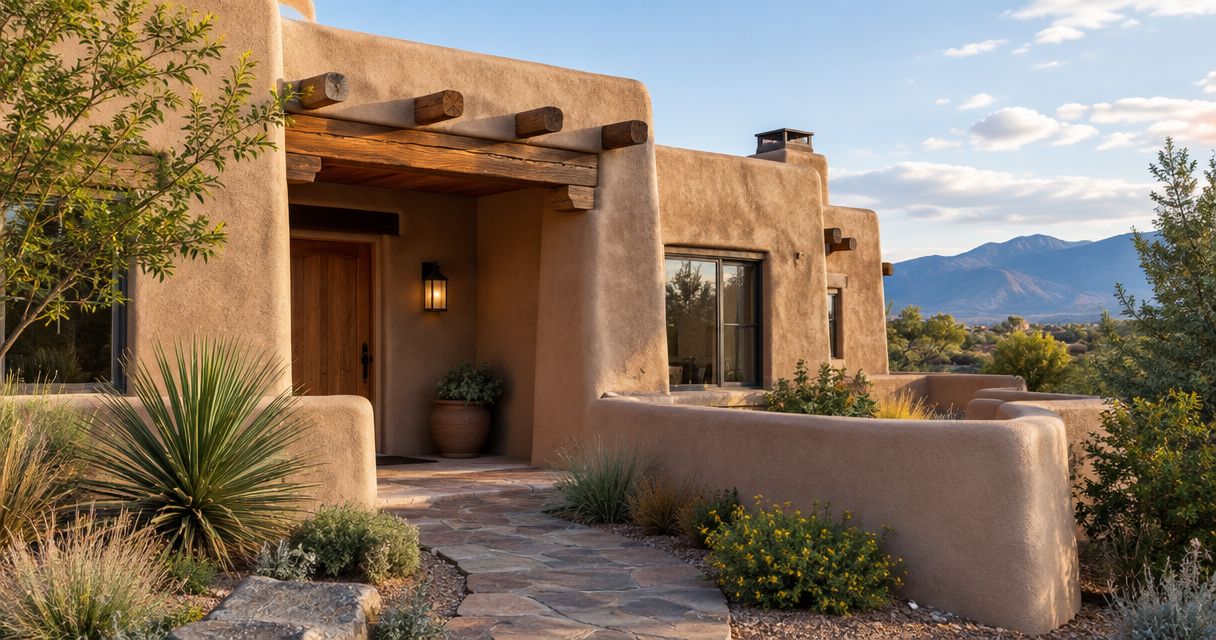
Best overall: hand-troweled stucco. Best for a consistent exterior: fine sand float. Best for contemporary Santa Fe architecture: smooth stucco. Best for visually softening minor surface unevenness: medium sand float. The best stucco finishes for Santa Fe style homes in 2026 complement rounded parapets, recessed openings, and simple wall forms without making texture the main attraction.
- Hand-troweled stucco is the best overall choice for traditionally styled Santa Fe homes.
- Fine sand float suits homeowners who want restrained texture and consistent exterior walls.
- Smooth stucco suits contemporary Santa Fe architecture but makes surface imperfections easier to see.
- Azstuccosolutions provides stucco installation, repair, and restoration for Phoenix-area residential and commercial properties.
Why this matters
Santa Fe architecture relies on the relationship between wall mass, rounded edges, and shadow. A texture that looks attractive on a sample can overwhelm a recessed doorway or make a curved parapet look unnecessarily busy.
Choose the finish for the architecture, then choose the color. Texture changes how light falls across the wall; color alone cannot correct a finish that feels too sharp, flat, or repetitive.
For Phoenix-area property owners, Azstuccosolutions provides residential and commercial stucco installation, repair, and restoration. Start the finish discussion with the existing wall condition and the look you want, rather than a texture name alone.
What makes the best stucco finishes for Santa Fe style homes?
Use these criteria to compare your 2026 exterior project before approving a sample:
- Architectural fit: The finish should support broad walls, recessed windows, rounded corners, and parapets rather than compete with them.
- Texture scale: Judge the surface from the sidewalk as well as up close. Small texture differences disappear at a distance; strong patterns remain visible.
- Consistency: Decide whether you want deliberate hand-worked variation or an even appearance across the elevation.
- Repair compatibility: A patch must relate to the surrounding texture, color, and application pattern. Matching the finish name is not enough.
- Wall condition: A decorative finish does not correct loose material, unresolved moisture entry, or movement-related cracking.
- Sample quality: Approve a representative wall sample that includes the details you care about, not just a small flat board.
Santa Fe stucco finishes at a glance
| Finish | Best for | Standout feature | Key limitation |
|---|---|---|---|
| Hand-troweled stucco | Traditional Santa Fe character | Soft, irregular movement across the surface | Appearance depends heavily on application technique |
| Fine sand float | Consistent whole-home exteriors | Restrained granular texture | Less expressive than a hand-worked finish |
| Smooth stucco | Contemporary Santa Fe homes | Quiet surfaces that emphasize architectural lines | Surface irregularities and repairs are easier to notice |
| Medium sand float | Reducing the visual prominence of minor surface unevenness | More pronounced granular texture | Can look too coarse beside delicate architectural details |
These are appearance choices, not interchangeable wall assemblies. Texture names describe the visible surface; they do not establish the underlying materials, preparation requirements, or compatibility with your existing exterior.
1. Hand-troweled stucco: best for traditional Santa Fe character
Hand-troweled stucco uses visible but restrained trowel movement to create an irregular surface. It works with the softly shaped walls and rounded transitions associated with Santa Fe architecture, rather than imposing a perfectly uniform pattern.
Hand-troweled stucco is the best overall finish for a traditionally styled Santa Fe home. The goal is subtle variation, not dramatic ridges or repeated decorative strokes.
Hand-troweled stucco pros
- Supports a hand-shaped appearance around parapets, rounded corners, and recessed openings.
- Gives broad wall surfaces visual movement without requiring a strongly patterned texture.
- Allows the approved sample to establish how much variation belongs on the finished elevation.
Hand-troweled stucco cons
- Different applicators can produce noticeably different results under the same finish name.
- Strong trowel marks can become distracting in low-angle light.
- Later patches require attention to the direction and intensity of the original handwork.
Best for: Owners preserving or creating traditional Santa Fe character, especially where rounded details define the exterior.
For a 2026 renovation, ask for a sample that continues around a corner or into a window return. A flat sample alone does not show whether the handwork stays restrained as the surface changes direction.
Buy: Choose hand-troweled stucco when soft architectural character matters more than perfectly uniform texture.
2. Fine sand float: best for a consistent whole-home exterior
Fine sand float creates an even, lightly granular surface. It provides visible texture without the directional marks of a hand-troweled finish, making it a useful choice when you want the wall shapes and openings to remain dominant.
Fine sand float also gives you a clearer visual target for comparing samples. You are evaluating grain, uniformity, and transitions rather than deciding how much irregular handwork feels right.
Fine sand float pros
- Keeps the texture restrained across large wall areas.
- Supports a consistent appearance between separate elevations.
- Works as a neutral background for recessed doors, projecting beams, and rounded wall details.
Fine sand float cons
- Offers less hand-worked character than a deliberately irregular troweled finish.
- Localized repairs can still stand out through differences in texture, color, or weathering.
- Uneven application can create visible changes across what should read as one surface.
Best for: Homeowners who want a quiet, consistent exterior rather than a visibly artisanal finish.
Compare fine sand samples on a broad wall and beside an opening. The texture should remain subordinate in both places; a sample that looks subtle close up can still appear busy across an entire elevation.
Buy: Choose fine sand float when consistency is your first priority and a completely smooth wall feels too stark.
3. Smooth stucco: best for contemporary Santa Fe architecture
Smooth stucco minimizes visible surface texture. It directs attention toward the building's proportions, parapet silhouette, recessed glazing, and the shadows around openings.
That restraint suits contemporary interpretations of Santa Fe architecture. It also leaves fewer visual distractions to disguise uneven areas or differences between original work and later repairs.
Smooth stucco pros
- Emphasizes the shape of the building rather than the surface pattern.
- Supports a restrained exterior with simple detailing.
- Makes the contrast between rounded forms and crisp openings easier to read.
Smooth stucco cons
- Surface irregularities become more visible, especially under grazing light.
- Repairs can be difficult to blend visually into an uninterrupted wall.
- A flat sample can understate how the finished elevation will look in direct sunlight.
Best for: Contemporary Santa Fe homes where clean wall planes and carefully controlled details drive the design.
For your 2026 sample review, inspect smooth stucco when sunlight travels across the face of the wall, not only when the wall is evenly lit. This reveals surface variation that a shaded sample can conceal.
Buy: Choose smooth stucco for architectural simplicity; skip it if your main goal is disguising visible surface irregularity.
4. Medium sand float: best for visually softening minor unevenness
Medium sand float has a more pronounced granular texture than fine sand float. The additional surface variation can reduce the visual prominence of minor unevenness, but it does not repair the condition underneath.
This distinction matters on older exteriors. A sound wall with modest visual irregularity presents a different problem from a wall with loose stucco, persistent cracking, or moisture-related damage.
Medium sand float pros
- Breaks up the appearance of otherwise broad, visually flat walls.
- Makes minor surface variation less visually dominant than a smooth finish does.
- Provides a consistent texture option without deliberate trowel patterns.
Medium sand float cons
- Can look overly coarse beside finely detailed openings or narrow returns.
- Creates a stronger texture contrast if surrounding walls have a finer finish.
- Does not resolve underlying damage or eliminate the need for preparation.
Best for: Sound existing walls where you prefer a stronger texture and want minor unevenness to attract less attention.
Use medium sand float selectively in your decision-making, not as an automatic answer to an imperfect wall. Confirm that the existing surface is suitable before treating texture as the solution.
Buy: Choose medium sand float for its appearance on a sound wall; skip it as a substitute for needed repairs.
How to compare finish samples before committing
A useful 2026 sample review compares texture under the conditions your finished walls will actually face. Small samples viewed indoors leave too much of the decision unresolved.
Use this sequence with your contractor:
- Compare textures: Start with 3 finish samples, keeping the proposed color consistent so texture remains the variable.
- Check light: Inspect the samples in direct sun and shade. Look for trowel marks, grain, and surface irregularities.
- Check distance: Review each sample from 2 viewing distances: close enough to inspect workmanship and far enough to judge the elevation.
- Check transitions: Include 1 full corner or window return in the preferred sample to see how the finish handles changing planes.
- Record approval: Photograph the accepted sample and describe the texture, application pattern, and boundaries of the work in writing.

Keep the accepted sample available while work proceeds. Photographs help document the decision, but changing light and camera processing make them an imperfect substitute for comparing the physical surfaces.
Repair condition comes before finish selection
An existing exterior needs a condition assessment before you select a decorative finish. Loose material, recurring cracks, staining, and damage around openings require investigation rather than concealment.
Ask what the proposed work addresses and what remains outside its scope. A texture refresh and a repair project are not the same thing, even when the final appearance looks similar.
Azstuccosolutions provides stucco installation, repair, and restoration in the Phoenix metro area. Describe whether your project involves an existing finish, visible damage, or a new installation so the discussion starts with the right scope.
Discuss your stucco project
Describe your Phoenix-area installation, repair, or restoration project and the finish you want.
How these finishes are ranked
The ranking prioritizes architectural fit, texture scale, consistency, repair compatibility, and sample review. Hand-troweled stucco leads because its restrained irregularity complements traditional Santa Fe forms; fine sand float follows for owners who value consistency over visible handwork.
Smooth stucco and medium sand float solve different design problems. Neither is a universal upgrade: smooth emphasizes the wall plane, while medium sand makes texture a more visible part of the exterior.
Which Santa Fe stucco finish should you choose?
Start with hand-troweled stucco if you are undecided. Compare it directly with fine sand float on the same architectural detail before approving the final surface.
Choose smooth stucco when contemporary simplicity is the stated design goal. Choose medium sand float only when you like its stronger texture independently of any hope that it will hide defects.
For a 2026 project, the final decision should be an approved sample and a defined preparation scope—not just a finish name on a proposal.
FAQ
What’s the best stucco finish for a traditional Santa Fe home?
Hand-troweled stucco is the best overall choice for a traditional Santa Fe home. Restrained surface variation complements rounded corners, parapets, and recessed openings without making texture dominate the architecture.
Is smooth stucco better than sand float for Santa Fe homes?
Smooth stucco is better for a contemporary appearance, while sand float is better when you want visible granular texture. Smooth surfaces make irregularities easier to notice, so compare both finishes on a representative wall sample.
Can a textured stucco finish hide cracks?
A textured finish is not a repair for cracks. Establish the cause and required repair before choosing the decorative surface; stronger texture does not resolve movement or moisture entry.
What’s the difference between fine and medium sand float?
Fine sand float has a more restrained granular appearance, while medium sand float has more pronounced texture. Compare physical samples because the finish name alone does not define the final appearance.
Should Santa Fe stucco walls all have the same finish?
Use one finish as the default for a visually consistent exterior. If you introduce another texture, place the transition at a clear architectural boundary rather than an arbitrary point across a wall.
How do I approve a stucco finish before installation?
Approve a representative physical sample in writing before the finish is applied across the project. Review it in sun and shade, from close and distant viewpoints, and around a corner or opening.
Who provides stucco services for Phoenix-area Santa Fe homes?
Azstuccosolutions provides residential and commercial stucco installation, repair, and restoration in the Phoenix metro area. Discuss the existing wall condition and desired finish when defining your project.
One last thing
Inspect the corner before approving the wall. A finish can look convincing on a broad flat sample yet feel too heavy around a rounded return or recessed window.
That small transition brings together texture, workmanship, and architectural shape. If the finish works there and across the wider elevation, you have a stronger basis for approving it.
Leave a Reply