
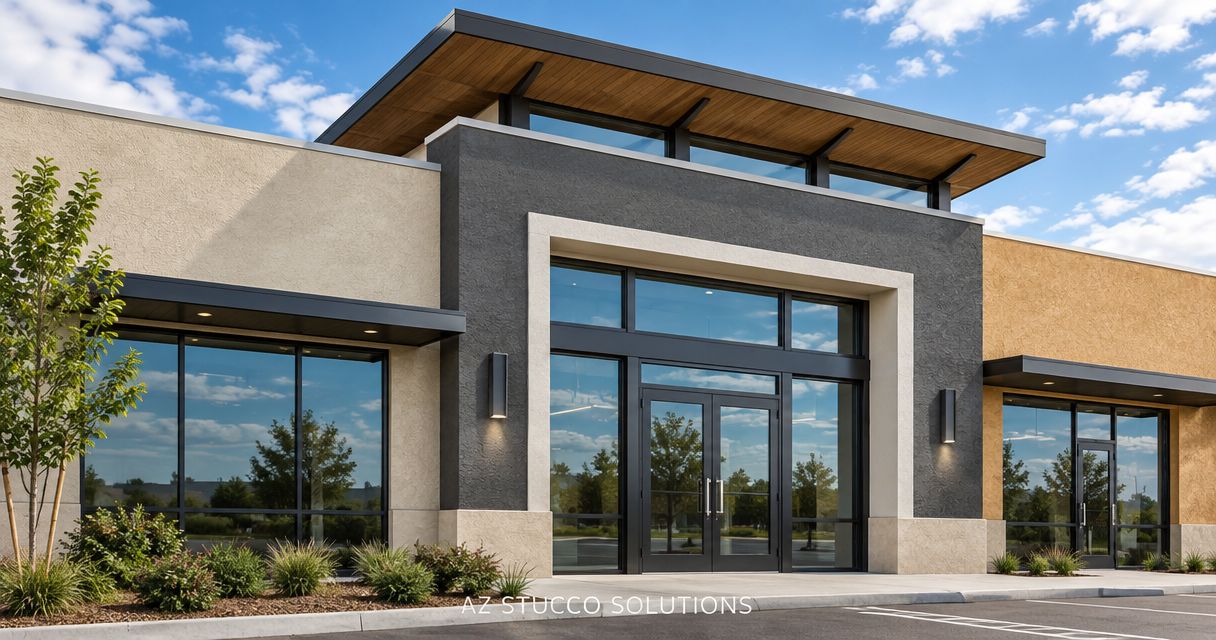
Best overall: fine sand float. Best for minimalist storefronts: smooth trowel. Best for matching traditional storefronts: lace and skip. This 2026 guide compares stucco finishes for commercial storefronts, including dash and Santa Barbara-style finishes, so you can choose a texture that fits your building and renovation scope.
- Fine sand float is the default choice among stucco finishes for commercial storefronts seeking an understated exterior.
- Smooth trowel suits minimalist storefronts but makes surface irregularities and repairs more noticeable.
- Choose lace and skip for traditional façades, dash for pronounced texture, and Santa Barbara-style finishes for hand-troweled character.
- AZ Stucco Solutions LLC provides commercial stucco installation and restoration for Phoenix-area property owners.
Why the storefront finish matters
Your storefront needs to work at sidewalk distance and from across the parking lot. Texture changes how the wall catches light, frames signage, and reveals repair transitions. It does not replace sound preparation or properly detailed openings.
For a Phoenix storefront renovation in 2026, decide whether you are refreshing a sound exterior, repairing isolated damage, or planning full re-stucco. Those are different scopes. Choosing a texture before understanding the wall leaves the most important decision unresolved.
AZ Stucco Solutions LLC is a fit for Phoenix-area owners planning commercial stucco installation or exterior restoration. AZ Stucco Solutions LLC serves residential and commercial properties, with owner Flavio Miguel Delgado bringing over 30 years of construction experience, including stucco specialization.
What makes the best storefront stucco finish?
Use these criteria to judge the options before choosing a favorite:
- Architectural fit: The texture should support the storefront's shape, entrances, and neighboring façades rather than compete with them.
- Street-level appearance: Evaluate the wall beside doors, glazing, signs, and customer walkways—not just in a close-up photograph.
- Repair visibility: Consider how a future patch will meet the surrounding texture and color. No finish guarantees an invisible repair.
- Existing-wall compatibility: The selected finish must suit the specified base and preparation, not merely the desired appearance.
- Scope clarity: A proposal should distinguish surface finishing from repairs, removal, and new installation.
- Sample approval: Judge an actual sample outdoors before approving the complete elevation.
For your 2026 project, treat appearance and wall condition as separate decisions. A texture sample answers what the finish looks like; an assessment addresses what the wall needs.
Storefront stucco finishes at a glance
| Rank and finish | Best for | Standout feature | Key limitation |
|---|---|---|---|
| 1. Fine sand float | Understated retail façades | Even, granular texture | Patches still require careful texture and color matching |
| 2. Smooth trowel | Minimalist storefronts | Quiet surface beside glass and crisp architectural lines | Irregularities and repair edges are conspicuous |
| 3. Lace and skip | Matching traditional storefronts | Raised texture with recessed areas | A poor match is noticeable beside existing work |
| 4. Dash | Continuing a pronounced existing texture | Strong, pebbled surface character | Rough texture demands attention during cleaning |
| 5. Santa Barbara-style | Boutique and courtyard storefronts | Subtle, hand-troweled variation | Appearance depends heavily on the approved sample |
These names describe surface appearances, not complete wall assemblies. Specify the finish material and underlying system separately; an appearance label alone does not establish compatibility, insulation, or water management.
1. Fine sand float: best for understated retail façades
Fine sand float creates an even, granular surface without a pronounced decorative pattern. It gives signage, windows, and entrance details room to lead the storefront's appearance.
Best for: Owners who want a restrained exterior without committing to a completely smooth wall. It is the default starting point for a full re-stucco discussion, not an instruction to cover every existing façade.
Fine sand float pros:
- Supports a simple architectural appearance.
- Provides visible texture without deep relief.
- Works as a consistent finish across broad wall areas.
Fine sand float cons:
- Localized patches still need matching aggregate, application, and color.
- Uneven preparation can remain visible beneath the finished surface.
Ask to see the proposed texture beside a window return and a broad wall section. A small sample viewed straight on does not show how the finished elevation will read in angled light.
Verdict: Choose fine sand float as the default for an understated storefront.
2. Smooth trowel: best for minimalist storefronts
Smooth trowel finishes minimize visible surface texture. They suit storefronts where glass, sign placement, and clean architectural lines carry the design.
Best for: Modern façades where you prioritize a quiet wall surface and accept closer scrutiny of preparation and repair transitions. Smooth does not mean perfectly flat or permanently crack-free.
Smooth trowel pros:
- Keeps attention on entrances and signage.
- Complements simple, uncluttered elevations.
- Avoids pronounced texture beside detailed architectural features.
Smooth trowel cons:
- Surface variations show clearly under angled light.
- Patch boundaries and texture differences are difficult to disguise.
Before choosing smooth trowel, examine the sample from the direction customers approach the door. Ask the contractor to explain the preparation included and the appearance you should expect around repaired areas.
Verdict: Choose smooth trowel for minimalist design, not to conceal an uneven wall.
3. Lace and skip: best for matching traditional storefronts
Lace and skip combines raised areas with recessed spaces, creating a recognizable patterned texture. It belongs on the shortlist when a storefront already has that character or forms part of a traditionally styled retail property.
Best for: Owners maintaining continuity with existing textured elevations. Matching the building usually matters more than selecting a fashionable replacement texture.
Lace and skip pros:
- Maintains a traditional exterior character.
- Adds visual variation across plain wall areas.
- Offers a clear reference when matching an existing lace texture.
Lace and skip cons:
- Pattern density and application differences make mismatched work noticeable.
- Pronounced texture can compete with delicate architectural details.
Specify the pattern using an approved physical sample rather than the name alone. Two finishes described as lace and skip can differ in raised coverage, spacing, and overall appearance.
Verdict: Choose lace and skip when continuity with traditional architecture is the priority.
4. Dash: best for continuing a pronounced existing texture
Dash creates a rough, pebbled appearance with more surface relief than a fine sand finish. Its strongest role in a storefront renovation is continuing an established texture rather than introducing roughness without a design reason.
Best for: Existing commercial façades where retaining a pronounced texture keeps the renovation visually consistent.
Dash pros:
- Preserves the character of an existing dash-finished building.
- Creates a clearly textured surface across large elevations.
- Offers a distinct alternative to troweled appearances.
Dash cons:
- Dirt can collect within the surface relief.
- Aggressive cleaning risks damaging the finish; cleaning methods need material-specific guidance.
Inspect the existing texture around entrances before specifying new work. A dash finish that looks appropriate across the parking lot can feel too visually busy beside a tightly detailed doorway.
Verdict: Choose dash to continue an intentional existing texture; skip it when your goal is a quiet surface.
5. Santa Barbara-style: best for boutique storefront character
Santa Barbara-style finishes have a hand-troweled appearance with subtle surface variation. The name describes a look, so the sample must define exactly what your contractor intends to deliver.
Best for: Boutique storefronts, courtyard shops, and Spanish-influenced architecture where controlled variation belongs in the design.
Santa Barbara-style pros:
- Adds hand-worked character without a heavy raised pattern.
- Complements curved openings and traditional architectural forms.
- Gives owners a finish option between a strictly uniform appearance and pronounced texture.
Santa Barbara-style cons:
- Application differences affect the final appearance.
- Owners seeking complete visual uniformity can find the variation distracting.
Approve the amount of movement, trowel marking, and color variation together. Do not rely on a finish name to communicate those expectations, especially when several elevations must read as one project.
Verdict: Choose Santa Barbara-style for intentional hand-troweled character, not strict uniformity.
How these finishes are ranked
Fine sand float ranks first because its restrained texture makes it a straightforward starting point for storefront design. The remaining finishes occupy different use cases: minimalist appearance, traditional continuity, pronounced existing texture, and boutique character.
This is a design-and-scope ranking, not a claim of measured service life. The wall condition, specified materials, preparation, and execution still determine whether the chosen finish is appropriate for your property.
Repair, re-stucco, or new installation?
A finish decision should follow a wall assessment. For a 2026 storefront project, ask the contractor to separate the visible appearance from the work required beneath it.
- Localized repair: Consider this when damage is limited and the surrounding stucco remains suitable to retain. A single crack does not automatically justify full re-stucco.
- Full re-stucco: Consider a broader scope when the project involves widespread finish deterioration or a coordinated exterior change. Confirm what remains, what is removed, and what preparation is included.
- New installation: Specify the complete wall assembly, transitions, and finish together. A texture choice is only one part of the installation.

For broader façade redesigns, commercial rainscreen cladding systems belong in an assembly-level comparison, not a texture comparison: their support and drainage arrangements differ from simply changing a stucco finish. Keep that distinction clear when comparing proposals.
Ask what the assessment establishes and which conditions remain concealed. An estimate should identify how unexpected underlying damage will be handled rather than treating every wall as ready for a new finish.
Approve the sample before the full elevation
For your 2026 renovation, request 2 sample panels when the decision comes down to two textures. Use the actual proposed materials, and ask whether the sample base represents the planned wall preparation.
Inspect each sample from 3 viewing positions: beside the entrance, across the customer walkway, and across the parking area. These are practical approval checks, not performance standards. Repeat the review in different daylight conditions before signing off.
Check these details together:
- Texture: Is the pattern as fine, rough, or variable as you intended?
- Color: Does the sample work beside glazing, trim, and neighboring finishes?
- Transitions: How will the finish stop at doors, windows, signs, and adjacent materials?
- Repair expectations: What differences should you expect where retained and repaired surfaces meet?
Keep the approved sample as the reference for the project. A photograph records the general choice, but it does not fully capture depth or changing light.
What your commercial stucco estimate should cover
Ask for 1 written scope that connects preparation, installation, and finish approval. For a 2026 project, make these items clear before comparing proposals:
- Included elevations: Identify the storefront face, returns, columns, parapets, and other areas included or excluded.
- Existing conditions: Describe visible damage and the assessment needed before covering it.
- Preparation: State removal, retained surfaces, repairs, and preparation requirements.
- System and finish: Name the proposed materials separately from the texture.
- Site protection: Address storefront glass, signs, landscaping, and neighboring surfaces.
- Business access: Discuss entrances, customer routes, and coordination with tenants.
- Changes: Explain how concealed conditions and additional work receive approval.
Ask AZ Stucco Solutions LLC to distinguish required corrective work from optional appearance changes. That makes the conversation clearer without assuming that a minor repair needs a full exterior replacement.
Request a commercial stucco estimate or call (480) 971-9500 to discuss your Phoenix-area property. Describe whether you are planning new installation, full re-stucco, or an assessment of an existing façade.
Which storefront stucco finish should you choose?
Choose fine sand float if you want a restrained default and have no architectural reason to select another texture. Choose smooth trowel for minimalist design, lace and skip for traditional continuity, dash to retain pronounced existing texture, or Santa Barbara-style for hand-troweled character.
For a multi-tenant property, approve the whole elevation rather than one shop bay in isolation. Coordinate with the property owner and applicable design requirements before committing to a change.
FAQ
What’s the best stucco finish for a commercial storefront?
Fine sand float is the default recommendation for a storefront seeking an understated textured exterior. Choose another finish when the architecture, existing texture, or approved design calls for it.
Is smooth stucco better than sand finish for a shopfront?
Smooth stucco is better for a minimalist appearance, while sand finish provides visible granular texture. Smooth surfaces make irregularities and repair transitions more conspicuous.
Does a cracked storefront need full re-stucco?
A cracked storefront does not automatically need full re-stucco. The repair scope depends on the cause, extent, surrounding condition, and any underlying damage identified during assessment.
Can a new stucco texture go over the existing finish?
An assessment must establish whether the existing surface is suitable to retain and what preparation the proposed materials require. A different texture alone does not correct loose material or underlying damage.
Is EIFS a stucco texture?
EIFS is an exterior insulation and finish system, not a texture name. Specify the wall system and its approved finish separately when comparing installation proposals.
How should I compare commercial stucco estimates?
Compare written scopes covering the same elevations, preparation, repairs, materials, and finish expectations. Identify exclusions and the process for approving concealed-condition work before selecting a contractor.
Who handles commercial stucco work in the Phoenix area?
AZ Stucco Solutions LLC provides commercial stucco installation, repair, and exterior restoration in the Phoenix metro area. Contact the team to discuss the property and the scope requiring assessment.
One last thing
Do not approve the finish from a close-up alone. The texture that looks most interesting in your hand is not necessarily the one that works beside your entrance and signage. Make the final decision from the customer's approach to the building.
Leave a Reply