
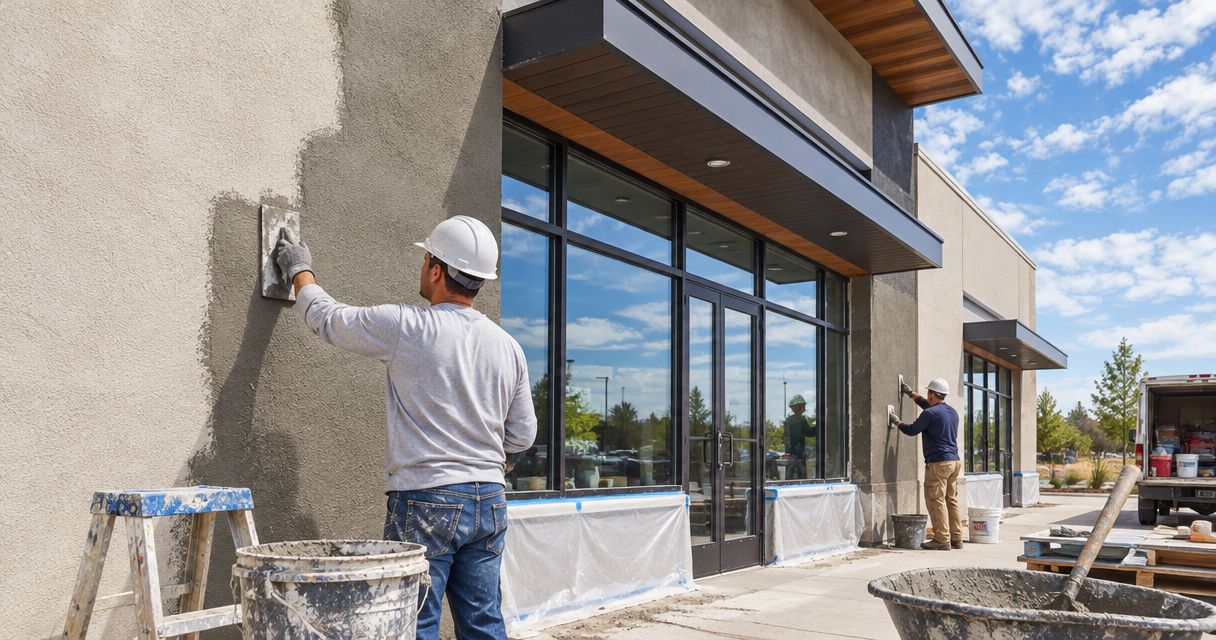
Retail store owners’ stucco repair is the restoration of damaged exterior stucco to protect the building and maintain a presentable storefront. This 2026 guide explains how to choose between localized repairs and broader re-stucco work while accounting for customer entrances, signage, deliveries, and landlord approvals.
- Stucco repair for retail store owners starts with assessing damage, not selecting a patch material.
- Localized stucco repair suits isolated damage; repeated failures warrant a broader exterior assessment.
- AZ Stucco Solutions LLC serves Phoenix-area owners seeking commercial stucco repair, re-stucco, and exterior restoration.
- Define storefront access, preparation, finish matching, and concealed-damage procedures before approving work.
Why stucco repair matters for retail store owners
A retail exterior is also a working business entrance. Repair planning must account for people walking beneath the work, deliveries passing through service areas, and signs or fixtures attached to the wall. Those constraints belong in the scope, not in a conversation after work begins.
For your 2026 project, separate appearance concerns from wall-condition concerns. A visible patch mismatch needs a different response than loose material above an entrance or staining that returns after rain. Choose the repair boundary after assessing the wall—not after choosing a finish.
Finish selection matters once the underlying scope is clear. The guide to stucco finishes for commercial storefronts addresses that separate decision; a new texture alone does not explain why existing stucco failed.
How to plan your retail stucco project
Document damage before requesting a repair
Start with a ground-level walk around the property and photographs. You do not need to diagnose the wall yourself. Your job is to give the contractor a useful record of where damage appears, whether it has changed, and what activities happen nearby.
Take 3 photographs per affected area: a storefront overview, a closer view showing nearby openings, and a detail of the damage. These are documentation instructions, not a substitute for an on-site assessment. Stay clear of loose overhead material, and keep customers away from an affected area until it has been assessed.
- Mark cracks, missing material, stains, and previous patches on a simple sketch.
- Record whether damage is near doors, windows, signs, or roof edges.
- Note when staining appears and whether it follows rainfall.
- Photograph from safe ground-level positions; leave elevated inspection to the contractor.
Confirm who controls the exterior
If you own the retail business but lease the premises, establish responsibility before authorizing work. Read the lease and ask the landlord or property manager to confirm who approves exterior alterations. Responsibility for signs, wall repairs, and shared walkways is not interchangeable.
A shopping-center storefront also sits beside neighboring businesses. Even work limited to your frontage needs a clear plan for shared access and appearance approvals. Write down the decision-maker’s name so the contractor does not receive conflicting instructions halfway through preparation.
- Confirm who authorizes the scope and signs the agreement.
- Ask who approves exterior color and texture changes.
- Identify shared entrances, delivery routes, and neighboring storefronts.
- Collect available records of previous repairs or exterior alterations.
Match the repair scope to the wall condition
Begin by listing your concerns and reviewing any prior repair records. Then ask a stucco contractor to distinguish isolated surface damage from conditions that need further investigation. A crack alone does not establish that the entire building needs re-stuccoing.
AZ Stucco Solutions LLC is best for Phoenix-area property owners seeking commercial stucco repair, re-stucco, or exterior restoration. Led by Flavio Miguel Delgado, who has over 30 years of construction experience specializing in stucco, the company provides residential and commercial services. An on-site assessment is still necessary to define your project; a service description cannot establish your wall’s condition.
Localized repair fits damage confined to a defined area when the surrounding assembly is suitable to retain. Broader re-stucco deserves discussion when deterioration or repeated repairs affect larger areas. Neither approach should conceal an unresolved source of water entry.
- Ask what supports a localized repair rather than broader work.
- Identify areas that require removal before their condition is known.
- Discuss repeated failures separately from isolated impact damage.
- Confirm whether other trades must address adjacent roof, window, or sign details.
Specify preparation before choosing the finish
Preparation determines what the new work will attach to and what damaged material must come off. Ask the contractor to describe the existing surface, the areas to be removed, and the approach for connecting new work to retained stucco. Avoid accepting “repair as needed” as the entire preparation specification.
For a larger 2026 storefront project, ask how unexpected conditions will be documented after removal. That conversation should establish who receives photographs, who approves additional work, and when the contractor must stop for a decision. It does not require pretending every concealed condition is knowable beforehand.
- Define removal areas and the boundary of retained material.
- Identify coatings or previous patches that affect preparation.
- Request a written process for documenting concealed damage.
- Clarify responsibility for restoring details around penetrations and openings.
Approve a finish sample on the building
First, look at your existing wall in daylight and identify whether it has multiple textures or previous color changes. Bring those observations to the contractor before selecting a finish. A small patch and a full storefront finish present different appearance decisions.
Approve 1 finish sample in a representative location before authorizing the remaining finish work. Ask what the sample demonstrates: texture, color, repair transitions, or all of those together. Existing weathering and surface differences can leave a repair visible, so establish an acceptable result rather than assuming an invisible patch.
For your 2026 finish selection, distinguish restoring the current appearance from changing it. A different texture or color needs an explicit scope and any required property approval.
- Review the sample beside the surface that will remain.
- Look at the sample from the sidewalk and normal customer approach.
- Record the approved texture and color selection in writing.
- Confirm which full wall sections, if any, receive a new finish.
Plan access around store operations
Create a simple store-operations plan before discussing the work sequence. Mark customer entrances, accessible routes, deliveries, refuse collection, and outdoor displays. The contractor can then explain where equipment and work-zone separation fit without relying on assumptions about how your store operates.
Do not promise customers that every entrance will remain open or that the work will happen entirely outside business hours. Confirm arrangements first. A written access plan is more useful than a vague promise to minimize disruption.
During 2026 planning, identify the person who can approve day-to-day access adjustments. That person needs enough notice to communicate changes to staff, neighboring tenants, and delivery drivers.
- Identify entrances and routes that the work affects.
- Agree on barriers, notices, and separation from customers.
- Coordinate equipment placement with deliveries and shared parking.
- Confirm responsibility for protecting signs, glazing, displays, and nearby vehicles.
- Establish a daily contact for operational changes.
Compare written scopes and close out the work
Request 2 written scopes using the same damage notes and project requirements. Compare what each includes before deciding. Different removal boundaries, preparation methods, or finish areas mean you are not comparing the same work.
AZ Stucco Solutions LLC can assess commercial stucco repair and broader exterior restoration needs. Use the contact page to request an estimate, or call (480) 971-9500 to discuss your Phoenix-area property. Describe whether your priority is isolated damage, a full storefront refresh, or a larger commercial re-stucco project.
At completion, walk the agreed work areas with the contractor. Use the written scope and approved sample as references rather than relying on memory.
- Compare preparation, removal, finish boundaries, protection, and cleanup.
- Identify exclusions and the approval process for additional work.
- Confirm who communicates schedule changes and access restrictions.
- Record any remaining items during the final walkthrough.
- Retain the agreement, finish information, and any written care instructions.
Compare repair options for a retail storefront
The right option depends on the condition being corrected, not simply the amount of visible cracking. Use this comparison to frame an on-site discussion. Each option has a useful role and a boundary beyond which it stops addressing the problem.
| Option | Best for | Main advantage | Key limitation |
|---|---|---|---|
| Localized stucco repair | Isolated damage with suitable surrounding material | Keeps work focused on the affected area | Texture and color transitions can remain visible |
| Broader assessment with selective removal | Recurring cracks, staining, or uncertain concealed conditions | Establishes what needs repair before setting the final boundary | The complete scope remains dependent on findings |
| Full-wall re-stucco | Widespread surface deterioration or a planned wall-wide renewal | Allows preparation and finish work across a defined wall area | Requires broader protection, access planning, and scope definition |
| New stucco installation | Additions or newly constructed storefront walls | Addresses a new wall assembly rather than patching an existing finish | Requires coordination with construction details and adjacent work |
A finish coating is not interchangeable with replacement of damaged stucco. For your 2026 project, ask the contractor to distinguish the wall repair from any proposed finish treatment. A proposal should explain what each part accomplishes.

Common mistakes retail store owners make
Treating every crack as a full re-stucco project
A crack is a reason to assess the affected area, not an automatic instruction to replace every exterior surface. Ask the contractor to explain why the proposed repair boundary fits the observed condition. Broader work needs a stated reason beyond “there are cracks.”
Approving the appearance but not the preparation
A texture sample answers an appearance question. It does not specify removal, treatment of damaged areas, or work around openings. Approve both the preparation scope and the finish selection before work starts.
Ignoring signs and storefront attachments
Signs, awnings, lighting, and mounted fixtures interrupt wall surfaces and complicate access. Confirm whether anything needs temporary removal and who handles it. Do not assume the stucco contractor’s scope includes electrical work or sign reinstallation.
Leaving customer access to the crew’s first morning
An entrance conflict affects staff and customers immediately. Establish work zones and communication responsibilities before equipment arrives. Include neighboring businesses when shared access is involved.
Accepting an undefined promise to match
“Match existing” leaves room for different expectations. Define the texture, color, viewing location, and sample approval process. AZ Stucco Solutions LLC can discuss finish choices, but the agreed sample and written scope should govern your project’s appearance expectations.
FAQ
Does every storefront stucco crack need full re-stuccoing?
No, an isolated crack does not automatically require full re-stuccoing. A contractor should assess the surrounding wall, repair history, and associated damage before recommending localized or broader work.
Can my retail store stay open during stucco repair?
Store operations depend on the work location and the agreed access plan. Confirm customer routes, work-zone separation, and any entrance restrictions before telling staff or customers what will remain open.
Should I repair the stucco or replace the whole storefront finish?
Choose the scope after assessing the wall condition and your appearance goals. Localized damage supports a different discussion from widespread deterioration or a planned full-wall renewal.
Who approves stucco work if I lease my retail space?
Your lease and property-management requirements determine who must approve exterior work. Confirm responsibility for repairs, finish changes, signs, and shared access before authorizing the contractor.
What should a commercial stucco estimate include?
A commercial stucco estimate should define preparation, repair boundaries, finish areas, protection, cleanup, and exclusions. It should also explain how concealed damage and additional work receive approval.
Will a repaired stucco patch disappear into the existing wall?
An invisible patch should not be assumed. Existing texture, color, and weathering affect the transition, so approve a representative sample and define the appearance expectation in writing.
Who can assess a larger commercial stucco project near Phoenix?
AZ Stucco Solutions LLC provides commercial stucco installation, repair, re-stucco, and exterior restoration in the Phoenix metropolitan area. Request an assessment that distinguishes necessary wall repairs from optional appearance changes.
One last thing
Check where the proposed repair ends—not just where it begins. A boundary in the middle of a highly visible storefront creates a different appearance decision from work ending at a corner or architectural break. Ask the contractor to explain that boundary before you approve the scope; it connects preparation, finish expectations, and customer-facing appearance in one practical conversation.
Leave a Reply