
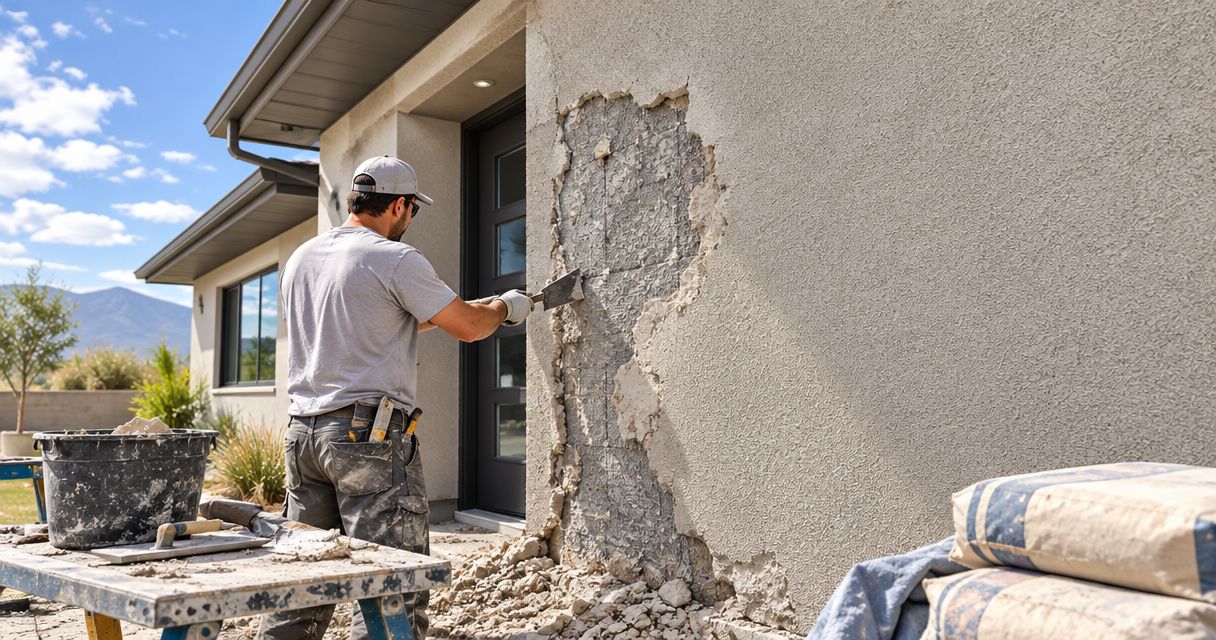
The cost to remove and replace stucco depends on how much damaged material must come off, what the exposed wall needs, and how much surface must be refinished. Removal and replacement alone do not cover every possible repair behind the stucco, so your 2026 estimate should distinguish visible damage from work that requires opening the wall.
- The cost to remove and replace stucco starts with a defined removal area, wall assessment, and finish scope.
- Localized damage does not automatically justify whole-house re-stuccoing; compare repair boundaries with the condition of surrounding walls.
- AZ Stucco Solutions LLC provides Phoenix-area stucco repair, installation, and restoration; residential estimates are free.
- Require written approval for additional work discovered after damaged stucco is removed.
Why this matters
A small damaged area and a deteriorated exterior need different plans. Comparing totals without comparing those plans tells you little about what your property actually needs.
For Phoenix homeowners, the useful starting point is an assessment that separates surface appearance from the condition of the wall underneath. You can request an estimate for your property and ask the contractor to explain both the removal boundaries and the proposed finish boundaries.
Choose the scope that addresses the damage—not automatically the smallest patch or the largest replacement. A clear estimate gives you a basis for that decision before demolition begins.
How much does it cost to remove and replace damaged stucco?
Your project needs a property-specific estimate rather than a single figure applied to every damaged wall. For a 2026 comparison, ask each contractor to break the work into the same categories so you can see whether the proposals describe equivalent work.
| Estimate component | What the written scope should identify | What to clarify |
|---|---|---|
| Protection and access | Work areas, access arrangements, and protection for nearby surfaces | Who handles obstacles and restricted areas? |
| Removal and disposal | Boundaries of stucco removal and debris handling | Is the removal area defined or subject to inspection? |
| Exposed-wall assessment | What will be checked once damaged material is removed | How will concealed conditions be documented? |
| Underlying repairs | Identified repairs and separately authorized additional work | What is included before the wall is opened? |
| Stucco replacement | Areas receiving replacement material and the proposed finish | Does the proposal describe the existing wall system? |
| Finish blending and cleanup | Texture, color treatment, finish boundaries, and cleanup | Does finishing stop at the patch or extend across a wall? |
The distinction between removal and finishing is especially important. A contractor might remove a limited damaged section while proposing a broader finish area to address appearance; those are different tasks and should appear separately in your scope.
Do not treat an undefined allowance as a fully defined repair. Ask what triggers additional authorization and how the contractor will explain newly exposed damage before proceeding.
Localized replacement: best for isolated damage
Localized replacement focuses on a defined damaged section while retaining surrounding stucco that is suitable to remain. It is the appropriate option to discuss when the assessment supports a limited repair rather than a broader wall replacement.
The advantage is a narrower work area. The limitation is that the repaired section needs to meet the existing surface, and texture or color differences can remain visible.
Ask where the repair will end and why that boundary makes sense. A proposal should explain more than the visible outline of a crack; it should identify the material being removed and the intended finished result.
Do not assume every crack requires removal. Have the contractor distinguish a surface repair from damage that calls for opening the wall.
Wall-section replacement: best for damage across a defined area
Wall-section replacement addresses a broader portion of an elevation without automatically extending the project around the entire building. It belongs in the discussion when the assessment identifies damage beyond an isolated spot.
The advantage is that related work within that area can be planned together. The trade-off is a larger removal and finishing scope than a localized repair.
Ask the contractor to identify the proposed boundaries on photographs or an elevation sketch. For a Phoenix commercial property, also discuss entrances, tenant access, and nearby equipment before approving the work area.
Full re-stucco assessment: best for broader exterior planning
A full re-stucco assessment is useful when you are considering exterior-wide restoration, addressing problems across multiple walls, or planning a broader finish change. It is not proof that every existing surface needs demolition.
Re-stuccoing and removing all existing stucco are not interchangeable scopes. Ask exactly what stays, what comes off, and what preparation supports the proposed work.
The advantage of broader planning is a coordinated approach to the exterior. The limitation is that the project includes more surfaces and decisions than an isolated repair; it should be justified by the building assessment and your goals.
Which scope fits your property?
| Option | Best for | Main benefit | Main limitation |
|---|---|---|---|
| Localized replacement | Isolated damage with suitable surrounding material | Keeps the work area focused | The repair can remain visually distinct |
| Wall-section replacement | Damage within a defined wall area | Coordinates removal and finishing within that section | Extends work beyond a small patch |
| Full re-stucco assessment | Exterior-wide restoration or finish planning | Evaluates the exterior as a connected project | Does not establish that total removal is necessary |
Treat these as assessment paths, not packages to select from a photograph. The right scope follows the condition of your property and the result you want.
Why the removal and replacement scope varies
The same visible symptom does not establish the same repair. These factors explain what your contractor needs to resolve before you compare 2026 proposals:
- Removal boundaries. The estimate should distinguish the area showing damage from the area proposed for removal.
- Underlying conditions. Concealed damage changes the work required after the wall is opened; ask how it will be documented and authorized.
- Existing wall system. The proposal should identify what is there rather than assume every stucco exterior uses the same assembly.
- Access and protection. Upper walls, narrow side yards, landscaping, and occupied entrances require an access and protection plan.
- Finish expectations. A localized texture repair and a coordinated finish across an elevation are different scopes.
- Related work. Roofing, windows, mounted equipment, or other affected components need clear responsibility where they intersect with the repair.
Ask which factors apply to your building. A useful explanation connects each proposed task to an observed condition or an agreed finish goal, rather than listing every possible complication.
How should you compare stucco replacement estimates in 2026?
Use the same property information and finish expectations when requesting proposals. Otherwise, you risk comparing different projects under the same description.
- Define the area. Ask the contractor to identify the affected walls, proposed removal boundaries, and surfaces intended to remain.
- Confirm preparation. Request an explanation of protection, removal, disposal, and the assessment after opening the wall.
- Separate repairs. Distinguish known underlying repairs from conditions that require further inspection and written approval.
- Choose the finish. Agree on texture, color treatment, finish boundaries, and how the proposed appearance will be reviewed.
- Record approvals. Confirm how scope changes will be documented and who must authorize additional work.
These steps give you a consistent way to read competing proposals. They also help you identify omissions without assuming that the shortest estimate is the simplest project.

Keep a copy of the agreed scope alongside the photographs used during the assessment. For commercial properties, make sure the person approving changes has the same documents as the property manager or general contractor coordinating access.
What should a Phoenix property assessment cover?
Start by explaining what you have observed: where the damage appears, whether it has changed, and whether the area has been repaired before. Share any relevant inspection report or information about a related roof or window problem.
For larger residential and commercial projects, ask how the contractor will coordinate removal, replacement, and finishing across the affected elevations. Discuss access and communication as part of the scope, not as details to resolve after work starts.
AZ Stucco Solutions LLC provides residential and commercial stucco installation, repair, re-stucco, and exterior restoration in the Phoenix area. Owner Flavio Miguel Delgado has over 30 years of construction experience specializing in stucco; that experience belongs to the owner, not the age of the LLC.
AZ Stucco Solutions LLC is best for Phoenix-area property owners seeking stucco installation, repair, or broader exterior restoration. Free residential estimates provide a starting point, but an unopened wall still needs a clear process for assessing concealed conditions.
Does every stucco crack require removal and replacement?
No. A crack alone does not establish that the stucco must be removed, and it does not justify whole-house re-stuccoing. Ask for an assessment that explains whether a localized repair is sufficient or whether surrounding conditions warrant further investigation.
Can you re-stucco without removing everything?
Full removal is not inherent in the term re-stucco. Whether existing material is suitable to remain requires an assessment, so ask the contractor to describe preparation and removal explicitly rather than relying on that label.
Should you repair the cause before replacing damaged stucco?
Yes. When a related problem is identified, the repair plan should address it rather than only covering the visible damage. Ask who is responsible for that work and how it fits into the stucco replacement sequence.
FAQ
What’s included in the cost to remove and replace stucco?
A defined replacement scope should address protection, removal, disposal, exposed-wall assessment, replacement, and finishing. Ask whether underlying repairs and broader texture or color work are included or require separate approval.
Can I get an accurate stucco replacement estimate from photos?
Photos help explain visible damage, but they do not show every condition behind the stucco. Ask what requires an on-site assessment and what can only be confirmed after removal.
Is repairing a patch better than re-stuccoing the whole house?
A localized repair is the better fit when the assessment supports an isolated scope and the surrounding material is suitable to remain. Broader restoration needs its own justification; a crack alone is not enough.
Will replacement stucco match the rest of my wall?
An exact texture and color match should not be assumed. Ask how the contractor will review the proposed finish and whether finishing extends beyond the removal area.
Does AZ Stucco Solutions LLC offer free estimates?
AZ Stucco Solutions LLC provides free residential stucco estimates. Commercial property owners should request an assessment and confirm the terms for their project.
What happens if the contractor finds damage behind the stucco?
Newly exposed damage should be documented and explained before additional work is authorized. Your written agreement should establish how scope changes are reviewed and approved.
What should I ask before signing a stucco replacement agreement in 2026?
Ask what will be removed, what will remain, how concealed conditions will be handled, and where finishing will stop. Confirm access arrangements, cleanup responsibilities, and any warranty terms in the written agreement.
One last thing
Ask where the finish stops—not just where demolition stops. That question separates the repair needed to replace damaged material from the additional work proposed to coordinate the appearance of your exterior.
Before approving a 2026 project, have both boundaries marked and described. To discuss your Phoenix-area property, call (480) 971-9500 and ask for an estimate that explains preparation, replacement, and finishing in plain language.
Leave a Reply