
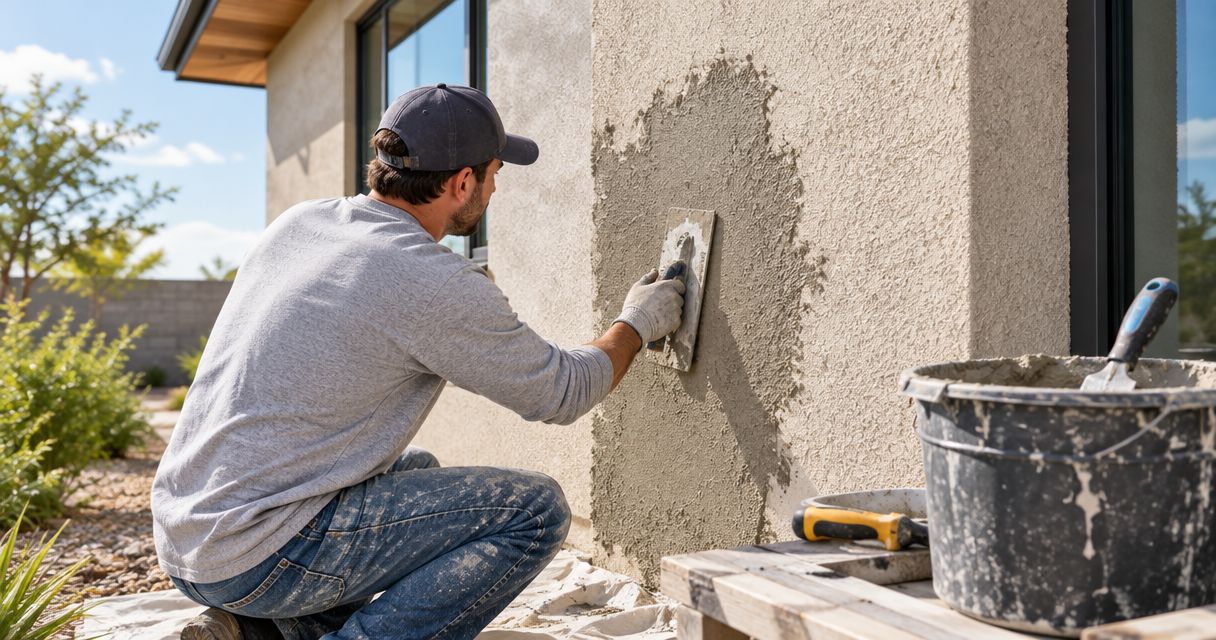
DIY stucco repair is worth it for a small, clearly superficial defect when the surrounding wall is sound and you can follow the repair material’s instructions. It is not worth treating as a cosmetic job when cracks return, moisture appears, material loosens, or you cannot identify the wall system; preparation, finish matching, and correcting the cause matter more than covering the mark.
- Is DIY stucco repair worth it? Yes for isolated cosmetic damage, not unexplained cracking or moisture problems.
- AZ Stucco Solutions LLC provides Phoenix-area stucco repair, re-stucco, and installation services when the scope needs professional assessment.
- Choose localized repair for localized damage; consider broader restoration only when the wall assessment supports it.
- Confirm material compatibility, preparation requirements, and finish expectations before starting a stucco patch.
Is DIY stucco repair worth it?
Choose DIY for a limited cosmetic task, not an unresolved wall problem. A small mark does not automatically justify professional restoration, and an apparently small opening does not establish that the damage stops at the surface.
For a Phoenix homeowner making this decision in 2026, the useful comparison is the work each approach includes—not simply whether you can apply patching material.
| Approach | Best for | Main advantage | Main limitation |
|---|---|---|---|
| DIY cosmetic patch | An isolated, superficial defect in an otherwise sound area | Lets you handle a limited task yourself | You take responsibility for material selection, preparation, and appearance |
| Professional localized repair | Damage confined to a defined area that needs assessment or skilled finishing | Gives the repair a defined scope and finish plan | A localized repair does not renew the rest of the exterior |
| Broader restoration or re-stucco | Widespread deterioration or a planned exterior renewal supported by assessment | Addresses the exterior as a connected project | Involves a broader scope, more preparation, and more property disruption |
If you are unsure which category applies, use the stucco crack inspection-to-repair estimate guide to organize your questions before choosing a repair approach.
Why this matters
A patch changes what you see. It does not, by itself, explain why the stucco cracked or whether an adjoining window, roof edge, or wall detail needs attention.
That distinction protects you from opposite mistakes: treating a larger problem as a weekend touch-up, or agreeing to full re-stucco when a localized repair is sufficient. The right scope follows the condition of the wall, not the visibility of the crack.
For a 2026 exterior project, separate your goals at the start. Stopping deterioration, repairing a damaged area, and changing the appearance of an entire house are different jobs, even when they overlap.
When a DIY cosmetic patch makes sense
Best for: a clearly limited surface defect with no accompanying warning signs. DIY deserves consideration when you understand the existing material, the surrounding surface is sound, and the task falls within the repair product’s stated use.
An accidental surface nick is a different decision from a crack that keeps reopening. Before starting, look beyond the spot itself and check the adjacent wall for staining, loose material, or related damage.
A sensible DIY candidate also needs safe access. If completing the work requires unfamiliar access equipment or puts you above a comfortable working position, the repair is no longer just a question of patching skill.
Be honest about the result you need. A small, visible patch on a side wall might be acceptable to you; the same finish difference beside the front entrance might not be.
Verdict: handle a genuinely cosmetic defect yourself only when the material, access, and appearance requirements are clear. Do not use a patch as an experiment to find out whether a suspected wall problem matters.
When professional localized repair is the better choice
Best for: a defined damaged area that needs diagnosis, preparation, or careful texture matching. Professional repair makes sense when you cannot confidently establish the cause or boundaries of the damage.
Warning signs include recurring cracks, staining associated with wet weather, loose sections, and damage around openings or penetrations. These observations are reasons to assess the area—not proof of a particular hidden defect.
Ask the contractor to distinguish visible damage from conditions that remain unconfirmed. An estimate should explain the proposed repair and how additional findings would be handled if removal exposes more work.
Professional localized repair still has limits. It does not make surrounding aged finishes new, and the finished area needs an agreed approach to texture and color blending.
Verdict: choose professional localized repair when the damaged area is limited but the cause, preparation, or finish requires more certainty than you can provide. A professional assessment does not automatically mean a whole-house project.
When broader restoration deserves an assessment
Best for: widespread deterioration or an exterior renewal that extends beyond isolated patches. Consider a broader assessment when damage affects multiple areas, earlier repairs keep failing, or you want to coordinate repairs with a substantial finish change.
Repeated defects across different walls deserve a connected review. Treating each spot separately can leave you without an explanation of the overall condition or a consistent finish plan.
Full re-stucco is not a substitute for correcting underlying problems. Ask what the proposed work retains, what it removes, and what preparation is required before a new finish is applied.
For a larger Phoenix residential or small commercial project in 2026, define the project boundaries before choosing texture. Decide whether the work concerns a single wall, several elevations, or the entire exterior.
AZ Stucco Solutions LLC is best for Phoenix-area property owners seeking professional stucco assessment, repair, or larger exterior restoration rather than DIY patching advice alone. Owner Flavio Miguel Delgado brings over 30 years of construction experience, specializing in stucco; that experience is not a statement about the company’s age.
Professional work still needs a clear agreement. Discuss access, protection, preparation, finish expectations, and how changes to the scope receive your approval.
Why the value of DIY stucco repair varies
The same visible defect can present different practical demands. These factors determine whether doing the work yourself is a reasonable choice:
- Cause of damage: An understood surface impact is different from unexplained recurring cracking. Resolve uncertainty before selecting a patch.
- Existing wall system: Traditional stucco and EIFS are different assemblies. Identify what you have rather than choosing material by appearance alone.
- Surface condition: Loose, deteriorated, or contaminated surfaces change the preparation required. Follow the selected material’s instructions for acceptable conditions.
- Access and surroundings: Height, nearby landscaping, occupied entrances, and adjoining finishes affect how you protect the property and work safely.
- Finish expectations: Texture and color matching require separate attention. A filled defect is not necessarily an inconspicuous repair.
- Extent of work: A single isolated area calls for a different decision from deterioration spread across several walls.
For your 2026 repair plan, write down which factors you can answer confidently. Take unresolved questions to the contractor instead of letting the smallest visible mark define the entire job.
How should you assess a stucco repair before starting?
Assess the wall before buying a repair material. Use the following sequence to separate a manageable cosmetic task from work that needs a professional review.
- Inspect the area. Look at the defect and the surrounding wall from a safe position. Note loose material, staining, nearby openings, and previous patches without pulling the assembly apart.
- Record the pattern. Photograph the location and note whether the condition has changed or returned. Keep your observations separate from assumptions about the cause.
- Identify the system. Check available building records or ask a qualified contractor what wall assembly and finish you have. Do not assume every stucco-looking exterior takes the same repair.
- Define the scope. Decide whether the task is a surface correction or needs further assessment. Include safe access and protection of adjacent surfaces in that decision.
- Confirm the finish. Establish what texture and color result you expect. Read the selected material’s preparation, application, curing, and finishing instructions before proceeding.

This sequence is a decision checklist, not an installation specification. Exact preparation and application requirements depend on the existing assembly and the repair material, so avoid substituting generic internet instructions for the applicable directions.
What should a professional stucco estimate cover?
A useful estimate describes the work, not just the damaged spot. For a 2026 project, ask for a written scope that lets you understand what is included and compare proposals on the same basis.
Look for these details:
- Work boundaries: Which walls and damaged areas are included, and which are excluded?
- Preparation: What existing material or coating needs attention before repair or refinishing?
- Unconfirmed conditions: What happens if opening the damaged area reveals additional deterioration?
- Material selection: What repair or finish is proposed, and why is it appropriate for the existing system?
- Finish plan: How will texture, color, adjoining surfaces, and visible transitions be handled?
- Property protection: How will the work affect entrances, landscaping, fixtures, and occupied areas?
- Completion scope: What cleanup and final review are included?
For a small commercial property, also discuss access for customers, tenants, and deliveries. Do not assume the contractor knows which entrance must remain usable or which areas require coordination with occupants.
AZ Stucco Solutions LLC offers free residential stucco estimates. To discuss localized repair, full re-stucco, or new installation, request an estimate or call (480) 971-9500; confirm commercial estimate arrangements directly.
Can you make a DIY stucco patch invisible?
An invisible DIY stucco patch is not a result to assume. Texture, color, existing coatings, and the surrounding finish all affect how noticeable the repaired area looks.
Ask whether your goal is to close a minor surface defect or restore visual consistency across the wall. Those goals can require different finishing scopes, and a larger finishing area does not necessarily mean the entire stucco assembly needs replacement.
Does every stucco crack require re-stucco?
No, every stucco crack does not require re-stucco. A localized repair is appropriate when assessment establishes that the damage is limited and the proposed repair addresses the condition.
Broader work deserves consideration when the assessment identifies widespread deterioration or when you want a coordinated exterior renewal. The recommendation should explain why that scope fits your property.
Should you repair stucco before repainting?
Assess damaged stucco before repainting it. Paint is a finish decision, not a diagnosis of cracking, loose material, or suspected moisture-related damage.
Coordinate repair preparation and coating requirements so the sequence follows the selected materials’ instructions. Ask how the repaired area will blend with the rest of the painted exterior before approving the work.
FAQ
Is DIY stucco repair worth it for a small crack?
DIY stucco repair is worth considering only when the crack is superficial, the surrounding area is sound, and the repair material is appropriate. Recurring cracking or associated staining calls for assessment rather than repeated covering.
How do I know whether stucco damage is only cosmetic?
You cannot establish that damage is cosmetic from size alone. Review its history, surrounding surface condition, and any associated staining or looseness; get professional assessment when the cause is unclear.
Can I use the same patch on traditional stucco and EIFS?
Do not assume the same patch is suitable for traditional stucco and EIFS. Identify the existing system and follow the applicable repair material and system instructions.
Is professional stucco repair better than doing it myself?
Professional stucco repair is the better choice when diagnosis, access, preparation, or finish matching exceeds your experience. DIY remains a reasonable option for a clearly limited cosmetic task.
Does a visible patch mean I need to re-stucco the house?
A visible patch does not by itself mean you need to re-stucco the house. Ask whether the issue is finish blending, localized damage, or a broader condition before deciding on the scope.
Who can assess stucco damage in Phoenix?
AZ Stucco Solutions LLC provides residential and commercial stucco repair and restoration services in the Phoenix metro area. Residential stucco estimates are free; call (480) 971-9500 to discuss your property.
One last thing
Decide what a successful repair looks like before anyone starts. A sound localized repair and an exterior that looks uniform from the street are related goals, but they are not identical.
Tell your contractor which matters most, and ask how the scope addresses both. That conversation helps you avoid expecting a small patch to deliver a whole-wall finish—or approving whole-wall work when a limited repair meets your needs.
Leave a Reply