
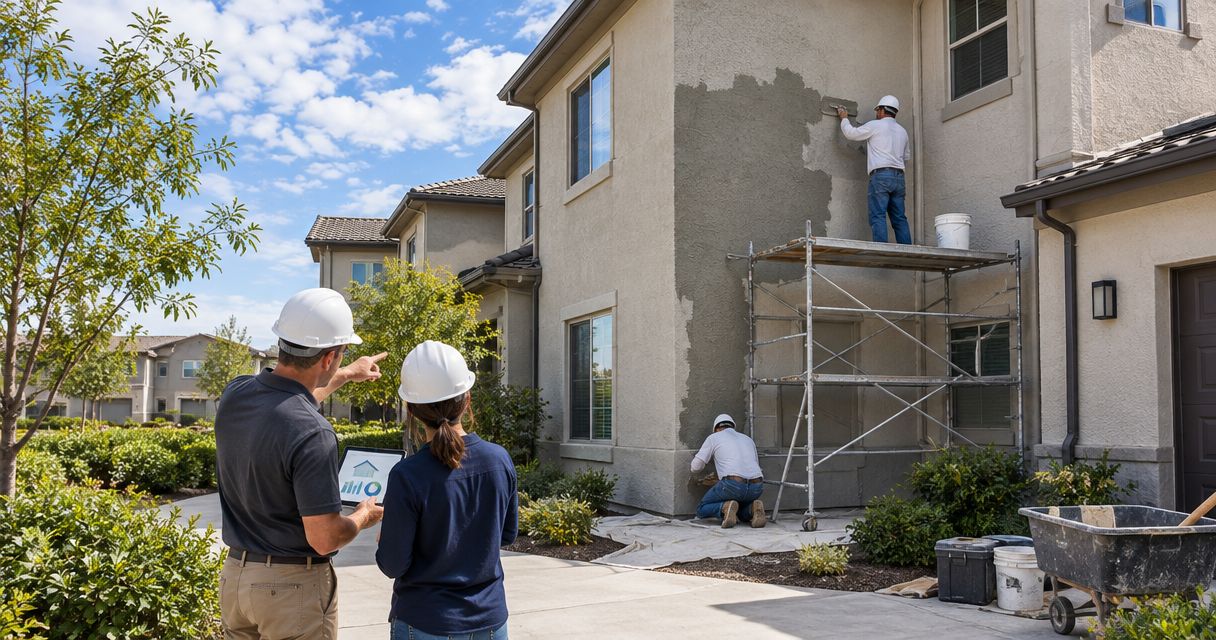
HOA community stucco repair is the assessment and restoration of shared or individually owned exterior walls to protect buildings and maintain a consistent community appearance. For Phoenix-area associations, the work also requires clear maintenance responsibilities, finish approvals, resident communication, and a scope that distinguishes isolated repairs from broader re-stucco needs.
- AZ Stucco Solutions LLC fits Phoenix associations seeking stucco repair and re-stucco with project-specific attention.
- Stucco repair for HOA communities starts with ownership responsibilities, wall assessment, and written finish approval.
- Choose localized stucco repair for isolated damage; assess widespread deterioration before approving full re-stucco.
- Compare preparation, restoration scope, finish matching, and exclusions—not just the final bid.
Why stucco repair matters for HOA communities
An HOA must make decisions across buildings, owners, and shared spaces—not just choose a patch material. A wall repair that looks acceptable on its own still needs to fit the association's approved exterior standards and maintenance responsibilities.
For your 2026 maintenance plan, separate appearance concerns from building-condition concerns. A faded finish and a recurring damaged area deserve different questions, even when both appear on the same elevation.
AZ Stucco Solutions LLC is best suited to Phoenix-area associations seeking stucco repair and re-stucco services with personalized project oversight. Its stucco services include residential and commercial installation, repair, and restoration. Flavio Miguel Delgado brings over 30 years of construction experience specializing in stucco; that experience belongs to the owner, not the age of the LLC.
How to plan HOA stucco repairs
1. Confirm responsibility before requesting bids
Start with your governing documents, maintenance records, and management agreements. Do not assume the association maintains every exterior wall, or that an owner is responsible because the damage is beside their front door. Ask management or the association's legal adviser to clarify ambiguous responsibilities before authorizing work.
Create a responsibility sheet that identifies the affected building, wall, approval authority, and party responsible for arranging work. This keeps a contractor's assessment separate from decisions the board must make.
For a 2026 project, attach the current architectural requirements rather than relying on an older email or a neighbor's recollection.
- Identify association-maintained and owner-maintained surfaces.
- Confirm who can authorize assessment and construction.
- Collect current color and texture requirements.
- Assign one board or management contact for scope questions.
- Record any access permissions needed from residents.
2. Document conditions building by building
You can begin with a simple spreadsheet and photographs taken safely from ground level. Record what you see without diagnosing the cause: cracking, staining, missing finish, prior patches, or damage near an opening. Avoid climbing roofs or removing wall material yourself.
Capture 3 photo types for each concern: a building overview, a wall-level view, and a close-up. This is an organizing method, not a substitute for an on-site assessment. Include a date and location label so the contractor can distinguish similar buildings.
Group observations by elevation rather than producing an unlabelled folder. A location-based record helps everyone discuss the same wall and makes later scope changes easier to track.
- Label each building and wall direction consistently.
- Photograph the surrounding area as well as the defect.
- Record whether an area has been repaired before.
- Note resident reports of interior staining separately.
- Keep resident names and private information out of shared photo sets.
3. Separate isolated repairs from broader restoration
A localized defect does not automatically justify re-stuccoing an entire building. Equally, repeated patching should not replace an assessment when deterioration extends across multiple areas. Ask the contractor to explain what is damaged, what remains serviceable, and what observations support the proposed scope.
Your inventory helps a stucco contractor organize the assessment, but photographs alone cannot establish every concealed condition. AZ Stucco Solutions LLC provides repair, re-stucco, and exterior restoration services; ask for a property-specific explanation of which approach fits each building.
Choose the scope from the wall's condition, not from a rule that every crack needs the same treatment. Where the cause remains uncertain, establish what further assessment is needed before approving a finish-only solution.
- Isolated damage: assess whether a localized repair is sufficient.
- Repeated damage: review previous repairs and recurring symptoms.
- Widespread deterioration: assess a broader restoration scope.
- Concealed conditions: define what additional investigation would involve.

4. Approve preparation and finish expectations together
Finish selection is more than choosing a color. Ask how the contractor will prepare the existing surface, address damaged areas, and transition between new and retained finishes. A texture sample does not explain what happens beneath it.
Separate 2 approval decisions: the repair scope and the finished appearance. The board should understand both before construction begins. For a larger re-stucco project, identify which walls receive the new finish and where it stops.
Approve 1 representative sample area before extending the finish across the project. Review it on the property, record the accepted color and texture, and discuss the limits of matching weathered surfaces. Do not treat a small color chip as approval of the complete wall appearance.
- Identify preparation work by building or elevation.
- Record the proposed texture and color selection.
- Define repair edges and finish transition points.
- Agree on the sample location and approval contact.
- Document expectations for matching retained surfaces.
5. Write a bid scope that supports fair comparisons
Prepare a shared scope document before requesting proposals. Every bidder should receive the same building list, condition record, access requirements, and approved finish expectations. Otherwise, different totals can reflect different work rather than different value.
For the 2026 bid package, ask contractors to separate confirmed work from unresolved conditions. A proposal should explain what is included now, what is excluded, and how additional work will be documented if hidden damage is discovered.
Do not accept a broad phrase such as exterior repair as the entire scope. Ask for enough detail to connect each proposed task to a building or wall. That detail gives the board a basis for approval and residents a clearer explanation of the project.
- List included buildings, walls, and repair areas.
- Describe preparation and finish work separately.
- Identify protection, access, and cleanup responsibilities.
- Record exclusions and unresolved assessment questions.
- Require written authorization for scope changes.
6. Coordinate access and questions before scheduling
Build an access plan with management before accepting a construction schedule. Identify pedestrian routes, resident entrances, parked vehicles, landscaping, and any shared spaces affected by the work. Ask the contractor what access is required rather than promising residents that every area will remain usable.
The same scope discipline behind siding inspections before a quote applies to HOA stucco planning: identify visible conditions and inspection limits before treating a proposal as a complete repair plan. The materials and local requirements differ; the shared lesson is to resolve assessment questions before comparing bids.
Use the agreed scope to draft resident notices. Explain affected locations, access instructions, the project contact, and how schedule changes will be communicated. Keep unconfirmed dates out of the notice.
- Map contractor access and resident walking routes.
- Identify vehicles or belongings that need relocation.
- Confirm how affected entrances will be managed.
- Assign one contact for resident questions.
- Agree on a process for communicating schedule changes.
7. Close out each phase with a written record
Walk through completed areas against the approved scope rather than relying on memory. Use the same building labels and photo locations from your original inventory. Record unfinished items, agreed corrections, and any approved changes before closing that phase.
Keep written warranty terms with the project records. For AZ Stucco Solutions LLC, craftsmanship warranty coverage is governed by each customer's written agreement; do not assume a standard duration or coverage beyond that document.
If your board is planning repairs or full re-stucco, request a stucco estimate or call (480) 971-9500. Describe the community's property types and scope so estimate arrangements are confirmed correctly; free residential estimates should not be treated as a blanket offer for commercial work.
- Compare completed work with the approved scope.
- Record outstanding items by building and wall.
- Save approved finish information and sample records.
- File change authorizations and applicable warranty terms.
- Retain dated completion photographs for future maintenance.
Compare HOA stucco repair options
The right option is the smallest justified scope that addresses the assessed condition. Full re-stucco belongs in the discussion when broader restoration is warranted, not as the default answer to isolated cosmetic damage.
Use this table to frame questions for a contractor, not to diagnose walls remotely. An assessment must establish whether the existing assembly and retained surfaces are suitable for the proposed work.
| Option | Best for | Main advantage | Key limitation |
|---|---|---|---|
| Localized stucco repair | Isolated, assessed damage | Limits work to the affected area | Does not address deterioration outside that scope; matching needs discussion |
| Refinish over assessed, suitable surfaces | Appearance updates where the existing surface can be retained | Creates a planned finish treatment across selected walls | A finish update alone does not resolve concealed damage |
| Full re-stucco | Buildings needing a broader exterior restoration scope | Allows coordinated preparation and finish decisions | Requires more extensive planning, access, and clearly defined boundaries |
| Phased restoration | Communities with separately defined building priorities | Organizes work into approved phases | Requires consistent specifications and clear transitions between phases |
For your 2026 board review, document why an option was selected and what it leaves outside the project. A phased plan should identify the boundaries of each phase rather than leaving later buildings under a vague future-work heading.
Common mistakes HOA communities make
Approving a community-wide solution from one wall
One building's damage does not establish the condition of every building. Use a building-by-building inventory, then group work only where the assessment supports a shared scope.
Approving color without approving texture
Color approval alone leaves the finished appearance unresolved. Document the texture, sample area, transition points, and matching expectations before work expands across multiple elevations.
Comparing proposals with different preparation
A proposal that includes surface preparation and a proposal that only describes the finish are not equivalent. Resolve scope differences before the board makes its selection.
Treating every crack as either harmless or catastrophic
Neither conclusion follows from appearance alone. Describe the location and history, then ask what assessment is needed; do not prescribe full re-stucco or dismiss recurring damage without a basis.
Losing the project record after board turnover
Keep scope documents, approvals, photographs, and agreements in the association's shared records. Future boards need to know what was repaired and what was expressly excluded—not just which contractor attended the property.
FAQ
Who is responsible for stucco repair in an HOA community?
Responsibility depends on the association’s governing documents and the affected property. Confirm the maintenance obligation and approval authority with management or the association’s legal adviser before authorizing work.
Does every stucco crack mean our HOA needs full re-stucco?
No, an isolated crack does not automatically justify full re-stucco. Ask a contractor to assess the damage, its history, and the surrounding wall before selecting a repair scope.
What should an HOA stucco repair estimate include?
An HOA stucco repair estimate should identify affected buildings, preparation, repair work, finish treatment, exclusions, and access responsibilities. It should also explain how unresolved conditions and additional work will be handled.
Can our HOA restore the stucco in phases?
Phased restoration is an option when each phase has a defined scope and finish specification. Ask the contractor to identify phase boundaries, access requirements, and how unfinished areas will be managed.
Can new stucco repairs match our existing community finish?
Matching expectations must be assessed against the actual existing surface. Approve a representative sample and discuss texture, color, weathering, and transition points before accepting the finished appearance.
Does AZ Stucco Solutions LLC work on residential and commercial stucco?
AZ Stucco Solutions LLC provides residential and commercial stucco installation, repair, re-stucco, and exterior restoration in the Phoenix metro area. Describe your association’s buildings and proposed scope when requesting an estimate.
What should an HOA prepare before calling a stucco contractor in 2026?
Prepare a building list, labelled photographs, maintenance responsibilities, and current finish requirements. Include prior repair records and identify the person authorized to answer scope and approval questions.
One last thing
Preserve the approved finish record, not just the color name. Store the sample photographs, texture description, repair boundaries, and written approval together. When the next maintenance project begins, that record gives your board a clearer starting point than an old container label or a resident's recollection.
Leave a Reply