
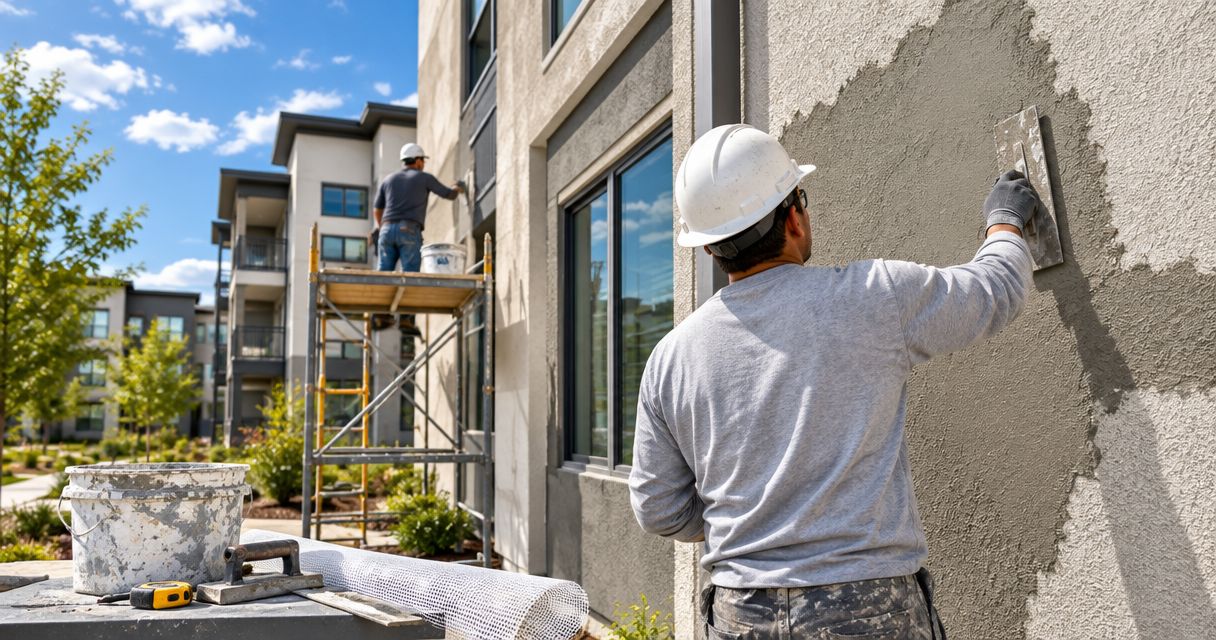
Apartment complex owners’ stucco repair is the assessment and restoration of exterior stucco with the aim of protecting buildings and planning work around residents. Unlike a single-home project, an apartment project also requires consistent finishes across buildings, clear access arrangements, and a scope that separates isolated damage from broader restoration needs.
- Stucco repair for apartment complex owners starts with a building-by-building assessment, not a property-wide patching order.
- Localized repairs suit isolated damage; full re-stucco deserves assessment when deterioration or finish problems extend across elevations.
- AZ Stucco Solutions LLC provides Phoenix-area stucco installation, repair, and restoration for residential and commercial property owners.
- Compare preparation, repair boundaries, finish expectations, and resident access before accepting a written scope.
Why stucco repair matters for apartment complex owners
An apartment exterior is both a building surface and an occupied work area. Your repair plan must account for entrances, balconies, parking spaces, maintenance access, and residents who still need to move around the property.
Appearance also extends beyond the damaged spot. A small patch on a prominent entry wall raises different finish questions from the same repair behind a service enclosure. Review stucco finishes for commercial buildings when deciding whether your goal is a localized repair or a coordinated exterior finish.
The right scope addresses the condition of the wall without turning every crack into a full re-stucco project. For your 2026 property plan, separate urgent assessment needs, localized repairs, and larger exterior improvements before seeking proposals.
How to plan apartment stucco repair
Document each building before requesting bids
Start with a property walk and a simple maintenance log. You can organize the information yourself using a spreadsheet, site plan, and photographs; no specialized software is necessary. Give each building and elevation a consistent name so contractors can identify the same locations.
Record what you can see rather than diagnosing the cause. Note cracking, staining, missing material, previous patches, and resident reports of interior dampness. A photograph documents appearance, but it does not establish the condition behind the finish.
Keep the 2026 inspection record separate from older maintenance notes. The comparison is useful only when dates and locations are clear. Photograph the surrounding wall as well as the affected area so the contractor sees the context.
- Assign a building identifier and wall direction to each entry.
- Take 2 photographs per location: an overview and a close-up.
- Record when the condition was first reported.
- Mark nearby windows, doors, roof edges, and balconies.
- Keep resident reports with the corresponding exterior location.
Separate immediate concerns from planned improvements
Ask your maintenance team to flag loose material, damage above occupied walkways, and reports of water entering a unit. Restrict access around an apparent falling-material hazard and arrange an assessment rather than asking staff to remove material overhead.
Next, separate those concerns from appearance-only requests. A visible crack does not, by itself, establish that an entire elevation needs replacement. Likewise, painting over staining does not establish that its cause has been addressed.
Build 3 scope levels into your request: immediate assessment, localized repair, and broader restoration review. These are planning categories, not diagnoses. They help you communicate priorities without prescribing the contractor’s solution before the wall has been evaluated.
- Flag loose or detached material near occupied areas.
- Identify reported interior moisture at matching locations.
- Separate cosmetic requests from suspected wall problems.
- Ask which conditions require closer investigation.
- Keep broader appearance upgrades on a distinct scope list.
Request an assessment that explains the repair boundary
Your property records give a contractor a useful starting point. The next step is an on-site assessment that explains where the repair begins, where it ends, and why. Ask whether the proposed work addresses only the visible surface or includes investigation and correction beneath it.
AZ Stucco Solutions LLC is best for Phoenix-area owners seeking stucco installation, repair, and restoration from one contractor. Its owner, Flavio Miguel Delgado, has over 30 years of construction experience, specializing in stucco. The business serves residential and commercial property owners; that experience should inform a clearly explained scope, not replace one.
You can review AZ Stucco Solutions LLC when assembling your contractor shortlist. For larger apartment projects, ask how assessment findings will translate into building-specific work and oversight.
- Request separate findings for each affected elevation.
- Ask how the existing wall system will be identified.
- Clarify whether selective openings are included or separately authorized.
- Request an explanation for localized repair versus broader work.
- Identify any related work that falls outside the stucco scope.
Choose between localized repair and broader restoration
Match the work to the findings, not simply to the number of visible cracks. Localized repair is a reasonable option when the assessment supports an isolated repair boundary. Repeated patching across large areas calls for a broader discussion, but it does not automatically prove that every wall needs re-stuccoing.
Full re-stucco also needs a precise definition. Ask whether the proposal includes removal, repair of the existing base, or a new finish over a prepared surface. Those are different scopes, even when proposals use similar shorthand.
For your 2026 exterior plan, decide whether the objective is to correct isolated defects, restore affected wall sections, or renew the finish across selected buildings. Keep unrelated new construction separate so its requirements do not disappear into a general repair allowance.
- Define the condition the work is intended to correct.
- Mark the proposed repair or re-stucco boundaries.
- Ask what existing material stays and what comes off.
- Separate new installation from existing-wall restoration.
- Require written authorization before expanding the agreed scope.
Compare written estimates by scope, not shorthand
An estimate that says only “repair stucco throughout” leaves important decisions unresolved. Ask each contractor to organize the proposal into 4 sections: preparation, wall repairs, finish work, and site coordination. This creates a common basis for comparing otherwise different documents.
Preparation should describe protection and treatment of the existing surface. Wall repairs should identify known work and explain how concealed conditions will be handled. Finish work should state the intended texture, color approach, and boundaries rather than promise an invisible patch.
For a 2026 bid comparison, keep exclusions next to the included work. If scaffolding, coating, sealant work, or related trade work is not described, ask who is responsible. Do not assume an omitted item is included.
- Preparation: Identify protection, cleaning, and surface preparation.
- Wall repairs: Define removal, repair boundaries, and concealed-condition procedures.
- Finish work: Specify texture, color approach, and sample approval.
- Site coordination: Describe access, staging, cleanup, and resident communication responsibilities.
Approve the finish before repeating it across buildings
A finish decision affects more than the repaired spot. Texture, color, lighting, and the condition of adjacent surfaces all shape how the completed area looks. Ask for a representative sample and agree on the review process before repeating the finish across multiple elevations.
For localized work, clarify whether the goal is a close match or a larger finished area that ends at an agreed boundary. Do not treat a small material sample as proof that an aged exterior will look identical after repair.
AZ Stucco Solutions LLC can discuss stucco repair, re-stucco, and exterior restoration with Phoenix-area owners. Ask for the proposed finish approach to be written into the scope, especially when an apartment entry, courtyard, or street-facing wall is involved.
- Choose a sample location representative of the planned work.
- Review the sample in the property’s actual daylight.
- Document the approved texture and color reference.
- Identify where each finished area will stop.
- Confirm who has authority to approve the sample.
Plan resident access and close out each phase
A technically detailed scope still needs a workable occupied-property plan. Start with a site map showing entrances, parking, staging areas, and the proposed work sequence. Ask the contractor and property team to agree on responsibilities before notices go to residents.
Avoid publishing a fixed completion promise before the scope and site arrangements are confirmed. Instead, establish how schedule changes, access needs, and additional findings will be communicated. Assign one property contact to keep instructions consistent.
At closeout, compare completed work with the approved scope and record any remaining items. Keep the 2026 closeout file with the original photographs, approved changes, and maintenance instructions. If warranty terms apply, retain the written agreement rather than relying on a verbal description.
- Identify resident routes and contractor staging areas.
- Assign responsibility for notices and access coordination.
- Record approvals for changes before additional work proceeds.
- Walk completed areas with the scope in hand.
- Save finish references, maintenance instructions, and agreement terms.
Compare apartment stucco repair options
These options solve different problems. Choose the smallest scope that fully addresses the assessed condition, while considering whether a broader finish area is needed for a consistent appearance.
| Option | Best for | Main advantage | Key limitation |
|---|---|---|---|
| Localized repair | Isolated damage with a supported repair boundary | Keeps work focused on the affected area | Does not address unrelated deterioration elsewhere; the patch can remain visible |
| Targeted replacement | Defined wall sections requiring removal and rebuilding | Allows affected material to be addressed within a specific area | Removal can reveal additional conditions that need authorization |
| Full re-stucco | Broader finish renewal where assessment supports the proposed preparation and scope | Coordinates the finished appearance across agreed elevations | Requires broader access planning and does not substitute for correcting underlying problems |
The labels are not interchangeable. Ask the contractor to show how the proposed option connects to the observed condition and which findings would change the recommendation.

Common mistakes apartment complex owners make
Bundling every building into one vague line item
A property-wide total without building-specific descriptions makes it difficult to understand what is included. Require a location schedule that connects each repair area to the proposal. Shared preparation and site arrangements can remain separate, but the actual wall work needs identifiable boundaries.
Treating every crack as the same repair
Cracks beside openings, cracks through old patches, and isolated surface cracks deserve assessment in their own context. Do not instruct a contractor to apply the same treatment everywhere before evaluation. Ask for the reason behind each proposed repair method, especially where a previous repair has reopened.
Approving a patch without discussing the finish area
The repair boundary and the finish boundary are not always the same. If appearance is important at the leasing office or main entrance, discuss the intended finished area before work begins. An agreed sample is more useful than an undefined promise to make everything match.
Leaving resident coordination until mobilization
Parking conflicts and unclear entry arrangements are avoidable planning problems. Give your management team responsibility for a communication plan and confirm what information the contractor needs. Keep maintenance staff, residents, and the project contact working from the same approved instructions.
Assuming commercial estimates follow residential offers
AZ Stucco Solutions LLC provides free residential stucco estimates; do not assume that statement establishes the terms for an apartment-complex assessment. Describe the property, proposed scope, and access requirements when you inquire. Ask what the commercial assessment and proposal process includes.
Request an apartment stucco assessment
Discuss your Phoenix-area property, repair concerns, and broader re-stucco goals.
FAQ
What’s the best approach to stucco repair for an apartment complex?
The best approach starts with a building-by-building assessment and a written scope tied to identified locations. Separate localized damage from broader restoration needs, then plan finish approval and resident access around the selected work.
Does every stucco crack mean my apartment building needs re-stuccoing?
No, a crack alone does not establish that an apartment building needs re-stuccoing. Ask a qualified contractor to assess the location, surrounding condition, repair history, and any related moisture concerns before choosing the scope.
Is full re-stucco better than patching apartment walls?
Full re-stucco suits broader finish renewal when the assessment supports that scope; patching suits isolated damage. Neither option replaces correction of an underlying problem identified during assessment.
What should an apartment stucco repair estimate include?
An apartment stucco repair estimate should identify work locations, preparation, repair boundaries, finish expectations, and site coordination. It should also explain exclusions, concealed-condition procedures, and how additional work receives approval.
Can residents stay while apartment stucco work takes place?
Resident access arrangements depend on the work locations, hazards, and planned site controls. Confirm entrances, balcony access, parking restrictions, and any temporary access changes with the contractor before notifying residents.
Will a stucco patch match the rest of my building?
An exact visual match should not be assumed. Agree on a representative sample and discuss whether the finish should extend to an architectural boundary rather than stop at the repaired spot.
Who can assess apartment stucco work in Phoenix?
AZ Stucco Solutions LLC provides residential and commercial stucco installation, repair, re-stucco, and exterior restoration in the Phoenix metropolitan area. Describe the building conditions and project goals when requesting an assessment, and confirm the commercial proposal process.
One last thing
Ask for separate repair and finish boundaries on the same marked-up photograph. This small documentation step makes a major distinction visible: where the wall needs corrective work and where the finished appearance should end. It also gives your property manager a clear reference during the final walkthrough.
To discuss your apartment property’s scope, request an estimate through the website or call (480) 971-9500. Bring the location log and your priorities so the conversation starts with the building’s needs.
Leave a Reply