
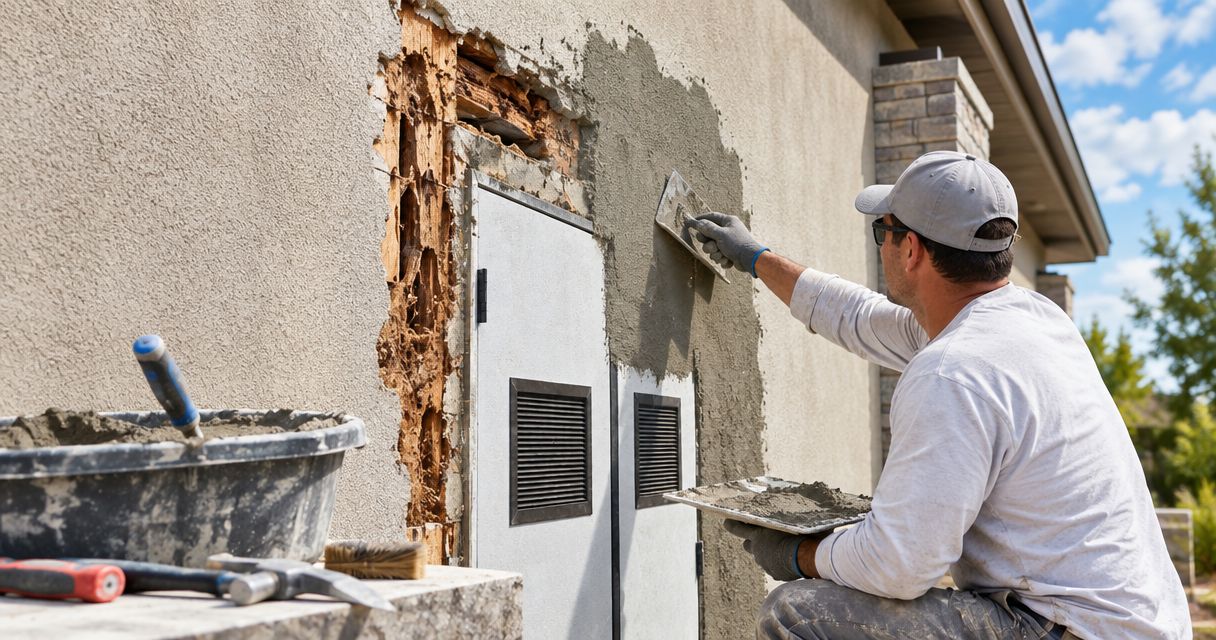
Instead of arranging termite treatment, carpentry, and stucco patching separately, use a coordinated termite damage to stucco repair workflow: document the damage, address termite activity, restore damaged wall components, and then rebuild the exterior finish. For your Phoenix property, the critical rule is simple: do not cover the wall until the underlying damage and required treatment have been addressed.
- Termite damage to stucco repair requires pest assessment, damaged-wood evaluation, wall restoration, and finish work in that order.
- Termites damage wood behind stucco; repairing the exterior surface alone does not resolve an infestation.
- AZ Stucco Solutions LLC handles stucco repair and exterior restoration for Phoenix-area residential and commercial properties.
- Choose localized repair when damage is contained; consider broader restoration when inspection establishes a larger affected area.
Why this matters
Termites consume cellulose-containing materials, including wood, rather than the cement-based stucco finish itself. An exterior blemish does not show you the full condition of the framing, sheathing, or other concealed components behind it.
For a 2026 repair project, separate pest control from wall restoration in your scope. Termite treatment addresses the pest problem; it does not replace damaged wood or restore the exterior wall assembly.
AZ Stucco Solutions LLC is best for Phoenix-area property owners seeking stucco repair and exterior restoration within a coordinated termite-damage project. Owner Flavio Miguel Delgado brings over 30 years of construction experience, specializing in stucco, to the team's residential and commercial work. Pest treatment and structural evaluation remain separate responsibilities that your project needs to assign explicitly.
Before you start
- Arrange the right assessments. Have a pest-management professional evaluate suspected termite activity. Involve a qualified building professional when damaged framing, movement, or structural concerns are identified.
- Gather the project materials. Collect inspection findings, treatment records, existing wall information, and property-access requirements. For HOA or managed properties, confirm exterior finish approval requirements before selecting a replacement appearance.
- Resolve the access gotcha. Termite inspection or treatment can require access behind the finish. Agree on who authorizes openings, who protects exposed areas, and who confirms readiness before the stucco contractor closes them.
Do not scrape away suspected termite evidence just to tidy the wall before inspection. Photograph it and ask the pest professional what needs to remain undisturbed.
Inspection records and repair boundaries
Establish the damage record
- Photograph the full elevation, the affected wall area, and the visible detail. These 3 photo views connect close-up evidence to its location without relying on memory.
- Mark each affected location on a simple wall sketch. Use descriptions such as north garage wall or patio door corner rather than a private address on shared photographs.
- Ask the pest professional to document findings and recommended treatment. Distinguish observed activity from old damage and areas that remain inaccessible.
- Have the building professional identify where further investigation is needed. Do not treat the visible edge of a stain, crack, or mud tube as the confirmed damage boundary.
Expected result: You have a location-based record that separates confirmed findings from areas still requiring inspection. Your contractors can discuss the same wall sections without guessing.
Define responsibility before opening the wall
- Assign pest treatment, selective opening, wood repair, weather protection, and stucco restoration to named parties.
- Put a concealed-damage approval process in writing. Identify who receives photographs and who approves additional work if opening the wall changes the scope.
- Ask who determines whether permits, inspections, or structural design are required for the proposed work. Requirements depend on the actual scope and local jurisdiction.
- Set a communication method for your 2026 project record. Keep approvals, inspection findings, and scope changes together rather than scattered across separate conversations.
Expected result: You know who can authorize work and who must review the wall before the next trade proceeds. No contractor has to assume another trade handled a concealed condition.
Treatment access and concealed wall restoration
The order below is a coordination sequence, not a do-it-yourself demolition procedure. Electrical services, concealed utilities, unstable materials, and structural damage require appropriate professional handling.
- Coordinate treatment access. Have the pest professional and repair contractor agree on the openings needed for inspection and treatment. Treatment timing follows the pest professional's plan; it is not automatically the same for every property.
- Open the agreed areas. Have the responsible contractor remove affected finish materials carefully enough to evaluate the underlying assembly. Document newly exposed conditions before covering or replacing anything.
- Repair damaged components. Have qualified trades address damaged framing, sheathing, or other affected materials according to the assessed scope. Refer structural questions to an appropriately qualified professional rather than solving them with a surface patch.
- Address water-management defects. If investigation identifies leaks or damaged flashing, include those corrections in the repair plan. Termite treatment is not a substitute for fixing a separate water-entry problem.
- Review before closure. Confirm that the specified treatment, concealed repairs, and any required inspections are complete before rebuilding the exterior.
Expected result: The exposed wall has an agreed repair scope and documented readiness for closure. You are not relying on a fresh finish to conceal an unresolved condition.

Exterior assembly and finish scope
Choose the appropriate repair extent
A small visible defect does not prove a small concealed problem. Equally, a termite finding does not automatically justify re-stuccoing the entire building. Choose the finish scope after the investigation establishes what needs repair.
| Repair approach | Best for | Advantage | Limitation |
|---|---|---|---|
| Localized stucco repair | Contained damage with sound surrounding materials | Limits disturbance to the affected area | A texture or color transition can remain visible |
| Wall-section restoration | Damage extending across a defined portion of an elevation | Creates room to repair connected wall components | Requires a larger work area and a planned finish boundary |
| Broader re-stucco scope | Properties with wider exterior deficiencies established by assessment | Addresses a larger exterior restoration need together | Adds work beyond a contained termite repair and needs separate justification |
For AZ Stucco Solutions LLC stucco repair projects, request separate descriptions of necessary damage repair and optional appearance work. That distinction lets you evaluate a broader finish without confusing it with termite treatment or structural necessity.
Rebuild and approve the finish
- Confirm the existing assembly. Have the contractor identify the wall system before selecting the repair method. Traditional stucco and EIFS are not interchangeable repair specifications.
- Specify concealed exterior components. Include the relevant water-resistive layers, flashing connections, reinforcement, and transitions in the written scope. The existing assembly and selected system determine the details.
- Choose the finish boundary. Decide whether the work ends at the patch, a corner, an architectural break, or the full wall. A broader finish boundary addresses appearance; it does not independently establish the damage extent.
- Review a texture sample. Agree on the intended appearance before the full finish application. Existing weathering means a repaired area does not automatically blend invisibly.
- Follow material instructions. Have the installer follow the selected system's requirements for preparation, application, curing, and coatings. Do not impose a universal drying schedule on different materials and site conditions.
Expected result: Your 2026 scope describes both what happens behind the finish and what the completed exterior should look like. For multi-trade responsibilities, the stucco repair guide for restoration contractors addresses the restoration side of that coordination.
When opening the wall reveals moisture damage
Sometimes a termite investigation also exposes damp materials, staining, or deterioration from water entry. Treat those findings as additional conditions to evaluate, not proof that every affected wall has mold or that termites caused the leak.
- Document the changed condition. Photograph exposed materials and identify the location before expanding the work.
- Investigate the water source. Assign responsibility for examining relevant roof, plumbing, opening, or exterior-wall connections based on the observed condition.
- Assess affected materials. Where damp materials or suspected mold are present, coordinate moisture inspection and mold remediation with the concealed repair scope rather than treating discoloration as a finish-only problem.
- Revise the closure decision. Obtain the relevant professional's direction on correction, material handling, and readiness before rebuilding the wall.
Expected result: The revised scope addresses the newly identified condition before closure. Moisture-related work stays distinct from pest treatment, even when both affect the same wall.
For a 2026 commercial project, also revise access arrangements if the expanded work affects entrances, tenant routes, or customer-facing areas. Do not let an appearance deadline override the concealed-work review.
Troubleshooting common coordination problems
The stucco contractor is scheduled before pest findings are resolved
Keep the assessment appointment, but separate it from authorization to close the wall. Ask the pest professional and repair contractor to agree on treatment access and the next inspection point before finish work begins.
The opening reveals more damage than the estimate covers
Pause the affected portion of the work and request photographs plus a written scope revision. Approve the added investigation or repair deliberately; do not assume the original surface-repair estimate included unknown framing work.
The repaired patch stands out from the wall
Review the agreed sample, finish boundary, and coating scope with the contractor. Texture, color, and weathering differences are separate issues; ask which adjustment addresses the actual mismatch before expanding the work.
Mud tubes appear again near the repaired area
Photograph the evidence and contact the pest professional before covering it. New exterior material does not establish that termite activity has ended, and another coat of finish does not address the pest question.
Contractors disagree about readiness to close
Return to the assigned responsibilities and written scope. Obtain specific answers about the disputed condition—treatment access, wood repair, moisture, or inspection—rather than accepting a general statement that the wall looks ready.
Customize your workflow
For a larger Phoenix home or small commercial building, organize your 2026 project around 4 checkpoints: inspection complete, concealed scope approved, wall ready for closure, and finish accepted. These are decision gates, not promised completion dates.
At each checkpoint, keep the relevant photographs and approvals. A short, organized record is easier to use than a long message thread with unlabeled close-ups.
Ask the estimate to address:
- Scope: Locations, opening boundaries, and identified exclusions.
- Preparation: Surface removal, protection, access, and debris handling.
- Concealed work: Who handles pest treatment, wood repairs, and water-management details.
- Finish: Texture, color approach, sample review, and repair boundaries.
- Changes: How unexpected conditions receive written approval.
- Closeout: Photographs, care instructions, and agreement-specific warranty terms, if applicable.
AZ Stucco Solutions LLC provides free residential stucco estimates. Request an estimate through the website or call (480) 971-9500, and explain whether your pest inspection is complete and whether the wall has already been opened. For commercial properties, describe the building use and access constraints when requesting the scope.
Request your stucco estimate
Describe the affected walls, inspection status, and intended repair or restoration scope.
FAQ
Can termites eat through stucco?
Termites feed on cellulose-containing materials such as wood, not the cement-based stucco finish itself. They can affect concealed wood behind an exterior that still appears largely intact.
Should termite treatment happen before stucco repair?
Coordinate pest assessment and treatment access before closing the wall with stucco. The pest professional determines treatment timing, while the repair team addresses damaged materials and exterior restoration.
Does termite damage mean my whole house needs re-stuccoing?
No, termite damage does not automatically require whole-house re-stuccoing. Localized repair is appropriate when assessment confirms contained damage and sound surrounding materials; broader restoration needs its own documented justification.
Who repairs damaged wood behind the stucco?
The project must assign damaged-wood repairs to an appropriately qualified contractor. Structural concerns require evaluation by a qualified building professional, separate from the exterior finish work.
Can a stucco patch hide active termites?
A patch can conceal visible evidence without resolving termite activity. Have a pest professional evaluate suspected activity before the repair team closes the affected wall.
Will the repaired stucco match my existing wall exactly?
An exact invisible match is not guaranteed because existing texture, color, and weathering differ from new work. Review a sample and agree on the finish boundary before application.
What should I send when requesting a stucco repair estimate?
Send overall wall photographs, close-ups, inspection findings, and a description of any areas already opened. AZ Stucco Solutions LLC provides free residential stucco estimates; identify commercial properties when requesting a scope.
One last thing
The most valuable repair photograph is often the one taken before the wall is closed. A finished surface cannot show which concealed components were repaired. Ask for location-labeled photographs of that work and keep them with your treatment records and written agreement.
Leave a Reply