
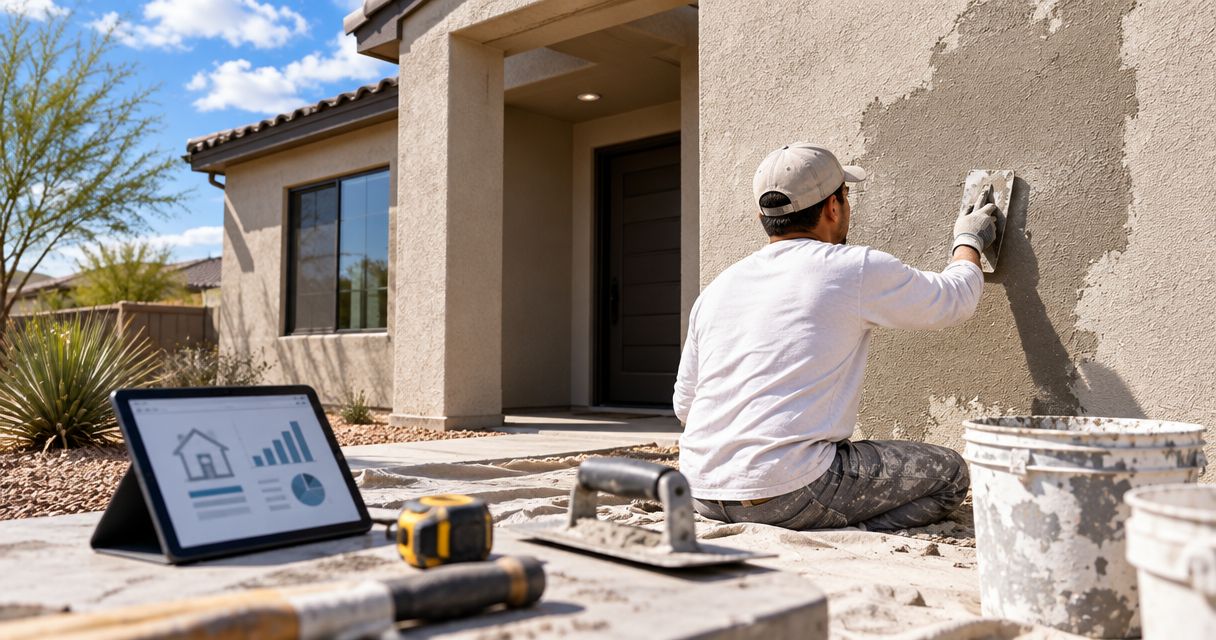
Stucco repair cost in Phoenix depends on the damaged area, the condition beneath the finish, access, and how much of the wall needs refinishing; a property-specific written estimate is the basis for a reliable budget in 2026. The main caveat is concealed damage: an estimate for surface repair does not automatically include work on the wall behind it.
- Stucco repair cost Phoenix estimates should separate preparation, wall repair, finish work, and exclusions.
- Localized stucco repair suits isolated damage; every crack does not require full re-stuccoing.
- Compare repair and full re-stucco scopes when damage or finish problems extend across several walls.
- AZ Stucco Solutions LLC provides residential and commercial stucco services in the Phoenix metro area.
How much does stucco repair cost in Phoenix?
Your repair budget should follow the wall condition and agreed scope—not the visible crack alone. A surface blemish, a loose section of stucco, and damaged material beneath the exterior require different work, even when they look similar from the driveway.
Before you request a stucco estimate, describe where the damage appears, whether it has returned after previous repairs, and whether you have noticed staining or leaks. Those details help frame the assessment; they do not replace examining the wall.
A written estimate for a 2026 Phoenix project should distinguish the following work:
| Scope component | What the estimate should explain | What to clarify |
|---|---|---|
| Assessment and preparation | Which areas need examination, protection, and preparation | Whether any exploratory removal is included |
| Removal and disposal | Which damaged materials will be removed | Where removal stops and sound material begins |
| Wall repair | Which underlying components need attention | How concealed conditions will be handled |
| Stucco application | What area and existing system the work addresses | Whether the scope is localized or wall-wide |
| Finish work | The texture and extent of refinishing | Whether painting or coating is included |
| Access and cleanup | How workers reach the wall and protect the property | Who handles debris and final cleanup |
Why this matters
A repair estimate is also a description of what your property will look like when the work ends. Fixing a damaged area and creating a consistent appearance across an entire elevation are different goals.
For a Phoenix homeowner, that distinction affects the choice between an isolated repair and broader exterior work. For a small commercial owner, the scope also needs to account for entrances, tenants, landscaping, and customer access. Compare what each proposal promises to complete before comparing its total.
Localized repair: best for isolated damage
Localized repair is the appropriate starting point when the problem is limited and the surrounding wall does not need broader work. A crack by itself is not evidence that your entire home needs re-stuccoing.
Ask the contractor to explain the repair boundary and the reason for it. You should understand whether the work addresses only the visible surface or also includes damaged material behind that surface.
The advantage is a focused scope. The limitation is appearance: a repaired section does not automatically make the rest of an aged wall look new, and an exact texture or color match should not be assumed.
If you are mainly concerned about a single crack, bring photographs of any previous repairs to the assessment. Recurring damage deserves an explanation rather than another cosmetic cover-up.
Full re-stucco: best for broader exterior renewal
Full re-stucco deserves consideration when your goals extend beyond isolated defects. That includes projects where you want to address widespread finish problems or establish a more consistent exterior appearance.
Re-stuccoing is not a substitute for identifying underlying problems. The proposal should describe preparation, what stays in place, what gets removed, and how unsuitable areas will be handled before the new finish is applied.
The advantage is the ability to plan the exterior as a whole. The trade-off is a broader work area, with more decisions about protection, access, finish selection, and coordination.
Ask for the reason behind the recommendation. A contractor should be able to explain why localized repair is sufficient—or why a broader assessment is justified—without treating every crack as a full re-stucco project.
New installation: best for new or rebuilt wall areas
New stucco installation belongs in the comparison when you are building an addition, creating new exterior walls, or rebuilding an area that cannot remain as it is. It is a different scope from repairing a surface defect.
The estimate should identify the wall assembly, preparation, finish, and connection to adjoining areas. If the project combines existing and new construction, ask how the transition will be treated visually and how responsibilities are divided between trades.
New installation gives you an opportunity to specify the finish before work begins. Its limitation is that a new section still needs to relate to the existing building; matching adjacent work requires a deliberate plan.
| Approach | Best for | Main advantage | Main limitation |
|---|---|---|---|
| Localized repair | Isolated damage with a defined repair boundary | Keeps work focused on the affected area | Does not renew the whole exterior |
| Full re-stucco | Broader finish renewal after wall assessment | Addresses the appearance of larger wall areas together | Requires broader preparation and coordination |
| New installation | New construction or rebuilt wall areas | Establishes the specified system and finish for new work | Requires careful transitions to existing construction |
The right comparison is not simply patching versus replacing everything. Start with the condition of the wall, then choose the smallest scope that addresses the actual problem and your finish goals.

Why stucco repair scope varies in Phoenix
The following factors explain why similar-looking requests do not necessarily produce comparable proposals. Use them to question the scope of your 2026 project, not to diagnose the wall yourself.
- Extent of damage. Ask whether the affected area is limited to a visible defect or extends into surrounding material.
- Underlying condition. Clarify whether the proposal includes only the stucco surface or work on components behind it.
- Access. Upper walls, narrow side yards, and areas above entrances need an access and protection plan.
- Finish expectations. A small texture repair and refinishing an entire wall are different deliverables.
- Related work. Roof, window, painting, or other exterior work needs clear responsibility and sequencing when it affects the same area.
- Property use. An occupied home and an operating storefront need different arrangements for work areas and access.
Ask the contractor to connect each proposed task to an observed condition or a stated goal. “Repair stucco” is too vague to tell you whether competing estimates cover the same result.
What should your written estimate include?
A useful 2026 estimate lets you understand the work without translating construction shorthand. It should identify the property areas involved and describe the intended finished result.
Defined boundaries
Look for an understandable description of the affected walls, openings, corners, or other features. Photographs or marked areas can help you and the contractor agree on where the work begins and ends.
A description such as “repair exterior damage” leaves room for different expectations. Ask whether adjacent damaged areas are included and what happens if removal exposes a larger problem.
Preparation and protection
Ask how nearby windows, doors, paving, landscaping, and fixtures will be protected. Preparation should also explain what happens to loose material and existing finishes within the proposed work area.
For a business, identify entrances that must remain usable and areas where customers or deliveries need separation from the work. These are planning requirements, not details to leave until work starts.
Finish and written changes
Specify the intended texture and whether the scope includes a localized finish, an entire elevation, or broader exterior work. Ask how you will review the proposed appearance before committing to the final finish.
Concealed work needs a written change process. Establish how additional findings will be documented, explained, and approved before they become additional work. Do not assume that an allowance, an exclusion, and a firm included scope mean the same thing.
How should you plan repairs around leaks or insurance work?
If staining or damage appears near a roof edge or window, discuss that location during the assessment. Restoring the visible stucco surface does not, by itself, establish that an associated water-entry problem has been resolved.
Keep the responsibilities separate and explicit: who investigates the source, who performs related work, and who restores the exterior finish. The guide to roof leak and stucco repair coordination addresses that connection.
When storm damage involves several exterior trades, hail damage claims and repainting belong in the same planning discussion as stucco restoration so the scopes do not leave an unfinished transition. Keep the insurer's coverage decision separate from the contractor's description of necessary work.
For a 2026 claim, retain dated photographs, assessment notes, and written proposals. Confirm coverage directly with your insurer; a stucco estimate is not a promise that a claim will be paid.
How do finish choices affect the repair decision?
Choose the appearance you want before approving the repair boundaries. A homeowner who accepts a visible localized repair has a different goal from someone who wants a consistent finish across the front of the house.
Discuss texture and color separately. Matching the surface pattern does not automatically resolve a color difference, and painting a wall does not correct a texture difference.
For larger residential and small commercial projects, ask whether the proposal treats connected wall areas consistently. If you are changing the exterior appearance, confirm any applicable association or property approval requirements before work starts.
A sample or agreed reference gives the discussion a concrete starting point. It is not a reason to promise an invisible repair; the written scope should state the intended result honestly.
Who should assess a larger Phoenix stucco project?
AZ Stucco Solutions LLC is best suited to Phoenix-area property owners seeking residential or commercial stucco installation, repair, or exterior restoration. The business is led by Flavio Miguel Delgado, whose background includes over 30 years of construction experience specializing in stucco.
For a larger residential or commercial project, ask AZ Stucco Solutions LLC to explain whether the assessment supports localized repair, full re-stucco, or new installation. Free residential stucco estimates are available; confirm the estimate arrangements for a commercial property directly.
Bring your priorities to the conversation: repairing a specific defect, renewing the whole exterior, or coordinating stucco with other construction. You can request an estimate through the website or call (480) 971-9500. Ask that the resulting proposal distinguish included work, finish expectations, exclusions, and the process for unexpected findings.
FAQ
How much does stucco repair cost in Phoenix in 2026?
Stucco repair cost in Phoenix requires a property-specific estimate covering the damage, preparation, access, underlying conditions, and finish work. Compare written scopes rather than treating every crack or damaged wall as the same job.
Does every stucco crack mean I need to re-stucco my house?
No, every stucco crack does not require full re-stuccoing. Localized repair is appropriate when the problem is isolated and the surrounding wall does not require broader work.
Is painting included in a stucco repair estimate?
Painting is included only when the written proposal includes it. Ask whether the finish scope covers the repaired area, an entire wall, or a larger part of the exterior.
Can a stucco repair match the existing wall exactly?
An exact match should not be assumed. Agree on texture, color, and the extent of refinishing before approving the work, especially where the existing finish has aged.
What happens if damaged material is found behind the stucco?
Additional concealed damage should follow the written change process agreed with your contractor. Ask how findings will be documented and how you will approve work outside the original scope.
Does homeowners insurance cover stucco repair?
Insurance coverage depends on your policy and the circumstances of the damage. Confirm coverage with your insurer and keep that decision separate from the contractor’s repair assessment.
Does AZ Stucco Solutions LLC offer free estimates?
AZ Stucco Solutions LLC provides free residential stucco estimates. Commercial property owners should confirm estimate arrangements directly when discussing the project.
One last thing
Before approving a proposal, ask: “What will remain unchanged when this work is finished?” The answer brings exclusions into focus, including adjacent finishes, unrelated cracks, painting, or work by another trade. A clear boundary is just as valuable as a clear description of the repair.
Leave a Reply