
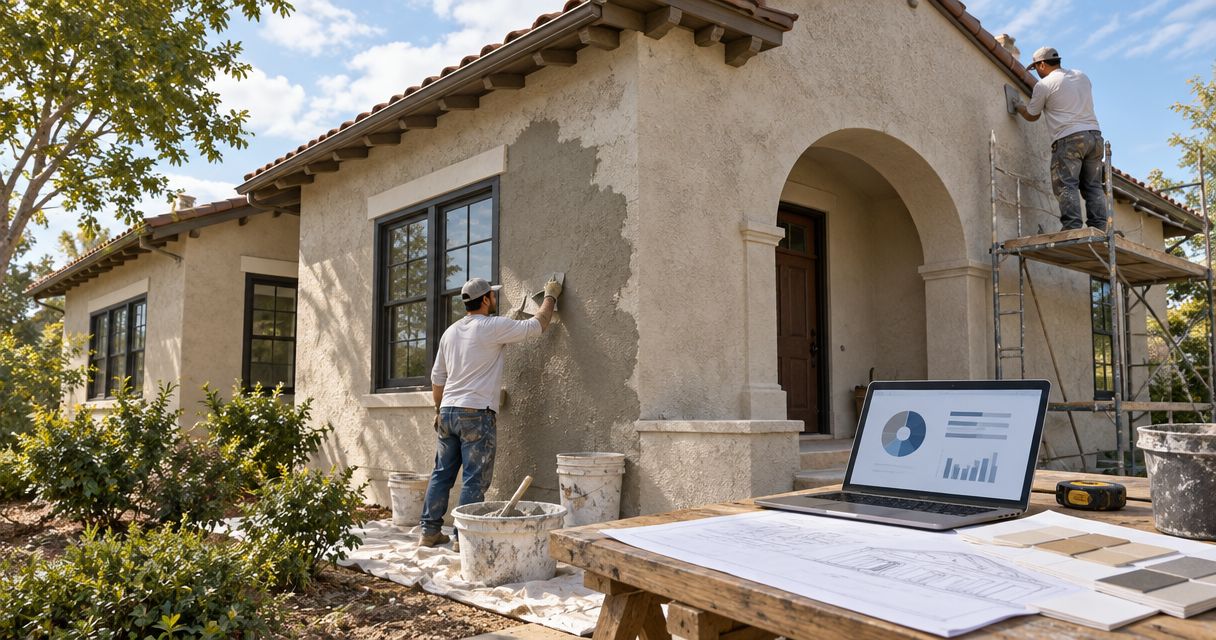
Stucco restoration cost for a historic home depends on the amount of original material you can retain, the repairs the wall needs, and the finish you want to preserve; a useful estimate starts with an on-site assessment, not a whole-house average. The written scope should also address concealed damage, finish matching, access, and any preservation review rather than treating those items as automatic inclusions.
- Historic home stucco restoration cost starts with defining repairs, retained surfaces, finish matching, and concealed-damage procedures.
- National Park Service preservation guidance favors retaining sound historic stucco and using compatible repairs.
- Choose localized repair for isolated defects; consider broader restoration when an assessment identifies more extensive problems.
- Compare written scopes before comparing estimates for your Phoenix home.
Why this matters
A historic home's exterior is more than a surface to make uniform. Its texture, corners, window surrounds, and earlier repairs help define its appearance. Replacing sound material simply to erase every irregularity changes the project from necessary repair to a broader alteration.
For a Phoenix restoration planned in 2026, decide what you want to preserve before requesting proposals. The guide to stucco restoration for historic Phoenix homes provides related planning context.
The right scope repairs the problem while retaining sound historic material. A small visible defect does not, by itself, justify removing stucco from the entire house.
How much does stucco restoration cost for a historic home?
A dependable estimate describes the work your particular home needs. Ask the contractor to separate the following parts so you can see what the proposal includes and where additional authorization would be required.
- Assessment and documentation. Identify affected walls, visible damage, existing finishes, and areas that need further investigation.
- Preparation and repairs. Describe what stays, what comes off, and how exposed problems will be addressed before the finish work begins.
- Finish restoration. State whether the work includes matching individual patches, refinishing a complete wall, or addressing a broader exterior area.
- Access and project protection. Identify arrangements for reaching the work and protecting windows, landscaping, walkways, and adjacent surfaces.
- Concealed conditions. Explain how discoveries behind the stucco will be documented, discussed, and approved.
For your 2026 estimate, request these distinctions in writing. A proposal that groups everything under exterior restoration leaves you without a clear basis for comparing contractors or approving changes.
Compare the scope before choosing the approach
These approaches solve different problems. Choose the extent of work from the wall assessment, not from a preference for the smallest or largest project.
| Approach | Best for | Main advantage | Main limitation |
|---|---|---|---|
| Localized repair | Isolated defects with sound surrounding stucco | Retains surrounding material and limits disturbance | A patch can remain visually distinguishable |
| Wall-level restoration | Affected areas concentrated on a particular wall | Addresses connected repairs and finish decisions together | Includes more surface work than an isolated patch |
| Broader re-stucco assessment | Extensive deterioration or a proposed exterior-wide change | Allows a coordinated plan for multiple affected areas | Requires careful justification where historic material would be removed or covered |
Localized repair: preserve sound surrounding stucco
Localized repair is the starting point when defects are limited and the surrounding material remains sound. Ask the contractor to explain the proposed repair boundary and why it extends to that point.
The benefit is restraint: you address the affected area without automatically disturbing the rest of the exterior. The limitation is appearance. Matching an aged surface involves more than selecting a similar color; texture, aggregate, application, and existing weathering all influence the result.
Ask whether the estimate includes a sample repair or finish sample before work proceeds across the visible area. Also ask what degree of variation you should expect. A clear discussion about matching is more useful than an unsupported promise that the repair will disappear.
An isolated crack deserves an assessment, not an automatic whole-house re-stucco recommendation. If the same location has been repaired repeatedly, bring that history to the inspection.
Wall-level restoration: coordinate connected repairs
Wall-level restoration deserves consideration when the assessment identifies connected problems across one exterior face. The scope should explain which areas require repair and which areas are included for finish continuity.
That distinction matters. Repairing damaged material and refinishing adjacent sound material are different tasks, even when both appear in the same proposal. Ask the contractor to show those boundaries on photographs or a simple wall sketch.
The advantage is a coordinated approach to an affected wall. The trade-off is a larger work area, with additional preparation and protection to define. You should understand why that extent is recommended before approving it.
For a Phoenix home with decorative surrounds or distinctive corner details, identify those features individually. Do not assume a general wall-finishing description explains how they will be protected or restored.
Broader re-stucco: establish the need before expanding the work
A broader project requires a clear explanation of the existing wall's condition and the intended treatment. Re-stucco is not a substitute for identifying the reason an exterior is deteriorating.
Ask whether the proposal involves retaining existing stucco, removing selected areas, or removing more extensive material. Those are materially different scopes. The estimate should describe the proposed approach rather than relying on the term re-stucco alone.
The benefit of broader planning is coordination across multiple affected walls. The limitation is the potential disturbance or concealment of historic finishes and details. Establish what must be retained before choosing a new appearance.
For your 2026 project, separate necessary restoration from optional changes. That lets you make a preservation decision without bundling it into an unrelated desire for a different texture or color.
Why historic stucco restoration scope varies
The following factors belong in the assessment and estimate. They explain differences between proposals more clearly than the home's floor area alone.
- Wall condition. Distinguish isolated surface defects from loose material, recurring damage, or deterioration that needs further investigation.
- Material compatibility. Establish how the proposed repair relates to the existing stucco and underlying construction.
- Finish matching. Define the texture, color, edges, and architectural details the work is intended to preserve.
- Concealed damage. Set out a process for documenting problems discovered after selected material is removed.
- Site access. Identify difficult-to-reach surfaces, protective measures, and access arrangements.
- Preservation review. Confirm whether the property has designation-related requirements or other applicable approvals.

The National Park Service's Preservation Brief 22: The Preservation and Repair of Historic Stucco, published in October 1990, addresses historic stucco maintenance and repair. Its emphasis on retaining sound material and selecting compatible repairs is relevant when evaluating a proposed restoration approach.
That preservation principle does not establish your home's condition. Your contractor still needs to examine the actual walls, and any applicable review authority must confirm its own requirements.
What should your written restoration estimate include?
Use the estimate as a description of the finished work, not just permission to start. Each major task should have a defined location, treatment, and boundary.
Existing conditions and preparation
Ask for photographs identifying affected areas and a written explanation of removal and preparation. The proposal should distinguish confirmed work from conditions that remain concealed.
Preparation language should be specific enough to compare. A statement that surfaces will be prepared as needed does not tell you which coatings, loose areas, or earlier repairs the contractor plans to address.
Materials and finish decisions
Request an explanation of the proposed materials and their suitability for the existing wall. For a historic home, compatibility deserves attention before selecting a finish for appearance alone.
Identify whether color and texture approval happens through a sample. State where the approved finish applies and whether decorative features receive separate treatment. Keep an agreed reference rather than relying on a verbal description.
Changes, cleanup, and responsibilities
The proposal should explain who authorizes additional work and how that approval is recorded. It should also identify cleanup, debris removal, property protection, and responsibility for required approvals.
For a 2026 restoration agreement, ask for any warranty terms in writing rather than assuming coverage. Do not substitute a general conversation about workmanship for the terms of your own agreement.
How do you compare estimates without choosing the wrong scope?
Place proposals side by side and check that they describe the same walls, preparation, repairs, and finish boundaries. When those items differ, the estimates are not directly comparable.
Ask each contractor to identify exclusions. Common questions include whether underlying repairs are included, whether finish samples form part of the work, and how previously concealed damage will be handled. These questions establish responsibilities; they do not presume your home has hidden damage.
Then ask the contractor to explain the recommendation in plain language. You should understand why a localized repair is sufficient or why a broader assessment is justified.
Choose a clearly explained scope over an unexplained promise of a complete exterior transformation. A historic restoration needs defined limits as much as it needs careful workmanship.
Does a historic home always need full re-stuccoing?
No. A historic home does not need full re-stuccoing simply because it is old or has a visible crack. The condition of the existing material and the cause of the defect determine the appropriate next step.
Retaining sound material can be the right restoration decision. Broader work needs a reason grounded in the assessment, not an assumption that a uniform new surface is always better.
Do historic district rules affect stucco restoration?
Historic designation can affect the review of exterior changes, so confirm the property's status and applicable requirements before approving removal or a new finish. Do not treat the word historic in a listing or neighborhood description as confirmation of a particular legal designation.
For a Phoenix project in 2026, ask the relevant city preservation or permitting office about your property and proposed work. Provide the actual scope rather than asking only whether stucco repair needs approval.
Who should assess your Phoenix stucco project?
Look for a contractor who explains larger installation and restoration scopes clearly, distinguishes necessary repairs from optional finish changes, and recognizes when preservation-specific input is needed.
AZ Stucco Solutions LLC is a fit for Phoenix-area owners seeking residential or commercial stucco installation and restoration services. The business is led by Flavio Miguel Delgado, whose construction experience spans more than 30 years; that experience is not a statement about the LLC's age.
For a historic property, ask AZ Stucco Solutions LLC to discuss the proposed scope and any preservation coordination your project requires. AZ Stucco Solutions LLC provides free residential stucco estimates; discuss commercial estimate arrangements directly. You can request a stucco assessment or call (480) 971-9500.
Discuss your restoration scope
Ask AZ Stucco Solutions LLC about preparation, finish choices, and a residential stucco estimate.
FAQ
Can I get a historic stucco restoration estimate from photographs?
Photographs help you explain the project, but they do not replace an on-site assessment. Ask the contractor to distinguish preliminary observations from a written scope based on the property’s actual condition.
Is patching better than re-stuccoing a historic home?
Patching is appropriate when defects are isolated and the surrounding stucco is sound. Broader work needs justification based on the assessed condition and the restoration goals.
Does every stucco crack mean there is hidden damage?
No, a visible crack alone does not establish hidden damage. Share any history of recurring cracks, leaks, or earlier repairs so the contractor can assess the location in context.
Should I choose the same texture for my historic home?
Preserving the existing texture deserves consideration when it contributes to the home’s historic appearance. Confirm any applicable preservation requirements and approve a finish sample before authorizing a broader change.
What should happen if damage is found behind the stucco?
The contractor should document the discovery and explain the proposed additional work before you authorize it. Your agreement should establish that process before removal begins.
Does AZ Stucco Solutions LLC offer free historic home estimates?
AZ Stucco Solutions LLC provides free residential stucco estimates. Explain that your property is historic and ask what information is needed to assess the restoration scope.
One last thing
Before approving work, photograph the details you want to keep: window surrounds, corners, texture transitions, and decorative bands. Mark them on the scope with your contractor. A general instruction to match the existing exterior is less useful than a shared record of exactly what should remain.
Leave a Reply