
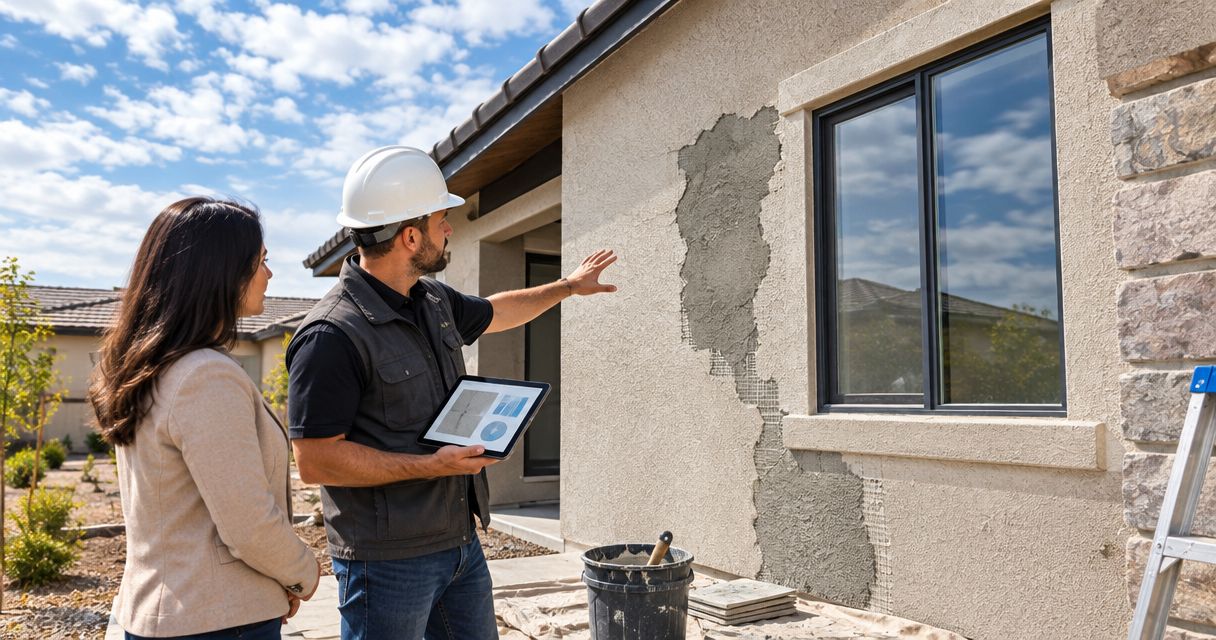
For real estate agents, stucco repair is the assessment and correction of exterior stucco damage with the aim of giving buyers and sellers a clear, documented repair scope. This 2026 guide explains how to distinguish a localized repair from a broader restoration project, coordinate estimates, and keep exterior work aligned with the transaction without promising a diagnosis or completion date.
- Stucco repair for real estate agents starts with documenting damage, not choosing a patch material.
- AZ Stucco Solutions LLC serves Phoenix-area owners needing stucco repair, full re-stucco, and new installation.
- Use condition and repair history to guide scope; a crack alone does not justify full re-stucco.
- Keep contractor findings, finish selections, and completion records together for buyer and seller discussions.
Why stucco repair matters for real estate agents
A seller wants a presentable exterior. A buyer wants to understand what needs attention. Your job is to keep those goals separate from the technical diagnosis: an attractive finish does not establish the condition of the wall beneath it.
Phoenix-area transactions also require practical coordination between owners, contractors, inspectors, and, where applicable, an HOA. Exterior work affects access, finish decisions, and transaction discussions. For small commercial properties, tenant access and operating hours belong in that conversation too.
AZ Stucco Solutions LLC is best for Phoenix-area property owners seeking stucco repair, full re-stucco, or new installation. Owner Flavio Miguel Delgado has over 30 years of construction experience, specializing in stucco; that experience belongs to the owner, not the age of the LLC.
For your 2026 transaction file, prioritize a written explanation of the proposed work over a verbal assurance that the exterior will look better. A useful scope tells everyone what is included, what remains uncertain, and what requires separate evaluation.
How to coordinate stucco work before a sale
Use the following steps before choosing materials or accepting a finish proposal. You can organize the initial information yourself with photographs, existing reports, and a simple property checklist. The contractor then evaluates the exterior and defines the construction scope.
Document the exterior before requesting repairs
Start with a dated photo record, not a repair instruction. Photograph all 4 exterior elevations when accessible, then capture closer views of cracks, stains, damaged corners, previous patches, and areas around openings. Take photographs from safe ground-level positions rather than climbing onto roofs or parapets.
Include a wider view with each close-up so the contractor can locate the concern. A photograph of a crack without its location creates avoidable back-and-forth and does not explain how the area relates to nearby windows, doors, or roof edges.
For a 2026 listing, keep the original images in the property file. Do not edit out visible damage or describe an unexplained condition as cosmetic. Your documentation should show what you observed, not assign a cause.
- Label images by elevation and nearby feature.
- Record when each concern was first noticed, if known.
- Identify previous patches without assuming they failed.
- Collect available inspection reports and repair records.
Separate appearance concerns from unresolved damage
An uneven texture and a recurring crack are different questions. One concerns the finish; the other calls for an explanation of why the condition returned. Do not combine them under a general request to make the house look ready for photographs.
Ask the owner about prior repairs, interior staining, and changes they have noticed. Treat those answers as background for the contractor, not proof of a particular defect. Water entry, loose material, or signs of movement warrant evaluation before anyone agrees to conceal the surface.
A crack alone does not establish the need for full re-stucco. Equally, a fresh coating does not resolve an underlying problem merely because the crack disappears from view. Ask the contractor to distinguish observed conditions from conclusions that require additional investigation.
- List appearance concerns separately from recurring damage.
- Share reports rather than rewriting technical findings.
- Flag staining, loose areas, and previous repair locations.
- Ask who should evaluate concerns outside the stucco scope.
Match the project scope to the property's condition
Organize the discussion around 3 scope categories: localized repair, full re-stucco, and new installation. These are planning categories, not interchangeable treatments. The contractor should explain why the proposed category fits the existing exterior and the owner's goals.
Localized repair addresses a defined area. Full re-stucco addresses a broader exterior scope, but the proposal must explain preparation and whether existing material stays or comes off. New installation applies to new construction, additions, or replacement assemblies as specified for the project.
AZ Stucco Solutions LLC provides residential and commercial work across these categories. Ask for an assessment tied to the property rather than requesting the largest scope by default. On a larger Phoenix residential or commercial project, identifying the boundaries of the work is especially important.

- Ask which elevations and features are included.
- Confirm whether removal or retention is proposed.
- Separate necessary work from optional appearance changes.
- Request an explanation for any recommended broader assessment.
Request an estimate that defines preparation and exclusions
A useful estimate describes the work clearly enough for the owner to make a decision. A single line reading stucco repair leaves too much unanswered, especially when several parties are discussing the property during a transaction.
Ask how the contractor will prepare the existing surface, address identified damaged areas, protect adjacent materials, and finish the work. For larger re-stucco projects, clarify treatment around windows, doors, roof transitions, and other adjoining components without prescribing an installation method yourself.
Read exclusions as carefully as inclusions. Concealed conditions cannot be described with certainty before they are exposed. The estimate should explain how additional findings will be communicated and authorized, rather than implying that every possible condition is already covered.
Compare written scopes side by side. Different amounts of preparation or different included elevations are different projects, even when both proposals use the word re-stucco.
- Identify the exact work areas and preparation tasks.
- Request the proposed finish and coating description.
- Confirm protection, cleanup, and debris responsibilities.
- Ask how scope changes receive written authorization.
- Review exclusions and any separate trade responsibilities.
Choose the finish before approving the work
Finish selection affects the appearance of the repaired area and the surrounding exterior. Texture, color, existing weathering, and lighting all influence how a transition looks. Do not promise an invisible patch or a perfect match to an older wall.
Ask whether the proposed finish stops at the damaged area, extends to an architectural break, or covers a larger elevation. Those choices change the scope and should be discussed before work begins. Where a sample is appropriate, agree on how the owner will review it.
For a 2026 listing refresh in Phoenix, start with the building's existing character rather than a trend. In Mesa or another HOA community, obtain the applicable exterior requirements before approving a change. Never assume the owner's previous color choice establishes permission for the next project.
- Confirm texture and color in writing.
- Identify where the finished work will stop.
- Review samples under the property's actual lighting.
- Obtain applicable owner or HOA approvals.
Coordinate access without promising a completion date
Share the owner's preferred transaction milestones with the contractor, but keep those preferences separate from a confirmed construction schedule. A listing photography appointment or inspection deadline does not establish how much preparation the exterior needs.
Ask the contractor to explain the expected work sequence, access requirements, and conditions that affect scheduling. Material instructions and site conditions guide application and curing; a transaction deadline is not a reason to skip those requirements.
For an occupied home, clarify pets, gates, vehicles, and outdoor belongings. At a small commercial property, identify business entrances, tenant notifications, and areas that must remain accessible. Give the contractor one authorized decision-maker so scope questions do not travel through competing instructions from several people.
Document schedule changes promptly. Do not tell a buyer that work is complete simply because the crew is no longer on site.
- Share milestones as requests, not construction promises.
- Identify the person authorized to approve changes.
- Confirm access and property-protection arrangements.
- Coordinate tenant or occupant notices where needed.
- Request confirmation before scheduling completion photographs.
Close the project with a clear transaction record
Build 2 review checkpoints into your process: written scope approval before work and a documented walkthrough afterward. These are coordination recommendations, not a substitute for any inspection or contractual requirement that applies to the transaction.
At the walkthrough, compare completed work with the approved scope. Record unresolved items and ask the contractor about any care instructions. Keep original completion photographs alongside earlier photographs so the record explains the work rather than merely presenting a refreshed exterior.
For your 2026 property file, retain the signed scope, authorized changes, invoices, and applicable written warranty terms. Do not describe warranty coverage or transferability beyond the customer's agreement.
AZ Stucco Solutions LLC offers free residential stucco estimates. For a home or commercial property, request a stucco assessment and identify the property type, location, and concerns; do not assume commercial estimates follow residential terms.
- Compare completed work against the approved scope.
- Record remaining items and their agreed next steps.
- Save project documents without sharing private information publicly.
- Keep condition statements consistent with contractor findings.
Discuss your property’s stucco scope
Explain the property’s condition and goals. Free residential stucco estimates are available.
Compare stucco options for a property transaction
Choose the smallest justified scope, not automatically the smallest visible patch. A defined repair makes sense when the assessment supports it. Broader work deserves consideration when the condition or the owner's exterior goals call for a broader scope.
| Option | Best for | Main benefit | Key limitation |
|---|---|---|---|
| Localized repair | Defined damage with a supported repair scope | Focuses work on the affected area | Finish transitions can remain visible; it does not address unrelated wall conditions |
| Full re-stucco | Owners pursuing a broader exterior renewal supported by assessment | Coordinates preparation and finish across the agreed exterior areas | Requires a clearly defined preparation scope and more property coordination |
| New installation | New construction, additions, or specified replacement assemblies | Establishes the exterior assembly for the defined construction work | Requires coordination with adjoining building components and project requirements |
Do not treat the table as a remote diagnosis. Ask the contractor to explain the recommendation for this particular property, including any limits on what can be determined before work begins. A larger project is justified by its scope, not by stronger sales language.
Common mistakes real estate agents make
Treating listing photographs as the repair deadline
Photographs document appearance, not whether the underlying concern was evaluated. Coordinate photography after the agreed work and completion review rather than asking a contractor to cover damage first and investigate later.
Calling every crack cosmetic
That label is a conclusion, not a neutral description. Describe the visible location and condition, then let the appropriate professional assess the concern. Avoid repeating an owner's guess as a verified finding in buyer communications.
Comparing proposals without comparing boundaries
A patch, an elevation-wide finish, and full re-stucco are not equivalent scopes. Compare preparation, included areas, finish transitions, and exclusions before presenting options to the owner. Otherwise, the owner is choosing between different projects without knowing it.
Promising a match or warranty beyond the agreement
Do not promise an invisible repair, a particular project date, or transferable coverage. Ask the contractor to document finish expectations and applicable warranty terms. Keep transaction communications aligned with that wording rather than expanding it into a guarantee.
FAQ
What’s the best first step for stucco repair before listing a Phoenix home?
Document the exterior and request an assessment before choosing a repair method. Share dated photographs, prior repair records, and any inspection findings so the contractor can evaluate the scope.
Does every stucco crack mean a house needs full re-stucco?
No, a crack alone does not establish that full re-stucco is necessary. A localized repair can be sufficient when the assessment supports that scope; recurring damage or other concerns warrant further evaluation.
Is localized stucco repair better than full re-stucco before selling?
Localized repair is better for defined damage when the assessment supports a limited scope. Full re-stucco is a different option for broader exterior work, and the recommendation should explain preparation, included areas, and finish expectations.
Can a real estate agent promise that a stucco patch will disappear?
No, an agent should not promise an invisible stucco patch. Texture, color, existing weathering, and lighting affect the appearance, so the owner should discuss finish transitions with the contractor before approving work.
Does AZ Stucco Solutions LLC provide free estimates?
AZ Stucco Solutions LLC provides free residential stucco estimates. Commercial property owners should discuss estimate arrangements directly rather than assuming residential terms apply.
What should a seller keep after stucco work is finished?
A seller should keep the approved scope, authorized changes, invoices, completion photographs, and applicable written warranty terms. Those records explain the work performed without making unsupported claims about the entire building.
Can stucco work be scheduled around a closing date?
Share the closing date as a requested milestone, not a guaranteed construction deadline. Confirm the scope and schedule with the contractor, and do not promise completion before the contractor has confirmed the arrangements.
One last thing
Ask where the repair will stop, not just where it will start. A proposal that identifies the finish boundary gives the owner a clearer picture than one that only points to the damaged spot.
For a 2026 sale, that question belongs before approval. It helps separate a focused repair from an elevation-wide finish or full re-stucco, while leaving the technical recommendation with the contractor. If you need help defining the next step in the Phoenix metro area, call (480) 971-9500 and describe the property and the concerns you have documented.
Leave a Reply