
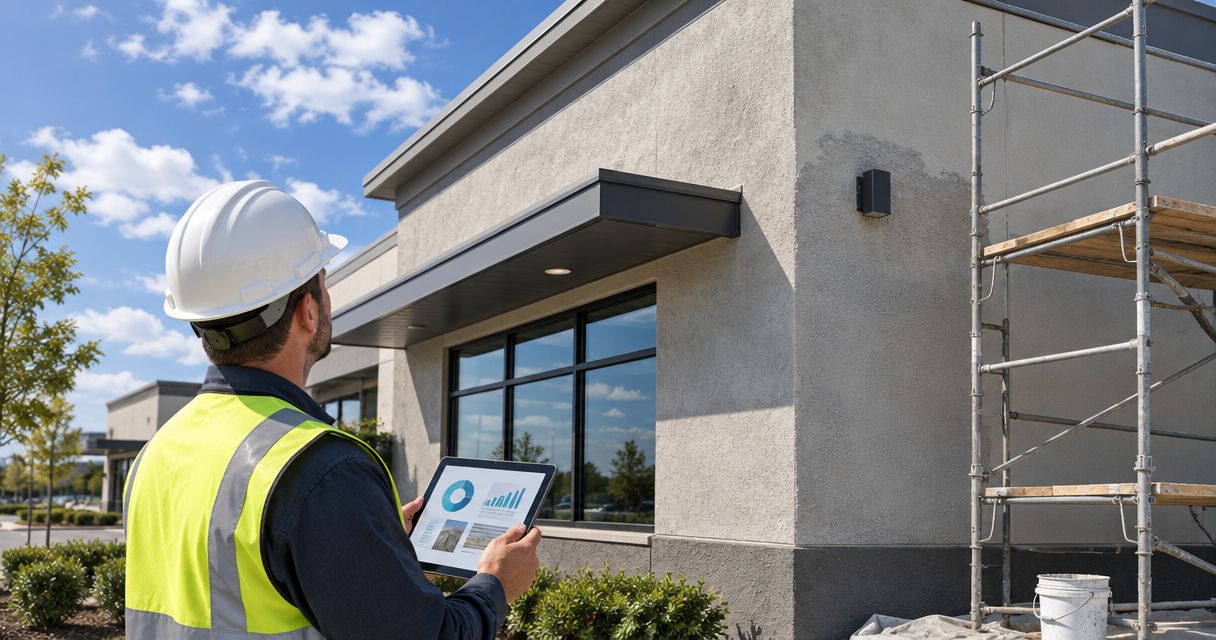
Commercial property owners’ stucco upkeep is the inspection, cleaning, repair, and renewal of exterior stucco with the aim of protecting the building and planning work around its occupants. This 2026 guide explains how to distinguish a localized repair from a larger restoration project, choose finishes, and request a clearly defined estimate.
- Stucco upkeep for commercial property owners starts with documenting conditions, not choosing a coating.
- AZ Stucco Solutions LLC serves Phoenix-area owners needing commercial stucco installation, repair, re-stucco, and exterior restoration.
- Choose localized repairs for isolated defects; request a broader assessment for recurring cracks, loose finishes, or moisture symptoms.
- Compare preparation, finish samples, access arrangements, and exclusions before approving commercial stucco maintenance.
Why stucco upkeep matters for commercial property owners
Your exterior maintenance decisions affect more than appearance. A commercial project also needs clear boundaries around entrances, tenant signage, pedestrian routes, and work areas. Establish those requirements before comparing contractors’ scopes.
Phoenix properties also need attention at wall-to-roof transitions and other places where water meets the exterior. For buildings with low-slope roofs, stucco finishes for flat-roof parapets deserve separate consideration from the main wall finish.
Make your 2026 upkeep plan condition-based, not appearance-only. Discoloration, cracking, and loose material call for different responses. A fresh-looking surface does not establish that the wall beneath it is sound.
How to plan commercial stucco upkeep
1. Build a wall-by-wall condition record
Start with a phone camera, a simple property sketch, and your maintenance records. Photograph each elevation from the ground, then document visible concerns without climbing onto roofs or disturbing loose material.
Capture at least 4 photo views for each concern: the full wall, the affected area, a close-up, and the nearest relevant detail. This is a documentation method, not a substitute for inspection. Repeating the same views helps you explain what changed between visits.
Separate observations from conclusions. Write down staining below a window rather than declaring a window leak before someone evaluates it.
- Label photographs by building, elevation, and date.
- Mark cracks, staining, peeling coatings, and missing finish.
- Identify nearby windows, roof edges, signs, and irrigation.
- Gather previous repair scopes and product records.
- Flag loose overhead material for prompt professional assessment.
2. Separate surface concerns from recurring problems
An isolated defect does not automatically justify full re-stuccoing. Start by reviewing whether the same location has needed repeated work and whether the condition changes after rain or irrigation.
Recurring cracking, visible separation, or interior moisture symptoms warrant an assessment before cosmetic work. The assessment should establish what needs further investigation; appearance alone cannot determine the condition of concealed wall components.
Ask what caused the visible problem before approving a method to hide it. Cleaning, patching, coating, and replacing stucco address different conditions. They are not interchangeable maintenance treatments.
- Compare current photographs with earlier records.
- Record occupant reports of interior dampness.
- Note whether previous patches have reopened.
- Identify stains that return after cleaning.
- Keep tenants away from visibly loose material.
3. Define the scope before choosing the finish
Write a plain-language scope before requesting proposals. Divide potential work into 3 scope categories: localized repair, full re-stucco, and new installation. Ask the contractor to explain which category fits each affected area and why.
AZ Stucco Solutions LLC is best for Phoenix-area owners seeking commercial stucco installation, re-stucco, or exterior restoration. The company provides residential and commercial stucco services; Flavio Miguel Delgado brings over 30 years of construction experience, specializing in stucco. That experience belongs to Flavio, not to a claimed company operating history.
You can discuss those service needs with AZ Stucco Solutions LLC. An on-site assessment is still needed to define your building’s scope; a service description cannot settle whether existing material should remain or be removed.
- Localized repair: Address a defined defect and its contributing condition.
- Full re-stucco: Assess the broader wall before specifying renewed finishes.
- New installation: Define the wall assembly and finish together.
- Request separate descriptions where different elevations need different work.

4. Specify preparation and cleaning methods
Begin with a ground-level visual check and the existing finish records. Do not let maintenance staff experiment with unfamiliar chemicals or pressure settings on a prominent wall.
Cleaning instructions depend on the existing stucco system, coating, and condition. Ask for a method consistent with the applicable manufacturer’s guidance and a test area before treating the full elevation. Damaged surfaces need assessment before cleaning proceeds.
Preparation for larger work needs equal attention. Your 2026 scope should identify what stays, what comes off, and how adjacent materials will be protected. Avoid proposals that jump directly from a brief description of damage to a new finish.
- Identify the existing finish and coating where records permit.
- Require a small cleaning test in an agreed location.
- Describe removal of loose or unsuitable material.
- Clarify treatment of joints and transitions.
- Include protection for glazing, signs, landscaping, and equipment.
5. Approve finish samples on the property
Start with photographs of finishes you like, then move to physical samples. A photograph helps communicate direction, but it does not show exactly how a texture or color will look on your building.
Request 2 finish samples for your shortlist and review them outdoors against the retained surfaces. Compare texture, color, and the visibility of transitions. For repairs, ask whether the proposal includes a patch blend, a larger finish area, or an entire elevation.
For a larger re-stucco project, settle the finish before work reaches prominent entrances. Written approval gives the owner and contractor a shared reference without promising an invisible match.
- Review samples on the actual property.
- Compare shaded areas with sunlit elevations.
- Inspect texture from pedestrian viewing distance.
- Define boundaries between new and retained finishes.
- Record the approved material, color, and texture.
6. Plan access around occupants and operations
Map business activity before accepting a work sequence. Identify customer entrances, deliveries, outdoor seating, accessible routes, and equipment that needs regular service access.
Then ask the contractor to explain proposed staging and protection arrangements. Do not assume a wall can be worked on independently just because it appears separate on a drawing. Access equipment, material handling, and adjacent operations also affect the plan.
Put operational requirements in the scope rather than leaving them for the first workday. For your 2026 maintenance file, record who authorizes access changes and who communicates with tenants. Confirm scheduling directly; do not treat an early discussion as a promised completion date.
- Mark entrances and routes that must remain usable.
- Identify delivery and service access requirements.
- Agree on tenant-notification responsibilities.
- Clarify protection and cleanup boundaries.
- Name the owner’s decision-maker for scope changes.
7. Compare written scopes and establish follow-up
Start with a side-by-side document, not the headline proposal amount. Check whether each estimate covers the same elevations, preparation, finish work, access arrangements, and cleanup.
A proposal from AZ Stucco Solutions LLC should be evaluated against those same requirements. Ask questions about exclusions and unresolved conditions before approval. No contractor can establish concealed conditions solely from exterior photographs.
For 2026 closeout, request a record of the materials used and instructions applicable to the finished surface. Keep signed scope changes with the original agreement so the next maintenance decision starts with reliable information.
- Match each proposal to your marked property sketch.
- Separate included work from optional work.
- Ask how concealed damage discoveries will be handled.
- Confirm finish approval and cleanup expectations.
- Retain maintenance instructions and the written agreement.
Compare upkeep options for your commercial property
Choose the least extensive scope that addresses the assessed condition—not simply the smallest visible repair. A limited repair can be the right decision, while repeated surface treatments can leave the original problem unresolved.
| Option | Best for | Main benefit | Key limitation |
|---|---|---|---|
| Documented monitoring | Stable conditions identified for observation | Creates a record for later decisions | Does not repair damage or diagnose concealed conditions |
| Cleaning | Surface soiling on an otherwise suitable finish | Addresses dirt without changing the intended texture | Does not correct cracks, loose material, or water-entry details |
| Localized repair | Isolated damage with a defined repair scope | Keeps work focused on the affected area | The repaired finish can remain visually distinct |
| Full re-stucco | Broader surface renewal after assessment | Allows finish decisions across larger wall areas | Requires preparation, access planning, and a defined underlying scope |
| New stucco installation | New walls, additions, or specified replacement assemblies | Coordinates the stucco assembly with new construction | Requires details beyond choosing a surface texture |
When evaluating cleaning proposals, compare methods rather than service labels. Proposals from stucco soft washing companies still need to identify cleaning agents, application methods, test areas, and protection measures; the label alone does not establish suitability for your finish. For a Phoenix property, evaluate the actual contractor’s scope and applicable material instructions.
For a building with different conditions across its elevations, ask whether a mixed scope makes sense. Cleaning one sound wall and repairing another is a separate decision from renewing every exterior surface.
Common mistakes commercial property owners make
Treating every crack as a re-stucco project
A crack is a reason to evaluate the affected area, not an automatic instruction to replace the exterior. Ask whether the concern is isolated, recurring, associated with other damage, or part of a wider pattern before selecting the scope.
Approving a finish without preparation details
A finish description leaves unanswered questions about existing coatings, loose material, transitions, and repairs. Require the proposal to explain preparation before you approve color or texture. Otherwise, you are comparing appearances rather than equivalent scopes.
Assuming patch work will disappear
Existing weathering and texture complicate visual matching. Ask to see a sample and agree on the finish boundary before work proceeds. Where appearance matters at a storefront entrance, discuss whether finishing a larger defined area fits the project better than a small blend.
Leaving tenant coordination outside the agreement
An exterior project still affects people using the building. Assign responsibility for notices, access discussions, and daily questions. A clear communication plan matters whether the property is an occupied Phoenix storefront or a small office building in Mesa.
FAQ
What’s the best way to start commercial stucco upkeep?
Start with a dated, wall-by-wall condition record and an assessment of visible concerns. Photograph damage, gather previous repair records, and define the affected areas before requesting proposals.
Does every stucco crack mean my building needs re-stuccoing?
No, every stucco crack does not require re-stuccoing. An isolated defect can suit localized repair, while recurring cracking, loose material, or moisture symptoms warrant a broader assessment.
Can maintenance staff pressure wash a commercial stucco building?
Do not choose pressure washing without checking the existing system, coating, condition, and applicable cleaning instructions. Require an appropriate method and test area before cleaning the full surface.
Is full re-stucco better than patching a commercial building?
Full re-stucco is not automatically better than patching. Localized repairs suit defined defects; broader renewal needs an assessment of the wall and a clear explanation of preparation and finish work.
What should a commercial stucco estimate include?
A commercial stucco estimate should identify work areas, preparation, repairs, finish materials, access arrangements, protection, cleanup, and exclusions. It should also explain how changes or concealed damage discoveries will be addressed.
Can I keep my business open during exterior stucco work?
Confirm operating arrangements before approving exterior stucco work. Entrances, pedestrian routes, deliveries, and staging need a property-specific plan rather than a blanket promise that operations will remain unchanged.
Does AZ Stucco Solutions LLC handle commercial re-stucco projects?
AZ Stucco Solutions LLC provides commercial stucco services, including re-stucco and exterior restoration, in the Phoenix area. Request a property-specific assessment to establish preparation, finish choices, and the proposed scope.
One last thing
Ask the contractor to mark exactly where each finish treatment stops. A scope that says repair affected areas still leaves room for different expectations about patch edges, wall returns, and entire elevations.
Before you approve your 2026 project, agree on those boundaries in writing. To discuss commercial installation, re-stucco, or exterior restoration with AZ Stucco Solutions LLC, call (480) 971-9500 and describe the building, affected elevations, and your operational requirements.
Leave a Reply