
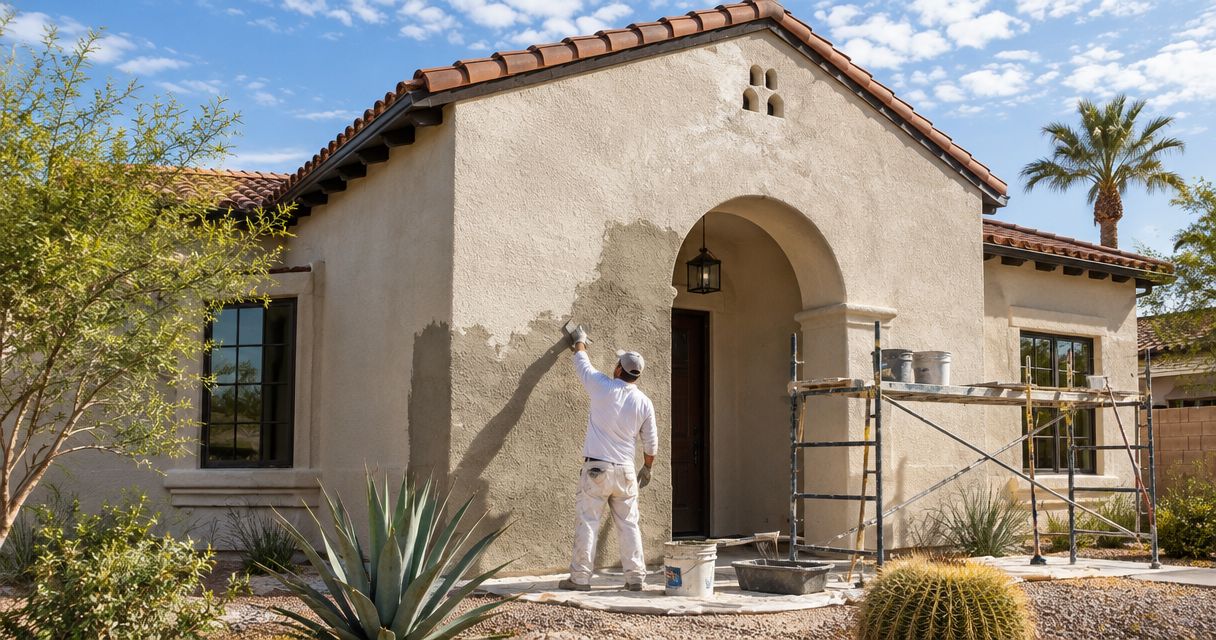
Historic Phoenix home stucco restoration is the repair or renewal of an existing stucco exterior to protect the building while retaining its architectural character. For your 2026 project, preserve sound material, address the cause of damage, and choose a finish that respects the home rather than treating every crack as a reason to re-stucco.
- Stucco restoration for historic Phoenix homes starts with assessing existing walls, not automatically choosing full re-stucco.
- AZ Stucco Solutions LLC suits Phoenix homeowners seeking stucco installation, repair, and exterior restoration services.
- Retain sound historic stucco; consider broader restoration when deterioration extends beyond isolated areas.
- Approve preparation, finish samples, and written scope before authorizing exterior work.
Why stucco restoration matters for historic Phoenix homes
Your goal is to protect the wall without erasing what makes the house distinctive. Texture, rounded corners, trim edges, and the relationship between stucco and adjoining materials all deserve attention before work begins. A uniform new finish is not automatically a faithful restoration.
AZ Stucco Solutions LLC provides residential and commercial stucco restoration services in the Phoenix area, led by Flavio Miguel Delgado, whose construction experience exceeds 30 years. For a historic home, separate the contractor's proposed stucco work from any preservation consultation or approval your property requires.
You can learn about the broader service offering through AZ Stucco Solutions LLC, but ask specifically how the proposed work will retain your home's existing details. General stucco experience and a documented preservation approach are different considerations.
For your 2026 planning, the National Park Service's October 1990 Preservation Brief 22: The Preservation and Repair of Historic Stucco provides relevant guidance on retaining historic stucco, compatible repairs, and sample patches. Its scope is historic stucco conservation—not a diagnosis of your particular walls.
How to plan your historic stucco restoration
Start with a homeowner's record of existing conditions. Then move through assessment, scope selection, finish approval, and a written agreement; you do not need to select a new wall system before understanding the existing one.

1. Document existing conditions
Begin with your phone, a simple wall sketch, and any older photographs you already have. Create a dated 2026 condition record before cleaning, patching, or painting changes the evidence. This gives everyone the same starting point when discussing what stays and what changes.
Take at least 1 overview photo of each exterior wall, followed by close-ups that show the surrounding area—not just the crack. Stay on the ground; leave roof edges and elevated inspection work to qualified professionals.
- Label photographs by wall location and date.
- Record visible cracks, staining, loose areas, and earlier patches.
- Photograph window surrounds, corners, parapets, and decorative details.
- Gather previous repair descriptions and material information you possess.
- Note whether visible changes followed rain, alterations, or earlier work.
2. Check approval requirements
Contact the City of Phoenix's historic preservation and permitting staff before committing to exterior changes. Ask whether the property has a designation or other review requirement that affects repairs, texture changes, removal, or replacement. An older house and a formally designated historic property are not interchangeable descriptions.
Keep the response with your project documents. If your property also has association restrictions, treat those as a separate check rather than assuming one approval covers everything.
- Confirm the property's designation and applicable review process.
- Describe proposed removal, replacement, texture, and color changes.
- Ask which drawings, photographs, or samples are required.
- Identify who will submit information and obtain necessary approvals.
- Resolve approval responsibilities before authorizing exterior work.
3. Assess wall conditions
Start by sharing your photographs and concerns during a site visit. For a coordinated path from assessment to a proposed scope, AZ Stucco Solutions LLC offers stucco installation, repair, re-stucco, and exterior restoration; residential estimates are free. Ask what the inspection establishes and which concealed conditions remain unknown.
A crack alone does not identify its cause. Likewise, staining, separation, or recurring patches deserve investigation rather than an automatic recommendation to cover the entire wall. Where conditions call for structural or preservation expertise, obtain that input before selecting the finish work.
- Ask which existing areas appear sound enough to retain.
- Identify visible damage around openings and roof-to-wall junctions.
- Discuss signs that warrant investigating moisture entry.
- Separate cosmetic concerns from conditions needing further evaluation.
- Record any proposed exploratory openings and their purpose.
4. Compare restoration scopes
Write down what you want to preserve before discussing how much stucco to remove. Then ask the contractor to explain why localized repair, wall-wide restoration, or full re-stucco fits the observed conditions. The extent of damage should determine the scope—not the desire to sell a larger project.
Where the assessment supports more than one approach, request 2 written scope alternatives. Compare what each retains, removes, and leaves unresolved. Full re-stucco deserves a clear explanation of its preparation and treatment of historic details, not just a promise of a fresh appearance.
- Mark repair areas on photographs or a wall sketch.
- Identify original material proposed for retention.
- Explain the reason for each area of removal.
- Distinguish finish renewal from work beneath the finish.
- Document the limitations of each proposed alternative.
5. Approve finish samples
Use existing sheltered areas and older photographs as starting references, not proof of an exact material recipe. Compare 3 finish attributes: texture, color, and edge detail. A patch that looks acceptable at arm's length can still interrupt the appearance of a whole wall.
For your 2026 restoration, request a representative sample before approving broad application. Ask how the proposed repair material relates to the existing stucco and how the sample will be reviewed after the specified curing or drying period. Do not select solely from a wet sample or a photograph on a screen.
- Agree on the sample's location before application.
- Review texture from nearby and normal viewing distances.
- Compare color under consistent daylight conditions.
- Check transitions beside retained trim and wall features.
- Record the approved material, texture, and color reference.
6. Specify preparation details
Ask for the preparation sequence in writing before comparing finish descriptions. A new surface does not resolve an unaddressed leak, detached material, or an unsuitable base. The proposal should explain how the contractor will evaluate and prepare what remains.
Historic stucco also calls for restraint. The National Park Service guidance emphasizes compatible repairs and care with cleaning; ask what method is proposed rather than assuming aggressive washing or wholesale removal is appropriate. Product-specific application and curing requirements belong in the work plan.
- Define removal limits and protection for retained surfaces.
- Describe cleaning methods and any proposed test area.
- Identify repairs required before finish application.
- Explain treatment at windows, doors, trim, and adjoining materials.
- Record weather-related application and curing requirements.
- Assign responsibility for debris removal and final cleanup.
7. Review written estimates
Read the estimate as a description of work, not simply an amount at the bottom. AZ Stucco Solutions LLC provides free residential stucco estimates; use that conversation to clarify assessment, preparation, finish selection, and project oversight. Ask who will answer questions as work progresses.
Your 2026 agreement should distinguish confirmed work from concealed conditions that require another decision. Do not accept an undefined promise to fix whatever appears. Written change approval protects your control over both the scope and the treatment of the house.
- Confirm included walls, features, preparation, and finish work.
- List exclusions and unresolved assessment questions.
- Define how concealed damage will be documented.
- Require approval before additional work proceeds.
- Record any agreed warranty terms in the written agreement.
- Arrange a final walkthrough against the approved scope.
Compare restoration options for your home
Use this 2026 comparison after the wall assessment. These are scope choices, not interchangeable treatments, and none substitutes for addressing an identified source of damage.
| Option | Best for | Main advantage | Key limitation |
|---|---|---|---|
| Localized repair | Isolated damage with surrounding stucco suitable for retention | Preserves more existing material and limits the work area | Texture and color transitions need careful sample review |
| Wall-wide restoration | An elevation with multiple repairs or a finish needing coordinated renewal | Treats the wall as a complete visual surface | The scope must distinguish retained material from necessary removal |
| Full re-stucco | Broad deterioration or an assessed need for a larger exterior renewal | Allows coordinated preparation and finish planning across the project | Requires explicit decisions about removal, compatibility, and historic details |
Retain sound stucco wherever the assessment supports it. A broader project is justified by documented conditions and the agreed restoration goal, not by the age of the house alone.
For Phoenix homeowners seeking residential stucco restoration services, AZ Stucco Solutions LLC is a local option for installation, repair, and re-stucco. Confirm the preservation approach during the estimate: the general service description does not establish a property-specific restoration plan.
Request a residential stucco estimate
Discuss existing conditions, preparation, and finish choices for your Phoenix-area home.
Common mistakes historic-home owners make
Treating every crack as a re-stucco decision
A visible crack is a reason to assess the wall, not proof that the exterior needs replacement. Ask whether localized repair addresses the observed condition and what evidence supports a broader scope.
Choosing a modern finish before studying existing details
A new texture can change the appearance of corners, surrounds, and decorative elements. Document those features first, then approve a sample that considers the whole elevation rather than an isolated patch.
Painting over a recurring problem
Repeated staining or cracking deserves a discussion about cause before another cosmetic treatment. Record where the problem returns and ask what investigation is needed; do not use a coating choice as a substitute for diagnosis.
Assuming all estimates include the same work
One proposal can describe finish application while another includes removal and underlying repairs. Compare preparation, exclusions, protection, and change procedures line by line before deciding that the scopes are equivalent.
Leaving preservation questions until work begins
Approval questions become harder once material has been removed. Confirm review requirements and responsibility for submissions before authorizing work, particularly when changing the exterior appearance or replacing distinctive features.
FAQ
What’s the best approach to stucco restoration for historic Phoenix homes?
The best approach is to retain sound stucco and choose the repair scope after assessing existing conditions. Document historic details, check applicable approval requirements, and approve compatible materials and finish samples before broad application.
Does every crack in an older stucco home mean it needs re-stuccoing?
No, a crack alone does not establish that full re-stucco is necessary. Ask a contractor to assess the surrounding material and explain whether localized repair is sufficient or further investigation is needed.
Can I change the texture on my historic Phoenix house?
Check property-specific review requirements before changing the texture. Ask Phoenix historic preservation staff whether the proposed alteration requires review, and consider how the finish will affect existing architectural details.
Is a localized stucco repair better than full re-stucco?
Localized repair is the better fit when damage is isolated and surrounding stucco is suitable for retention. Full re-stucco requires a broader justification based on assessed conditions and a clear plan for protecting historic character.
What should a historic stucco restoration estimate include?
A restoration estimate should describe the work areas, preparation, retained material, proposed finish, exclusions, and treatment of concealed conditions. It should also explain how additional work receives approval and what the final walkthrough will cover.
Can new stucco match the existing historic finish exactly?
Do not assume an exact match before reviewing a representative sample. Assess texture, color, and transitions beside retained material, and agree on the acceptable appearance before extending the work.
Does AZ Stucco Solutions LLC offer residential stucco estimates?
AZ Stucco Solutions LLC offers free residential stucco estimates in its Phoenix-area service territory. Request an assessment focused on the existing walls, preparation needs, and whether repair or broader restoration fits your home.
One last thing
Ask for a drawing or photograph marking what will remain untouched. Removal areas get attention in proposals, but a retention plan makes original texture, trim edges, and other details part of the agreement—not an assumption left for the crew to interpret.
To discuss your home, call (480) 971-9500. Bring your condition photographs and questions about scope rather than feeling you need to arrive with a repair method already chosen.
Leave a Reply