
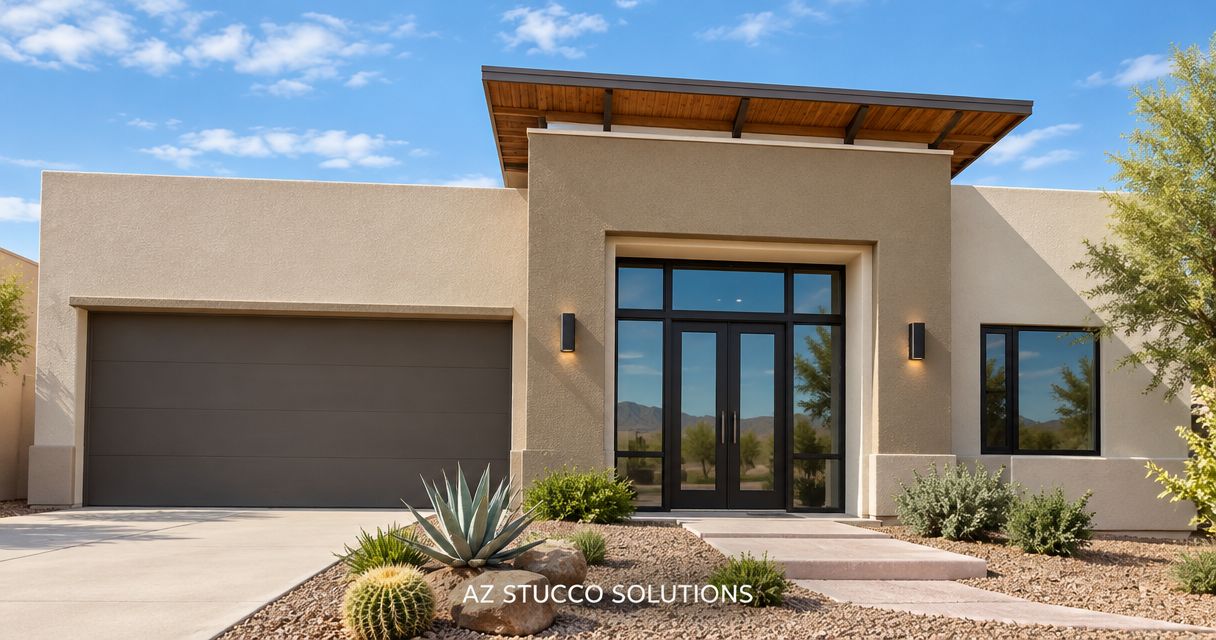
Best overall starting point: warm beige. Best with a gray roof: soft greige. Best for Mediterranean character: subdued terra cotta. These are color families to compare for your Mesa home in 2026, not a list of colors already approved by your homeowners association.
- For stucco colors for HOA-approved homes in Mesa, start with warm beige and your association’s current palette.
- Soft greige suits gray-roof comparisons; subdued terra cotta belongs on a Mediterranean shortlist only when permitted.
- Written approval should identify the exact wall color, trim combination, and proposed exterior work.
- AZ Stucco Solutions LLC provides residential stucco installation, repair, and restoration services in Mesa.
Why this matters
The best-looking color is not a workable choice if your association rejects the combination. Start with your HOA’s current architectural requirements, then narrow the permitted choices against your roof, masonry, trim, and stucco texture.
For a 2026 exterior project, separate the color decision from the condition of the wall. Sound stucco does not need full re-stuccoing simply because you want a different color. Damaged or loose areas need assessment before you choose the finishing scope.
AZ Stucco Solutions LLC serves Phoenix and surrounding communities, including Mesa, with residential and commercial stucco services. Owner Flavio Miguel Delgado brings over 30 years of construction experience, specializing in stucco.
What makes the best stucco color for an HOA home?
Use these criteria before comparing individual shades:
- Documented permission: The exact shade and wall-and-trim combination fit your association’s current requirements.
- Fixed-material compatibility: The color works with roofing, stone, brick, paving, and other features you are keeping.
- Texture compatibility: A sample on the intended texture looks right, not just a smooth paper chip.
- Whole-elevation balance: Walls, trim, garage doors, and accents read as one planned exterior.
- Appropriate project scope: The proposed work addresses wall condition without treating every crack as a reason to re-stucco.
- A reproducible specification: Your approved submission identifies the finish or coating and exact color reference.
For your 2026 shortlist, approval comes first. A shade that looks excellent but falls outside the permitted scheme belongs off the working list unless your association approves an exception.
Mesa stucco colors at a glance
These rankings compare design starting points, not named manufacturer colors or verified HOA selections. Each family contains different undertones; the exact sample decides whether it belongs on your house.
| Rank and color family | Best for | Standout quality | Key limitation |
|---|---|---|---|
| 1. Warm beige | A balanced starting point with mixed exterior materials | Connects warm stone, paving, and trim | Yellow or pink undertones can conflict with existing finishes |
| 2. Soft greige | Homes with gray roofing or gray stone | Bridges gray and beige elements | Some samples read violet or green beside nearby materials |
| 3. Muted sand | Landscape-led desert exteriors | Relates to warm gravel and earth-toned paving | Similar wall and landscape tones can flatten the elevation |
| 4. Warm off-white | Deeply recessed entrances and shaded wall areas | Creates a lighter visual backdrop | Bright samples can overpower softer neighboring finishes |
| 5. Light taupe | Homes with dark trim and garage doors | Gives dark details a softer contrast | Gray-brown undertones need careful roof matching |
| 6. Subdued terra cotta | Mediterranean-style architecture | Adds an earthy wall color alongside roof tile | Requires careful coordination and explicit palette permission |
1. Warm beige: best stucco color for mixed exterior materials
Warm beige is the default starting point when your Mesa home combines several permanent finishes. Compare it against the roof first, then against stone, paving, and trim. Do not choose beige simply because another house on the street uses it.
Warm beige pros:
- Gives you a restrained starting point for whole-house coordination.
- Pairs naturally with many warm-toned material combinations.
- Leaves room for a separate trim or entrance accent.
Warm beige cons:
- Yellow or pink undertones can look wrong beside existing masonry.
- A wall and trim of similar depth can lose definition.
Best for: Owners who need one wall color to connect several existing exterior materials.
Verdict: Hold until the exact beige and trim combination receive written approval.
2. Soft greige: best stucco color for gray-roof coordination
Soft greige belongs on your shortlist when beige looks too warm beside a gray roof. Compare the sample directly with roof tile, stone, and garage-door finishes rather than deciding from the color name. Greige describes a family, not a consistent undertone.
Soft greige pros:
- Offers a middle ground between distinctly gray and distinctly beige walls.
- Keeps gray roofing central to the color decision.
- Supports a restrained exterior without requiring white walls.
Soft greige cons:
- Certain samples show green or violet undertones.
- Warm paving can make an otherwise neutral sample look noticeably cooler.
Best for: Homes where gray roofing or gray stone is the fixed feature you need to accommodate.
Verdict: Hold until an exterior sample confirms the undertone and your HOA approves it.
3. Muted sand: best stucco color for landscape-led exteriors
Muted sand is a useful comparison when warm gravel, stone borders, and earth-toned paving dominate the approach to your home. Choose the wall color alongside those materials, not in isolation. Keep enough separation between walls and surrounding hardscape to preserve the shape of the house.
Muted sand pros:
- Connects the wall-color decision to the landscape.
- Provides an earthy alternative to gray-based neutrals.
- Works as a starting point for a restrained desert palette.
Muted sand cons:
- Similar wall and ground colors can make the exterior look flat.
- Strong yellow undertones need checking against roof tile.
Best for: Homes where the landscape and paving set the visual direction.
Verdict: Hold until you confirm both landscape contrast and association permission.
4. Warm off-white: best stucco color for recessed elevations
Warm off-white deserves a sample when deep entry recesses and shaded wall sections make an elevation look visually heavy. Review the same sample on an exposed wall before deciding. A shade that feels gentle inside a covered entry can look much brighter in direct daylight.
Warm off-white pros:
- Gives recessed architectural details a lighter backdrop.
- Creates visible contrast with darker doors and fixtures.
- Provides an alternative to a distinctly beige exterior.
Warm off-white cons:
- A bright sample can compete with softer stone or roof colors.
- Dark stains and splash marks stand out against a light background.
Best for: Owners whose main design concern is a deeply recessed entrance or shaded elevation.
Verdict: Hold until shaded and exposed samples both work within the approved scheme.
5. Light taupe: best stucco color for dark exterior details
Light taupe gives you a gray-brown comparison when dark trim, window frames, or garage doors dominate the elevation. The objective is controlled contrast, not matching every surface. Check whether the taupe’s undertone agrees with your roofing before treating it as neutral.
Light taupe pros:
- Offers a middle-depth backdrop for dark details.
- Avoids the sharp contrast of very light walls.
- Connects brown and gray elements when the undertones agree.
Light taupe cons:
- Some samples look muddy beside warmer roof tile.
- Similar trim and wall depths can blur architectural edges.
Best for: Homes where existing dark exterior details need a quieter wall backdrop.
Verdict: Hold until the roof, wall sample, and trim work as one approved combination.
6. Subdued terra cotta: best stucco color for Mediterranean character
Subdued terra cotta belongs on a Mediterranean-style shortlist when the association permits an earthy red or orange wall family. It is a deliberate color choice, not a neutral substitute. Roof tile and decorative details need particular attention because several warm finishes can compete.
Subdued terra cotta pros:
- Gives the walls a distinct earthy color.
- Supports a Mediterranean design direction.
- Offers an alternative when permitted neutrals do not match your intended look.
Subdued terra cotta cons:
- Strong undertones can compete with roof tile.
- It needs explicit confirmation within your association’s palette.
Best for: Mediterranean-style homes with a permitted warm-color scheme.
Verdict: Skip if the exact shade is outside your approved options; otherwise hold for written approval.
How these color families were ranked
Warm beige takes the default position because its role is coordination across mixed materials. The remaining choices solve narrower design problems: gray roofing, landscape continuity, recessed walls, dark details, or Mediterranean character.
HOA permission overrides the ranking. These are design comparisons, not performance tests, approval-rate findings, or claims that one color lasts longer than another.
Turn your shortlist into an approved scope
For a 2026 project, connect the color submission to the work you actually intend to perform. A repaint, a new finish over prepared stucco, and broader re-stucco work are different scopes; the paperwork and contractor estimate should describe the same project.
The HOA color approval process belongs before exterior work begins, so the approved colors and the contractor’s written scope describe the same result. Keep the approval with the final color schedule rather than relying on a conversation or an old neighborhood example.
Use this sequence:
- Confirm requirements: Obtain the current palette, application instructions, and any rules for trim or neighboring schemes.
- Assess walls: Identify whether the project needs localized repairs, broader preparation, or re-stucco assessment.
- Test samples: Compare exact colors on the intended texture alongside fixed materials.
- Submit scope: Identify wall colors, trim colors, finish changes, and the surfaces included.
- Retain approval: Keep the written decision and final specifications together before scheduling the approved work.

Ask whether approval applies to the full combination or only to the main wall color. A permitted wall shade does not establish permission for a different garage door, accent, or finish change.
Check color and texture together
A paper chip cannot show how shadows fall across textured stucco. Inspect samples on the texture you intend to keep or specify, and view them beside the actual roof, masonry, and trim.
As a practical sampling plan, compare 3 sample areas: an exposed wall, a shaded wall, and a location beside a fixed material. Review them under 2 light conditions, such as morning and late afternoon. These are decision steps, not association requirements.
Keep the color reference attached to every sample. Similar-looking shades are easy to confuse once you compare several wall areas, especially when the same color looks different between sun and shade.
Decide whether you need repair, refinishing, or re-stucco
A color change alone does not justify full re-stuccoing. A localized repair is sufficient when assessment confirms that the problem is limited and the surrounding stucco remains suitable for the proposed work.
Widespread cracking, loose areas, recurring staining, or repeated failed patches warrant a broader assessment. Those observations do not establish a diagnosis by themselves. They tell you to settle wall condition before committing to a cosmetic finish.
For larger residential or small commercial projects, ask AZ Stucco Solutions LLC to explain what stays, what gets repaired, and what the proposed finish covers. Full re-stucco and new installation estimates should make preparation and finish decisions clear, rather than reducing the project to a color selection.
What your estimate should cover
Your 2026 estimate should identify the surfaces included and the preparation required before the final finish. Compare written scopes, not just the final appearance described in a conversation.
Ask for clarity on:
- Areas included and excluded from the work.
- Existing surface preparation and identified repairs.
- Proposed stucco texture and finish or coating.
- Exact wall, trim, and accent color references.
- Protection of nearby surfaces and cleanup responsibilities.
- How concealed conditions or scope changes will be addressed.
- Who confirms that the final selection matches the HOA approval.
AZ Stucco Solutions LLC provides free residential stucco estimates. Request an estimate through the website or call (480) 971-9500 to discuss your Mesa property and proposed scope.
Request your residential stucco estimate
Discuss wall condition, preparation, finish choices, and your Mesa project scope.
Which stucco color should you choose?
Start with warm beige if you need a balanced default, then let your fixed materials and HOA requirements narrow the exact shade. Choose soft greige for a gray-roof comparison, muted sand for landscape coordination, or one of the more specific options only when it solves your home’s design problem.
Do not order the final finish from a screen image. Your approved specification and exterior sample should agree before work begins.
FAQ
What are the best stucco colors for HOA-approved homes in Mesa?
Warm beige is the default starting point in this guide, followed by color families chosen for specific exterior features. Only your association can confirm whether an exact shade and combination are permitted for your property.
Is beige automatically HOA-approved in Mesa?
No, beige is not automatically approved. Confirm the exact color reference and wall-and-trim combination against your association’s current requirements.
Is soft greige better than beige with a gray roof?
Soft greige is the more targeted starting point for a gray-roof comparison. Test it beside the actual roofing and masonry because green or violet undertones can change the result.
Can I use my neighbor’s stucco color without applying?
A neighbor’s color does not establish approval for your home. Check your own association’s submission requirements and obtain any required written permission.
Should I re-stucco my house just to change its color?
A color change alone does not justify re-stuccoing. Have the existing walls assessed so the scope addresses their condition rather than assuming full replacement or resurfacing is necessary.
Do I need new HOA approval if I keep the same color?
Check your association’s requirements before starting even when you intend to retain the color. The proposed finish, scope, or exact color reference still needs to match the applicable rules.
Does AZ Stucco Solutions LLC offer residential estimates in Mesa?
Yes, AZ Stucco Solutions LLC serves Mesa and provides free residential stucco estimates. Call (480) 971-9500 or request an estimate through the website to discuss preparation, wall condition, and finish choices.
One last thing
Keep 1 complete submission with your 2026 project records: the approval, exact color references, finish description, and agreed scope. The word beige is not enough to reproduce a finish later. Precise records help you discuss future repairs without restarting the color decision from memory.
Leave a Reply