
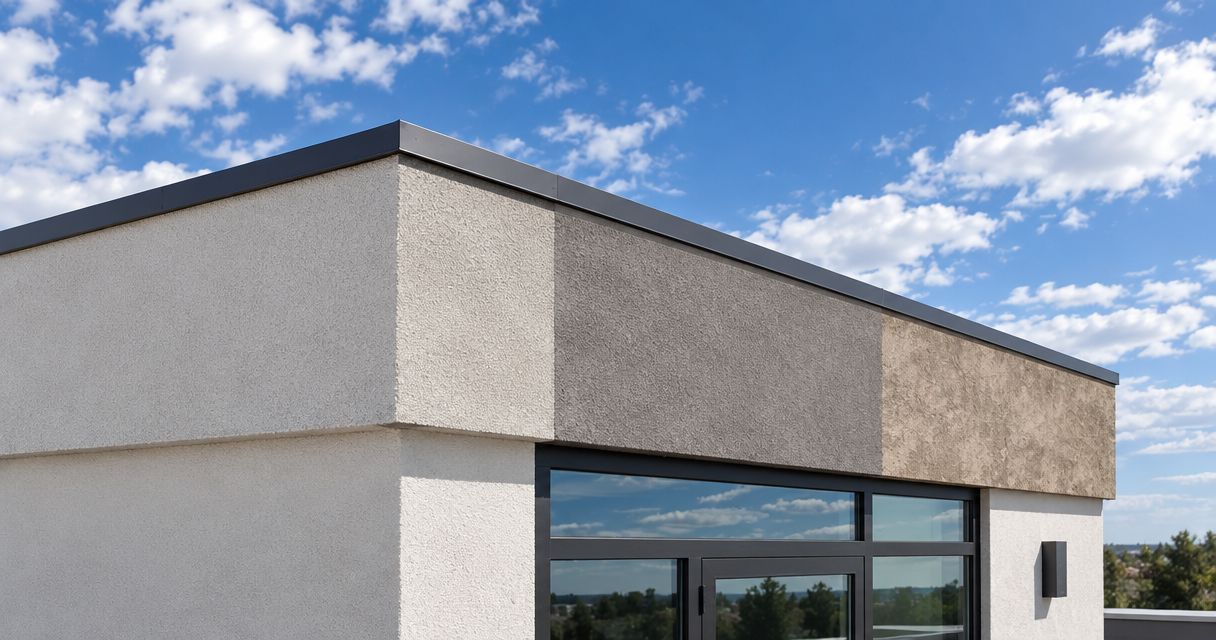
Best overall: a fine sand finish for a restrained, lightly textured parapet face. Best for contemporary architecture: smooth stucco. Best for matching an existing textured exterior: lace. Best for a deliberately coarse exterior: dash. This 2026 guide compares stucco finishes for flat roof parapets and explains what to settle before choosing the texture.
- Fine sand is the default choice among stucco finishes for flat roof parapets when you want understated texture.
- Smooth stucco suits contemporary parapets, but surface irregularities and repairs are more noticeable.
- Parapet coping, flashing, and roof transitions need attention before decorative finish selection.
- AZ Stucco Solutions LLC provides Phoenix-area stucco installation, re-stucco, repair, and exterior restoration.
Why this matters
A parapet is the wall extending above the roof edge. Its visible face contributes to your building’s appearance, but its top and roof-side connections also need proper weather protection. A decorative stucco finish does not replace coping, flashing, or roof waterproofing.
For a Phoenix home or small commercial property, start by separating the appearance decision from the water-management work. You can choose an attractive texture and still leave the underlying problem unresolved if the scope ignores damaged surfaces or roof-edge details.
AZ Stucco Solutions LLC is a fit for Phoenix-area owners planning stucco installation or full re-stucco with attention to preparation and finish selection. Owner Flavio Miguel Delgado brings over 30 years of construction experience, specializing in stucco. Explore AZ Stucco Solutions LLC for residential and commercial stucco services.
What makes the best stucco finish for a parapet?
Judge a proposed finish against these criteria before approving a sample:
- Architectural fit: The parapet should look connected to the walls below, not like a separate repair strip.
- Existing surface: Loose material, cracks, and coating compatibility affect preparation and the proposed finish system.
- Visual tolerance: Smooth surfaces expose irregularities more readily; texture changes how light reveals them.
- Repair matching: Texture, color, and application technique all affect whether a future patch stands out.
- Roof-edge coordination: The finish must work with the specified coping, flashing, joints, and roof transitions.
- Sample quality: Judge the actual proposed texture on a sample, not only its name or a photograph.
Texture and material are different choices. Sand, smooth, lace, and dash describe appearance or application; the contractor must separately identify the compatible finish material and underlying assembly.
Stucco finishes for flat roof parapets at a glance
This 2026 ranking prioritizes appearance, preparation, and matching—not an unsupported promise that one texture waterproofs a parapet better than another.
| Finish | Best for | Standout feature | Key limitation |
|---|---|---|---|
| Fine sand | Understated residential and commercial exteriors | Light, consistent-looking texture | Patches still require careful texture and color matching |
| Smooth | Contemporary architecture | Clean, uninterrupted appearance | Irregularities and repairs are easier to see |
| Lace | Matching an existing lace-textured building | Raised, patterned texture | Pattern matching depends on application technique |
| Dash | Matching a coarse exterior | Pronounced granular texture | A poor match for buildings with restrained, flat-looking finishes |
These are finish choices, not interchangeable repair systems. No texture eliminates the need to assess the wall beneath it.
1. Fine sand: best parapet finish for understated texture
A fine sand finish gives the vertical parapet face a lightly granular appearance. It provides texture without the pronounced relief of lace or dash, making it the default recommendation when you want the roofline to remain visually quiet.
For a full exterior re-stucco, consider the parapet and lower walls together. A sample should show whether the selected sand texture creates the continuity you want across the building.
Fine sand pros:
- Adds subtle texture rather than a strongly raised pattern.
- Fits an understated residential or commercial design.
- Offers a textured alternative when a smooth finish feels too unforgiving.
Fine sand cons:
- Localized patches can differ in grain, color, or application.
- Texture does not straighten an uneven wall or repair a failed substrate.
Best for: Owners seeking a restrained finish across parapets and adjoining exterior walls.
Verdict: Buy the fine sand finish specification when the sample suits your building and the preparation scope addresses existing defects.
2. Smooth: best parapet finish for contemporary architecture
Smooth stucco emphasizes the parapet’s shape rather than its texture. It suits a design where clean wall planes and a simple roofline carry the appearance.
That simplicity makes preparation especially important. Strong side lighting reveals waviness, trowel variation, and patch boundaries; smooth should not be treated as a shortcut over an uneven surface.
Smooth stucco pros:
- Creates a restrained, minimally textured appearance.
- Keeps attention on the building’s form and roofline.
- Provides a clear visual alternative to a heavily textured exterior.
Smooth stucco cons:
- Makes surface irregularities and repair edges more noticeable.
- Requires careful agreement on acceptable texture and visible variation.
Best for: Contemporary homes and commercial façades where appearance justifies detailed surface preparation.
For a 2026 renovation, view the proposed smooth sample in both direct and angled daylight. Do not approve it only under flat indoor lighting.
Verdict: Buy smooth stucco for a deliberate contemporary design; skip it if concealing existing surface variation is your main goal.
3. Lace: best parapet finish for matching existing texture
A lace finish creates raised, patterned areas over the background surface. It belongs on the shortlist when your existing walls already have a similar texture and the parapet should remain part of that composition.
“Lace” alone is not a sufficiently detailed specification. Ask for a sample showing the pattern density and relief you expect, particularly where new work meets an existing wall.
Lace finish pros:
- Supports continuity with an existing lace-textured exterior.
- Adds a visible pattern rather than a uniform granular surface.
- Gives the sample a clear role in defining the application style.
Lace finish cons:
- A different application technique can leave a conspicuous mismatch.
- Strong texture is unsuitable when you want a flat-looking roofline.
Best for: Parapet restoration on buildings whose adjoining walls already use lace texture.
Matching the existing wall is usually a better design brief than selecting a texture from its name. Compare the sample with an undamaged section of the building, not a previously patched area.
Verdict: Buy lace to continue an established exterior pattern; skip it as an isolated accent without a clear design reason.
4. Dash: best parapet finish for a coarse exterior
A dash finish produces a pronounced granular surface through its application. It is a purposeful texture choice, especially when the rest of the exterior already has a coarse finish.
The visible result depends on the specified material and application. Confirm the desired texture with a physical sample rather than assuming every dash finish looks alike.
Dash finish pros:
- Creates a distinctly textured parapet face.
- Provides continuity with an existing dash-finished exterior.
- Offers a clear alternative to smooth or lightly sanded appearances.
Dash finish cons:
- Contrasts strongly with nearby smooth surfaces.
- Repairs require attention to texture size and distribution.
Best for: Buildings where a coarse texture is already part of the exterior design.
Verdict: Buy dash for an intentional coarse finish or an existing texture match; skip it if you want the parapet to appear smooth and understated.
Set the scope before selecting the finish
For your 2026 project, ask the contractor to separate the work into 4 scope areas. This keeps a finish proposal from becoming a substitute for an assessment of the parapet itself.
Surface condition
Identify loose stucco, visible cracks, previous patches, and existing coatings. The proposal should explain what stays, what comes off, and how the remaining surface will be prepared.
Roof transitions
Discuss the roof-side wall, roof membrane termination, and flashing. Establish who handles roof-related work and how the stucco work connects to it; do not assume those tasks are included.
Parapet top
Confirm how the top of the wall is protected. Coping and other specified weatherproofing details serve a different purpose from the decorative finish on the vertical face.
Finish continuity
Define the finished area: an isolated repair, the complete parapet face, or a broader re-stucco. Include corners and returns so the scope does not end at an awkward visible boundary.

A homeowner should not need to climb onto the roof to prepare for an estimate. Share accessible ground-level observations and let the appropriate contractor assess roof-level conditions safely.
Localized repair or full re-stucco?
A single crack does not automatically justify re-stuccoing the building. A localized repair is a reasonable scope to discuss when the defect is isolated and the surrounding stucco is sound. The contractor still needs to assess the cause and explain the likely appearance of the repair.
A broader assessment is warranted when cracking repeats, material is loose across several areas, staining returns, or previous patches keep failing. These observations justify investigation—not an automatic diagnosis or a predetermined replacement scope.
Full re-stucco also deserves consideration when your goal is a consistent finish across the entire exterior. It is a different decision from fixing an isolated defect: the proposal should address preparation, transitions, and the intended appearance of the complete building.
For new installation, resolve the wall assembly and roof-edge details before choosing the decorative surface. A texture sample cannot answer those construction questions.
What your estimate should cover
Ask for a written description you can compare with the work being proposed. For a 2026 estimate, include:
- The exact parapet faces, returns, and adjoining walls included.
- Existing material removal and surface preparation.
- Identified repairs and how concealed damage will be handled if discovered.
- Responsibility for coping, flashing, and roof transitions.
- Proposed finish material, texture, color, and sample approval.
- Protection of nearby surfaces and cleanup.
- Any warranty terms specifically included in the written agreement.
Prepare 3 photo views if you can take them safely: the full elevation, the affected parapet from the ground, and a close-up of accessible damage. They help explain your concern without replacing an on-site assessment.
For appearance decisions, request 2 finish samples when you are genuinely deciding between textures. Compare them against the existing walls in outdoor light before authorizing the finish.
Discuss your scope through the contact page or call (480) 971-9500. AZ Stucco Solutions LLC provides free residential stucco estimates; commercial owners should ask about the estimate process for their property.
How these finishes are ranked
Fine sand ranks first as a restrained visual default. Smooth, lace, and dash each serve a distinct design need rather than representing progressively worse choices.
The ranking uses the criteria above: architectural fit, surface preparation, visible variation, repair matching, and coordination with roof-edge details. It does not assign unsupported lifespan, waterproofing, or crack-resistance scores to texture names.
Which parapet finish should you choose?
Choose fine sand if you are undecided and want subtle texture. Choose smooth for a deliberately contemporary exterior, lace to continue an existing lace pattern, and dash for a coarse-textured building.
For your 2026 project, approve the scope first and the sample second. That order keeps the decision focused on a sound, coordinated exterior rather than appearance alone.
FAQ
What are the best stucco finishes for flat roof parapets?
Fine sand is the default recommendation for understated texture; smooth suits contemporary architecture, while lace and dash suit matching existing textured walls. Choose the finish after assessing the surface and roof-edge details.
Does a stucco finish waterproof the top of a parapet?
A decorative stucco finish does not replace parapet-top weather protection. The coping, flashing, and roof transitions need their own properly specified details.
Is smooth stucco better than sand finish on a parapet?
Smooth stucco is better for a clean contemporary appearance, not for hiding surface variation. Fine sand provides light texture, while smooth makes irregularities and repairs more noticeable.
Does every parapet crack require full re-stucco?
No, an isolated crack does not automatically require full re-stucco. The repair scope should follow an assessment of the cause, surrounding material, and any recurring damage.
Can a repaired parapet match the existing wall texture?
Texture matching requires attention to the existing pattern, material, color, and application technique. Ask for a sample and a clear explanation of the expected transition rather than a promise of an invisible patch.
What should I ask a Phoenix stucco contractor before starting?
Ask what preparation, repairs, finish materials, and roof-edge coordination the scope includes. AZ Stucco Solutions LLC provides Phoenix-area stucco services and free residential estimates; confirm the details for your property directly.
One last thing
Ask where the new finish will stop. A repair ending in the middle of a visible parapet face creates a different appearance decision from work ending at a corner or another clear boundary. Settle that detail before approving the sample.
Leave a Reply